
Quick answer
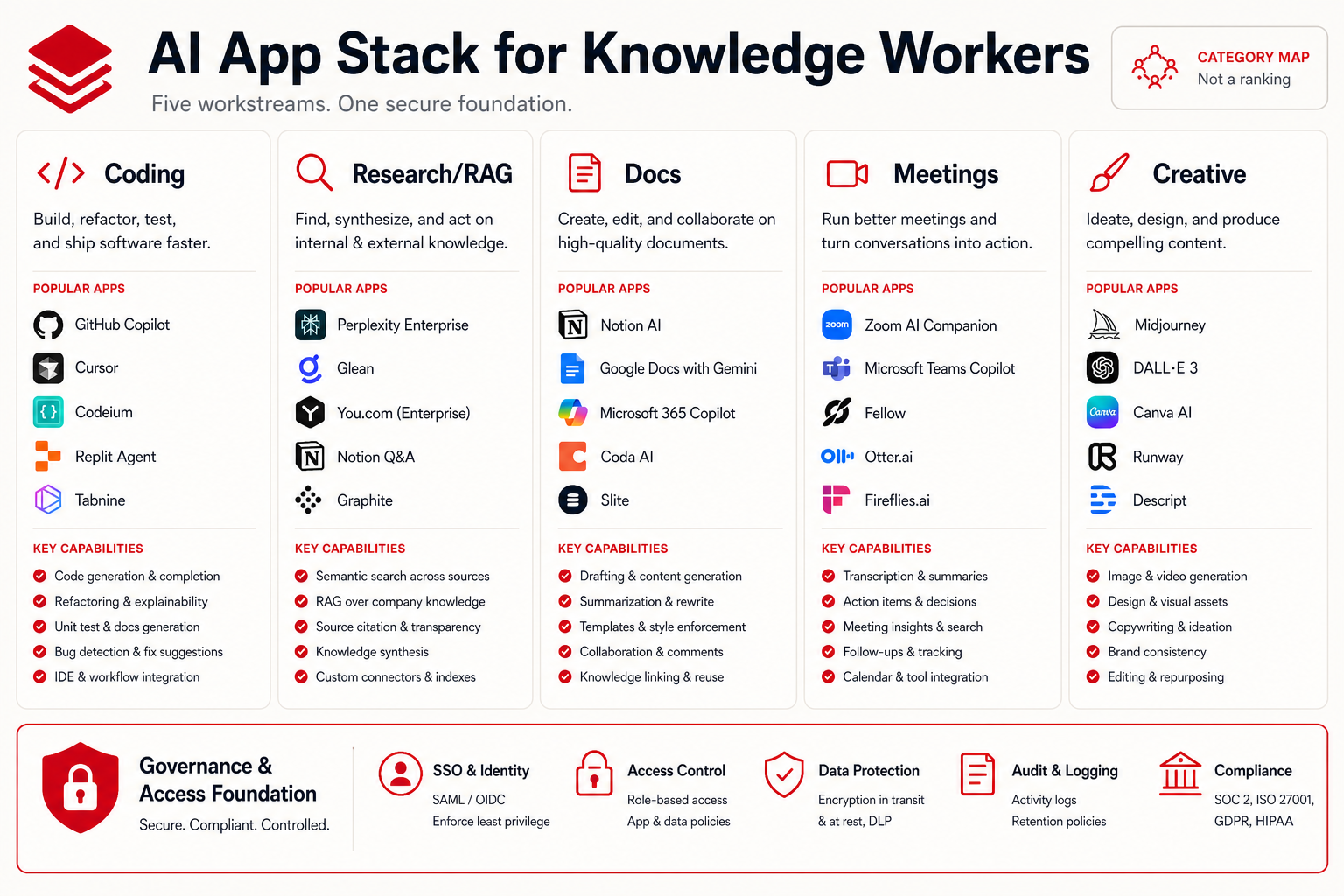
An AI app stack for knowledge workers is not one chat subscription. It is a category map: coding agents, research retrieval, docs and writing, meetings, and creative production—each with different trust, latency, and integration requirements. Most teams should buy commoditized surfaces such as meetings transcription, general drafting, and IDE copilots, then build thin glue for retrieval, permissions, eval replay, and systems of record where their workflows differ. Start from the 2026 model stack and chatbot-to-agent map; add categories only when you can name the user, the system of record, and the failure cost.
Key takeaways
- Knowledge work stacks fail when teams buy five overlapping chat boxes with no integration story.
- Coding agents category tools differ from doc copilots: they need repo access, test feedback, and rollback—not just autocomplete.
- Buy vs build AI hinges on data sensitivity, eval ownership, and whether the workflow is a commodity SKU.
- Link agent ambitions to observability; see from chatbot to agent before you rebrand support bots.
- We do not assign “#1 tool” scores here—use category criteria and your private replay suite.
Why a stack map beats a tool list
Search for “AI tools for knowledge work” returns endless listicles: ten apps, thirty apps, “ultimate 2026 stack.” Those lists age in weeks and rarely say who the tool is for, what it touches in your org, or when building internal glue is cheaper than another seat license.
This article is a best-for-x stack map (M6, M7, M9): categories, selection criteria, buy/build boundaries, and anti-patterns. It complements technical depth on models and agents—it does not replace model cards or leaderboard literacy.
Desk disclosure: Everything is AI operates research desks and may surface tools in editorial or catalog contexts. This map is a Models Desk synthesis as of 2026-08-17; it is criteria-first, not a ranked vendor list, and we do not claim universal “best tool” scores or undisclosed sponsorships. Verify pricing, data handling, regional availability, and contractual terms on each vendor’s official site at procurement time.
The five knowledge-work categories
Most white-collar workflows cluster into five buckets. Your stack may omit entire buckets early—that is healthy.
1. Coding agents and developer surfaces
The coding agents category spans IDE assistants, PR reviewers, terminal agents, and issue-to-patch runners. They share needs:
- Repository context (branch, diff, tests)
- Policy on write access (suggest vs commit vs deploy)
- Feedback loops (compiler, linter, CI)
- Traceability for security review
GitHub documents Copilot as AI paired programming across editor, CLI, and platform workflows (github.com/features/copilot). Treat that as a reference shape: embedded in where work already happens—not a separate chat window engineers ignore.
Buy when: you want fast time-to-value, standard git hosting, and vendor-managed model updates. Build when: you must run open weights on-prem (local open-weight checklist), enforce custom eval gates, or integrate proprietary static analysis.
Do not pick coding tools from public bench tweets alone. Read what SWE-bench measures, then run a private smoke set aligned to your repos—see open-weight coding shortlist for model-layer choices, not IDE brand wars.
2. Research, retrieval, and synthesis
Research stacks answer: “What do we know, with citations, under time pressure?” Components:
- Connectors to approved sources (drive, wiki, tickets, filings)
- Chunking, access control, and citation UI
- Optional web retrieval with allowlists
- Export to memo, slide outline, or structured JSON
This is often still chatbot + RAG, not a full agent—unless you add tools that fetch live metrics or query databases. Upgrade to agent loops only when fetch paths multiply and you can log traces (see agent map).
Buy when: connectors and compliance certifications matter more than custom ranking. Build when: your corpus is messy, permission model is non-standard, or citations must map to internal object IDs for audit.
3. Docs, writing, and knowledge capture
Docs tools emphasize tone control, templates, and revision—not autonomous execution. Typical uses: first drafts, style normalization, meeting notes cleanup, spec scaffolding, multilingual variants.
Failure mode: writers produce fluent text that looks authoritative but omits nuance from source material. Mitigation: require linked sources for factual claims, human sign-off on external-facing copy, and version diff—not blind accept.
Buy for general drafting assistants embedded in office suites. Build when brand/legal checklists, terminology locks, or CRM merge fields are non-negotiable.
4. Meetings and async voice
Meetings category covers transcription, diarization, action-item extraction, and CRM/ticket push. Latency tolerance is higher; accuracy for names and acronyms is the pain point.
Buy almost always—speech stacks are commodity. Build thin glue: which calendar events get recorded, which action items create tickets automatically, retention policy for audio.
Keep meetings AI separate from “agent” branding unless push-to-system-of-record is reliable and idempotent.
5. Creative and multimodal production
Image, slide, short video, and design assist tools differ from text stacks: asset rights, brand kit enforcement, and export formats dominate model choice. Capability claims change monthly—avoid hardcoding “best model” language in internal policy docs.
Buy for speed and rights-managed stock integrations. Build when brand safety pipelines (classifiers, watermarks, approval queues) must run inside your VPC.
Stack layers: where apps sit relative to models
| Layer | What it is | Typical buy | Typical build |
|---|---|---|---|
| Model access | API or self-hosted weights | Vendor API tiers | Inference on your GPUs; HF/transformers pipelines (huggingface.co/docs) |
| Retrieval & permissions | Index, ACL, citation | Enterprise search add-ons | Custom sync from internal stores |
| Application UX | IDE, docs, meetings UI | Copilots, notetakers, suites | Embedded widgets in internal portals |
| Orchestration | Tool loops, agents | Vendor agent modes | Internal runners with trace IDs |
| Governance | Logs, eval replay, DLP | SSO + vendor admin consoles | SIEM hooks, custom redaction |
The model stack explainer covers pretrain → post-train → inference economics. This table sits one level above: where employees actually click.
Buy vs build AI: a decision grid
| Signal | Favor buy | Favor build (or heavy customize) |
|---|---|---|
| Data residency | Vendor offers your region & cert package | Strict on-prem-only policy |
| Workflow fit | Commodity (notes, generic draft) | Proprietary objects & approvals |
| Eval ownership | You accept vendor change logs | You must replay 500+ internal tasks per release |
| Integration depth | OAuth to GitHub/365 enough | Custom ERP / mainframe / air-gapped |
| Time horizon | Pilot in 30 days | Multi-year platform bet |
| Failure cost | Low (internal draft) | High (client-facing, financial, safety) |
Hybrid is normal: buy meetings and IDE copilot; build retrieval ACLs and a single internal “company brain” API that multiple UXs call.
How coding agents differ from “general AI tools”
Procurement often bundles “Copilot-style” seats for engineering and marketing. That hides a capability gap:
- Coding agents need deterministic feedback (tests, typecheck) to steer loops.
- Marketing drafts need brand and legal gates, not compiler errors.
- Mixing them in one RFP produces either overspend or under-protection.
When evaluating coding agents, ask vendors:
- What writes to git (suggest-only vs branch push)?
- How are secrets and env vars isolated in terminal tools?
- Can you export traces for your private eval harness?
- Which base models power which modes—and can you pin versions?
Cross-check marketing numbers with leaderboard reading guide; never procure from a single public score.
Minimum viable stack (team of ~50 knowledge workers)
A pragmatic starting point—not a prescription:
- One enterprise-negotiated chat/assistant with SSO and DLP
- One coding assistant aligned to your git host
- One meetings transcription policy (opt-in, retention defined)
- One internal retrieval project with owned ACLs—even if v1 is just wiki + tickets
- One eval owner who replays tasks when models change
Defer extra categories until overlap hurts: if three tools summarize PDFs differently, pick a standard or build the retrieval layer once.
Rolling out by department (without stack sprawl)
A phased rollout beats enterprise-wide “AI day” launches:
- Engineering pilot (weeks 1–4): coding assistant on non-prod branches; measure suggest acceptance, CI pass rate, trace exports. Align model evals with coding model shortlist if you self-host.
- Research / PM cohort (weeks 3–6): grounded Q&A on wiki + tickets only—no web fetch until ACLs proven.
- G&A docs (weeks 5–8): template drafting with mandatory human review on external sends.
- Meetings policy (parallel): opt-in transcription; define retention; block auto-CRM push until idempotency tested.
- Creative (optional): only after brand kit and rights workflow exist—otherwise asset chaos.
Each phase needs an owner and a stop rule: if replay tasks regress after a vendor model change, freeze rollout until evals pass. That discipline connects procurement to the model stack changelog mindset.
Cost modeling without fake precision
We avoid publishing “$X per seat replaces Y FTE” claims—labor savings depend on task mix, wage bands, and error costs. Instead, build an internal model with ranges:
- Seat fees: quote from vendor admin at renewal; include overage for premium models
- API inference: if build path uses HF or self-hosted weights, add GPU amortization (HF docs for serving patterns)—not just API list price
- Integration labor: often underestimated; retrieval ACL projects frequently exceed first-year license cost
- Review labor: human edit time on AI drafts is real opex—measure it in pilots
- Incident cost: one data leak or bad client send can dominate five years of licenses
Procurement should ask finance to sign off on ranges and sensitivity cases, not single-point ROI slides from vendor decks.
Security and legal review checklist (knowledge-work SKUs)
| Question | Why it matters |
|---|---|
| Training opt-out and retention period? | Client data in prompts; regional privacy law |
| Subprocessors and regions? | Cross-border transfer assessments |
| Default agent write settings? | Autonomous commit/send risks |
| Audit log export? | Investigations and eval replay |
| IP ownership of outputs? | Client contracts and open-source contamination in code suggestions |
| Accessibility and records retention? | Regulated industries, public sector |
Legal review is not anti-AI—it prevents category mistakes (treating a meetings bot like a coding agent contractually). Everything is AI may reference tools editorially; your MSAs must stand alone regardless of our maps.
Integration principles (so the stack does not rot)
- Single identity: map SSO groups to tool roles; avoid shadow accounts.
- System of record first: AI writes drafts; CRM/wiki/ticket systems hold truth.
- Idempotent pushes: meeting action → ticket should not duplicate on retry.
- Model pin + changelog: note vendor model swaps; rerun eval slice.
- Category owners: eng owns coding agent policy; ops owns meetings retention; legal owns external copy.
Anti-picks: what to deprioritize early
- Duplicate general chat licenses per department “because UX differs slightly.”
- Agent platforms before you have retrieval hygiene and traces.
- Custom fine-tunes before you exhaust prompts, retrieval, and tool design.
- Creative suites for teams that only need text drafts—license sprawl.
- Benchmark-driven coding purchases without a private repo smoke suite.
Build path: when Hugging Face and open weights enter the stack
Teams choose build when API-only models cannot satisfy residency, custom eval cadence, or cost at high volume. The Hugging Face ecosystem documents model loading, tokenizers, and serving patterns (huggingface.co/docs)—but docs ≠ production. Budget for:
- GPU capacity planning and failover (see local open-weight checklist for realism checks)
- Model card license review (example card)
- Internal MLOps or vendor inference appliance
- Security patching for dependencies—not glamorous, mandatory
Open weights solve the model access layer; you still buy or build UX for each knowledge-work category. Hybrid stacks are common: API chat for G&A, self-hosted code model for eng, SaaS meetings for everyone.
Measuring pilot success (avoid vanity metrics)
Good pilot metrics tie to task completion:
- Coding: CI pass rate on agent-opened PRs vs baseline; time-to-first-reviewable diff
- Research: citation accuracy on a labeled question set; time to sourced memo
- Docs: edit distance before human approval; policy violation rate
- Meetings: action item acceptance rate; duplicate ticket rate
Bad metrics: “MAU on chat,” “messages sent,” or leaderboard scores copied from vendor blogs. If you cannot replay tasks monthly, you will not know when a silent model update regresses quality—exactly the problem leaderboard literacy warns about for public benchmarks, applied internally.
Observability and procurement questions
Before annual renewals, request:
- Admin export of model/version used per feature flag
- Data retention and training opt-out language (verify against your contract, not blog posts)
- Incident history for tool execution or data leakage (vendor security pages)
- Roadmap for agentic features—will they auto-enable write tools?
Desk synthesis: we did not run a blind bake-off of every SKU in this map. Treat vendor feature lists as hypotheses; validate with pilot cohorts tied to measurable task completion—not vanity adoption metrics.
Who this map is for
Read this if you:
- Lead IT or ops choosing AI seats across eng, product, and G&A
- Run a “center of excellence” balancing buy vs build
- Need vocabulary to separate coding agents from doc copilots in budget meetings
- Want internal links to technical pillars (models, agents, benches) for your enablement docs
Who should skip
Skip (for now) if you:
- Need click-by-click admin setup for one vendor—use official docs instead
- Want a numbered “top 10 tools” list with scores—we intentionally omit that
- Are selecting a single open model only—start with model stack 2026
- Run deep ML research infra—not knowledge-worker SaaS procurement
Common mistakes
- Stack by headline: buying “agents” for teams that need summarization.
- No integration owner: five tools, zero ticket/wiki push.
- Shadow AI: blocking official tools while staff paste client data into consumer chats.
- One eval for all categories: coding replay tasks applied to marketing copy tools.
- Ignoring license for open models when build path uses Hugging Face weights internally.
- Renewal amnesia: auto-renew without checking model changelog.
FAQ
What is an AI app stack for knowledge workers in one sentence?
It is the set of model-powered applications—coding, research, docs, meetings, creative—plus the retrieval, identity, and governance glue that connects them to systems of record.
Coding agents category vs doc copilots—can one tool cover both?
Some vendors span categories, but requirements diverge. Coding needs git/CI integration; docs need brand/legal workflows. Pilot each category against distinct task lists.
Buy vs build AI—where do open weights fit?
Open weights shift build economics for model access (see HF docs and local run guides) but not for full UX—you still build or buy everything above the inference layer.
How many chat subscriptions does a team need?
Often one negotiated enterprise assistant plus category-specific surfaces (e.g., IDE). More than two general chat boxes usually indicates overlap, not productivity.
How do agents fit this stack?
Agents are an orchestration layer on top of apps and tools—not a separate magic SKU. Read chatbot vs agent map before expanding autonomous write access.
Sources
- Hugging Face documentation (transformers, inference, hub usage): https://huggingface.co/docs
- GitHub Copilot product documentation: https://github.com/features/copilot
What we did not test: We did not run a blind benchmark of every knowledge-work SKU or publish private procurement scores. This map is desk synthesis from public docs and common rollout patterns, so each team should validate vendors with its own replay tasks and contracts.
Corrections: When vendors rename SKUs or merge copilot products, update category examples—not the five-category framework.
Next step
Pick one category to pilot with a 30-task replay sheet, align model choices with model stack 2026, and define agent boundaries using from chatbot to agent.
Subscribe to the Everything is AI Newsletter for stack map updates, procurement checklists, and model changelog digests—without unsourced “best tool” rankings.