Evidence note: Models Desk synthesis from public benchmark methodology pages and official leaderboard documentation as of 2026-08-17; this article does not compute new scores or declare a universal #1 model.
Quick answer
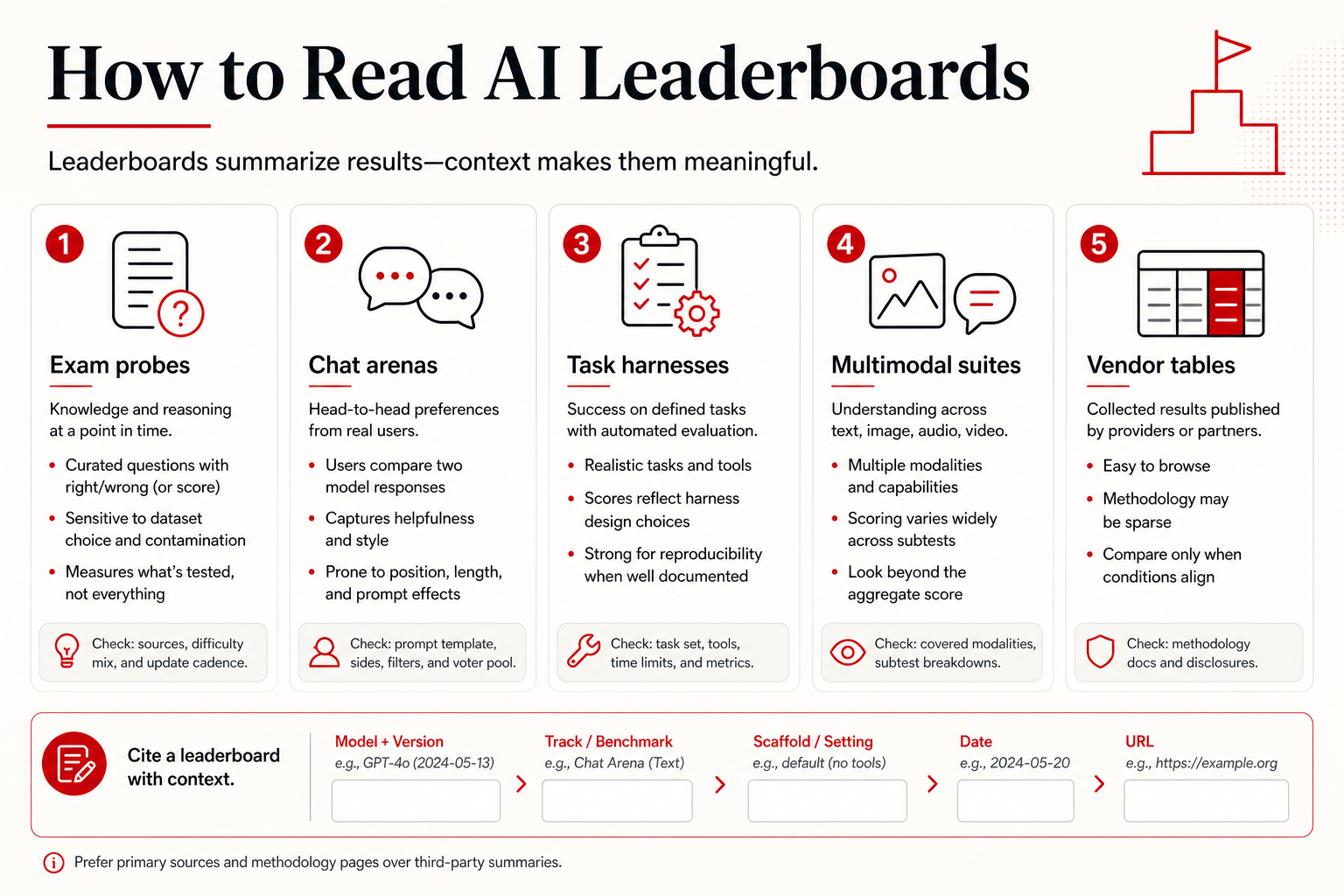
How to read AI leaderboards starts with naming the category of leaderboard you are looking at—knowledge probes, chat preference arenas, coding harnesses, multimodal suites, or vendor-run marketing tables—and refusing to merge them into one “best model” story. Every public score is a measurement under a specific task, prompt template, model version, date, and often a hidden scaffold (tools, retries, judge model). Before you cite a number in a deck or pick a vendor, copy a citation template: model name + version, benchmark track, scaffold, date, source URL. If any field is missing, treat the score as anecdotal, not evidence.
Key takeaways
- Leaderboards are instruments, not destiny—each measures a narrow unit of work under stated rules.
- LMArena-style arenas (crowd preference) answer a different question than SWE-bench-style harnesses (automated pass/fail).
- LLM benchmark caveats include train-test leakage, scaffold gaming, cherry-picked subsets, and version drift.
- Pair public scores with your private smoke tests and stack context (LLM model stack 2026).
- Never procurement-switch on a single bar chart without track, date, and cost-at-your-context checks.
Why learn how to read AI leaderboards now
Model releases now ship weekly. Social feeds compress complex evals into single percentages. Procurement asks for “the top model” while engineering needs “the model that passes our CI-style tasks at p95 latency under budget.” Without a framework, teams either ignore public signal entirely—or overfit to it and ship regressions.
This explainer is pillar E in the Everything is AI semantic network: benchmark literacy bridges model cards, compare pages, and task-specific shortlists. It complements—but does not replace—deep dives such as what SWE-bench actually measures and coding pickers like best open-weight LLM for coding.
Taxonomy: five leaderboard categories
Most confusion comes from comparing unlike categories. Use this map before you read any number.
| Category | What it approximates | Examples (official homes) | Blind spots |
|---|---|---|---|
| Knowledge / exam probes | Recall and reasoning on fixed Q&A | Various academic suites cited in papers | Contamination; not real workflows |
| Chat preference arenas | Human or crowd preference in open chat | LMArena (LMSYS-style) | Not your system prompt or tools |
| Task harness benches | Pass/fail on scripted tasks (code, math) | SWE-bench | Harness ≠ your repo; scaffold-dependent |
| Multimodal suites | Vision/audio + language joint tasks | Paper-linked eval kits per model | Preprocessing and resolution matter |
| Vendor summary tables | Marketing-friendly cross-bench snapshots | Release blog posts | Cherry-picking; inconsistent scaffolds |
None of these categories alone answers “will this model work in our product?” They provide priors—hypotheses to validate privately.
Category 1: Knowledge and exam-style probes
Multiple-choice and short-answer suites (often referenced collectively in papers as broad “knowledge” evals) test whether a model answers academic-style questions. Strengths: cheap to run, easy to compare across models if protocols match. Weaknesses: data contamination when benchmark text appeared in pretraining corpora; sensitivity to prompt formatting; poor correlation with long-form enterprise writing or agentic tool loops.
When you see a vendor claim “state-of-the-art on [exam suite],” ask for the exact subset, prompting strategy (zero-shot vs chain-of-thought), and whether the score is on a public test split or an internal reimplementation. Desk rule: exam probes are useful for coarse capability bins, not for ranking two adjacent frontier models for your SKU decision.
Category 2: Chat preference arenas (LMArena / LMSYS-style)
LMArena and similar platforms collect pairwise comparisons: users chat with two anonymous models and pick the better reply. Aggregated ratings produce leaderboard-style orderings often discussed as Elo or similar ratings in community coverage.
What arenas measure
Arenas measure open-ended chat preference under platform defaults: tone, helpfulness, creativity, and perceived correctness in short turns. They capture real human taste at scale—valuable signal for consumer chatbots and general assistants.
What arenas do not measure
- Your system prompt, brand voice, or compliance filters
- Tool use, JSON modes, or multi-step agent scaffolds
- Latency, cost, or uptime at your traffic tier
- Long-document workflows with proprietary retrieval
- Domain-specific risk (clinical, legal, financial advice boundaries)
LMArena explained in one sentence for PMs: it is a popularity-weighted taste test for anonymous chat, not a certificate of production readiness. Use it to shortlist models for qualitative review, not as a sole vendor selection criterion.
How to read arena movement
Ratings shift when new models enter, vote demographics change, or platform UI changes. A model can climb because it produces verbose friendly prose while your product needs terse structured output. Always run side-by-side trials on your prompts after arena curiosity—not before contract signature.
Category 3: Task harness benchmarks (coding exemplar: SWE-bench)
Harness benchmarks provide executable environments: given inputs, the model (or agent wrapping the model) must produce outputs that pass automated checks. SWE-bench is the canonical repo-level coding example—see the official project at swebench.com and our SWE-bench explainer.
Why harness scores are powerful—and fragile
Harnesses correlate better with “can it edit code in a git-like setting” than arena vibes—when the track, scaffold, and date match what you care about. Fragility comes from scaffold dependence: single-shot patch generation vs multi-turn agent with bash and file tools can reorder models dramatically. Mixing those in one chart is an eval gaming red flag whether intentional or sloppy.
Citation template (reuse everywhere)
Model M, <benchmark track>, scaffold <S>, date <YYYY-MM-DD>, source <URL>—comparable only under identical track+scaffold.
If a sales deck lacks scaffold and track, decline to internalize the number.
Category 4: Multimodal and domain-specific suites
Vision-language and audio-language benchmarks add preprocessing variables: image resolution, cropping, frame rate, OCR pipeline. A leaderboard row without specifying those inputs is weak evidence. Domain suites (medical QA, legal retrieval) exist but often use smaller public sets—easier to overfit and harder to generalize.
Treat domain benches as supplemental unless your use case matches the suite’s unit of work and patient/case distribution—otherwise invest in private eval with clinician or lawyer review loops, not public rank chasing.
Category 5: Vendor summary tables
Release blogs often show multi-benchmark bar charts. These are useful for orientation and spotting obvious outliers, but they are not independent audits. Vendors choose benchmarks where they win, update scaffolds between releases, and may compare against stale competitor versions. Read them as marketing plus pointers to primary sources—not as mergeable meta-leaderboards.
Eval gaming and Goodhart’s law
When a measure becomes a target, it ceases to be a good measure. LLM labs and open communities optimize for public numbers—fine-tuning on benchmark styles, tuning prompts on validation splits, selecting best-of-N runs, or upgrading agent tooling only for eval runs. Eval gaming is not always malicious; sometimes it is indistinguishable from legitimate improvement on the measured task.
Desk defenses:
- Hold out a private test set never shown to vendors or internal tuning loops.
- Require reproducibility metadata (version, scaffold, date) for any external claim.
- Run periodic re-eval—models decay relative to your tasks as the world changes.
- Compare dollars and latency per successful task, not raw accuracy alone (inference layer).
Scaffolds: the hidden variable
A scaffold is everything wrapped around the raw model weights during eval: system prompts, tool definitions, retry policies, temperature, max tokens, parsing scripts, and orchestration graphs. Leaderboard rows often omit scaffolds in headlines but document them in footnotes—read footnotes.
| Scaffold knob | Effect on scores | Question to ask |
|---|---|---|
| Agent vs single-shot | Large swing on coding/math harnesses | Will we ship an agent or one-shot API? |
| Best-of-N sampling | Inflates pass rates | Is N disclosed? Affordable at prod cost? |
| External retrieval | Changes knowledge probes | Is RAG allowed in the bench protocol? |
| Tool access (bash, browser) | Can dominate SWE-style tasks | Same tools in our security model? |
| Judge model (LLM-as-judge) | Biases open-ended evals | Which judge, which rubric? |
Version pins and moving targets
API models receive silent minor updates; open weights get community merges and quantizations. A leaderboard entry without model ID string (not just marketing name) expires quickly. Maintain an internal registry mapping “what we run in prod” to “what this public score referred to.” When versions drift, re-run private eval—do not assume monotonic improvement between releases.
Connecting leaderboards to the model stack
Public scores blend pretraining, post-training, and inference choices made by the eval runner (model stack map). A jump on a coding harness might come from post-training tool tuning, not “smarter pretrain.” A drop in arena rating might follow a safety update that helps your compliance team. Translate scores into layer hypotheses before you assign engineering work.
From leaderboard to product: a practical workflow
- Define the task unit—ticket resolved, form filled, slide drafted, not “general intelligence.”
- Pick 1–2 public instruments that resemble that unit (arena for chat taste, SWE-bench track for repo repair, etc.).
- Extract metadata—track, scaffold, date—from primary sources only.
- Build a private suite of 50–200 real examples with pass/fail rubrics.
- Measure cost and latency at your context distribution—not demo length.
- Pilot with humans on high-risk outputs before scale.
Agent-heavy products should add orchestration eval (chatbot to agent map) because leaderboards rarely stress multi-tool failure compounding. Knowledge-worker stacks add retrieval fidelity checks (AI app stack for knowledge workers).
How model cards should cite scores
Everything is AI model pages treat public benchmarks as contextual priors. Example pattern on DeepSeek-V3 model card: name the benchmark, note track/scaffold if known, show as-of date, link primary source, and state what EIA did not independently verify. Readers should never see a naked “#1” without a category label.
Red flags checklist
- Headline compares arena ranking to coding harness percentage
- Chart lacks error bars, dates, or model version strings
- Competitor model names are generic (“previous GPT”) without version
- Press release claims “human-level” on a single narrow bench
- Internal eval matches public bench prompts verbatim—likely overfit
- Scores cited without URL or with broken link to methodology
Building an internal scorecard (desk template)
Public leaderboards feed an internal scorecard—they do not replace it. A minimal scorecard for model selection in 2026 usually includes four columns:
- Task fit — pass rate on your private suite, broken down by journey (support draft, code review, extraction, etc.).
- Operational fit — p95 latency, error rate, and tokens per successful task at production context lengths.
- Economic fit — estimated cost per successful task using your token mix (label assumptions as typical ranges, not false precision).
- Risk fit — refusal behavior, PII leakage in tests, license and data-processing terms.
Weight columns by what hurts if wrong. A customer-facing medical summarization feature might weight risk and task fit highest; an internal JSON extractor might weight economics and latency. When a vendor cites a public leaderboard win, map it to which column it might inform—often only task fit, and only weakly.
Publish the scorecard template inside your org so PMs and engineers do not argue from incompatible charts. Include a mandatory field: public benchmark citation string (or “none”) so desk literacy scales beyond ML teams.
Open-weight vs closed API: transparency asymmetry
Open-weight releases often ship with partial eval logs and reproducible local runs—community members can re-score with disclosed prompts within license limits. Closed APIs may expose strong public numbers without releasing weights or full scaffolds. Neither side is automatically more honest; the asymmetry changes what you can verify.
For closed models, invest in private eval and contractual change-notification clauses when “the same” model name updates. For open models, invest in reproducible harness code in your repo and pin commit hashes for weights—community forks and quantizations multiply checkpoint variants faster than marketing names change. Both paths need stack-aware thinking: a reproduced exam score on quantized weights tests inference choices as much as capability.
LLM-as-judge and synthetic eval loops
Many teams use a strong model to grade outputs from a candidate model. This scales eval but introduces judge bias: leniency toward similar prose style, preference for longer answers, or failure to catch subtle factual errors in domain text. If your leaderboard row relies on LLM-as-judge, disclose judge model and rubric; better, spot-check with human graders on a fixed slice.
Synthetic eval loops (model-generated test cases graded by models) can inflate scores when the same family generates and judges tasks. Use synthetic data for coverage expansion, not as the only gate—especially before high-stakes deploys.
Communicating uncertainty to stakeholders
Executives want ranks; engineers want confidence intervals and version pins. Bridge the gap with language like: “Model A is stronger on repo-style coding tasks under SWE-bench Verified with scaffold S as of DATE; we have not verified agent-loop cost at our traffic. Model B leads arena preference for open chat, which may help consumer tone but not our JSON API.” That sentence is longer than a bar chart—it is also actionable.
Avoid internal slides that copy vendor colors and ordering without category labels. One honest table beats three cherry-picked percentages. Link stakeholders to this guide and the SWE-bench explainer when debates mix apples and oranges.
When public leaderboards help most
Leaderboards shine for early discovery (what should we trial?), regression sanity checks after a known protocol, and community alignment on methodology debates. They help least for final procurement, compliance sign-off, and SLA planning—those require your data, your harness, and your cost model. Treat public sites such as LMArena and SWE-bench as reference instruments with published rules, not as oracles.
Who this is for
- PMs and engineering managers translating vendor claims into roadmap bets.
- ML engineers designing eval harnesses and regression gates.
- Procurement and security requiring reproducible evidence before multi-year contracts.
- Technical writers maintaining model cards with honest benchmark sections.
Who should skip
- Researchers reproducing a specific paper’s exact table—follow that paper’s appendix instead.
- Readers wanting a single ranked list of “best models 2026”—this guide explains why that list does not exist universally.
- Teams with zero model choice (one mandated vendor)—focus on private eval only.
Common mistakes
| Mistake | Consequence | Fix |
|---|---|---|
| Treating LMArena as coding proof | Wrong model for IDE features | Add SWE-bench track + private repo tests |
| Ignoring scaffold footnotes | Un reproducible “wins” | Require citation template fields |
| Chasing 0.5 pt exam gains | Miss latency/cost regressions | Multi-objective scorecard |
| Using vendor tables as sole RFP evidence | Surprise private eval failure | Independent harness + pilot |
| Never re-eval after “minor” API update | Slow quality drift | Version pin + scheduled reruns |
FAQ
Is LMArena the same as “official” benchmark quality?
No. It is a large-scale preference collection platform with its own rules and audience. Valuable for chat quality exploration; not a substitute for task harnesses or your private tests.
Can we trust SWE-bench for hiring or ROI claims?
Only with track, scaffold, and date pinned—and only as one signal. Read what SWE-bench actually measures; it does not measure team productivity or IDE UX.
Why do two blogs rank the same models differently?
Different categories, dates, scaffolds, and subset choices. Merge only when metadata matches; otherwise you are comparing instruments, not models.
How often should we refresh public benchmark citations on our site?
When the underlying model version changes or when the benchmark maintainers publish track updates—typical cadence is quarterly review for active SKUs, not set-and-forget.
What is the minimum private eval size?
No universal number; start with 50–200 labeled examples covering top user journeys, then expand where error cost is high. Public leaderboards do not replace labeled production failures.
Sources
- SWE-bench — official coding benchmark project and track documentation.
- LMArena — public chatbot arena platform (LMSYS-style preference comparisons).
What we did not test: We did not compute new Elo ratings, reproduce SWE-bench runs, or rank models for this article. All category descriptions follow public methodology pages and desk synthesis.
Corrections: If SWE-bench renames tracks or LMArena materially changes voting methodology, update the taxonomy table and citation template first.
Next step
Map where scores come from in the training and serving stack: LLM model stack 2026. For coding-specific selection, continue to best open-weight LLM for coding after you pin your harness.