
Quick answer
GraphRAG for enterprises is worth adopting when priority questions require multi-hop relationships: reporting lines, bill-of-materials links, contract parties, service dependencies, or clause references. It combines knowledge graph traversal (or community summaries derived from graphs) with LLM synthesis. Skip it when users mostly need “find the paragraph that mentions X”; flat vector RAG is cheaper and easier to operate. GraphRAG works only when graph data is maintained from systems of record, access-controlled on nodes and edges, and evaluated with the same retrieval discipline as vector indexes (RAG eval guide).
Key takeaways
- Graph quality and ETL hygiene beat algorithm branding—stale HR graphs produce wrong approver chains.
- Hybrid vector + graph retrieval is the common 2026 pattern, not graph-only stacks.
- Community summary techniques (popularized by Microsoft GraphRAG) help global questions over large graphs.
- Over-extraction from LLMs hallucinates edges; validate against authoritative sources.
- Governance for PII on nodes/edges is mandatory in regulated settings (vertical RAG).
What GraphRAG measures vs what flat RAG measures
Flat vector RAG scores similarity between a query embedding and chunk embeddings. It assumes relevant text is locally coherent in one or a few chunks. GraphRAG scores paths and neighborhoods in a structured model: nodes (entities), edges (relationships), properties (attributes), sometimes with text attached to nodes from linked documents.
| Question shape | Flat vector RAG | GraphRAG |
|---|---|---|
| “Where is refund policy explained?” | Strong | Overkill |
| “Which suppliers feed factory A for SKU 123?” | Weak unless lucky chunk | Strong with BOM graph |
| “Who approves spend for team X under policy Y?” | Weak | Strong with HR + policy graph |
| “Summarize all themes in 10k support tickets” | Needs clustering/summary index | Community summaries help |
| “Find clause cross-references in MSA v4” | Moderate with good chunking | Strong with clause graph |
This explainer does not replace chunking and embedding choice for document nodes—it stacks on top when structure matters.
When enterprises should adopt GraphRAG
Adoption signals
- Roughly 30% or more of priority user questions require joins across entities (people, parts, accounts, clauses, services).
- You already have or can build authoritative graphs from ERP, CRM, HRIS, CMDB, or PLM—not only LLM-extracted graphs from PDFs.
- Wrong-hop answers create operational or compliance risk (wrong approver, wrong vendor, wrong dependency).
- Analyst users ask global synthesis questions over large connected corpora where brute-force chunk retrieval returns noise.
When to skip or defer
- Corpus is mostly unstructured blogs/marketing with weak metadata.
- No owner for graph maintenance—GraphRAG without ETL becomes a demo.
- Flat hybrid search already hits recall SLOs on gold questions.
- Team has not instrumented basic vector RAG eval yet (start with RAG pillar routing).
Reference architecture
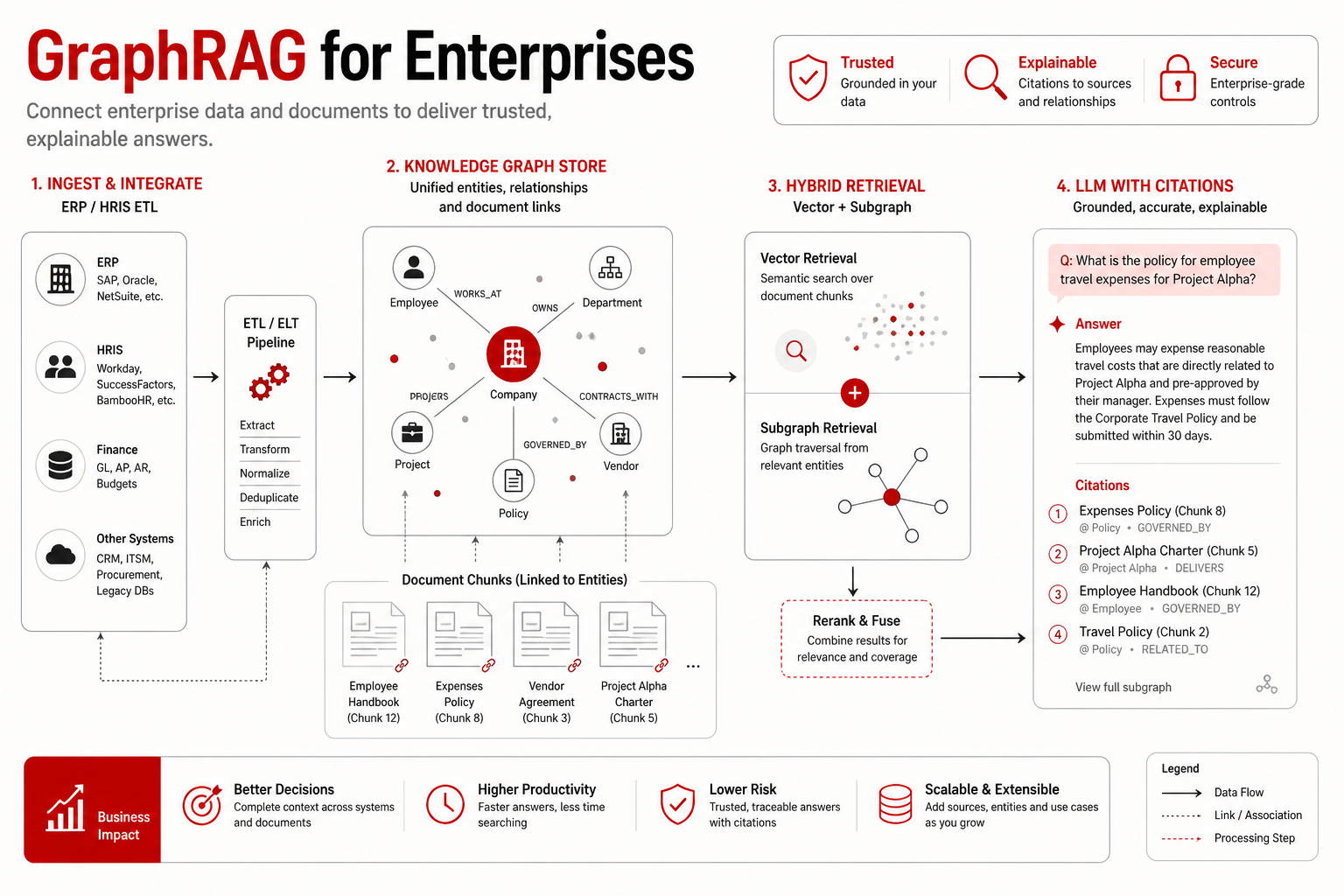
- Systems of record → ETL: Sync entities and relationships on a schedule; version snapshots.
- Document ingestion: Chunk and embed manuals, contracts, tickets; link document nodes to graph entities via stable IDs.
- Graph store: Property graph (Neo4j-class, Neptune-class, or equivalent) with typed edges and indexes on key properties.
- Retrieval planner: Classify query → vector search, graph expansion, or both; apply ACL filters on nodes/edges.
- Context builder: Serialize subgraph + top text chunks into LLM prompt with citation handles.
- Generator: Instruction-tuned model; optional reasoning for synthesis.
- Observability: Log traversed nodes/edges and attached chunk IDs for audit.
Agents orchestrating tools should treat graph queries as first-class tools with timeouts and row limits (chatbot to agent map). Unbounded graph traversals are a latency and cost footgun.
Microsoft GraphRAG pattern (desk summary)
Microsoft’s open GraphRAG project popularized a pipeline that:
- Extracts entities and relationships from text using LLMs.
- Builds a graph and detects communities (clusters).
- Precomputes community summaries at multiple levels.
- At query time, selects relevant communities and text units for LLM answer generation.
Strength: global questions (“what are the main themes across dataset X?”) without sending every chunk to the model. Weakness: extraction cost, summary staleness, and sensitivity to bad extractions. Treat community summaries as cached artifacts with TTL and invalidation on source updates—not static truth.
Building vs buying graph data
Authoritative operational graphs
Best for org structure, asset dependencies, customer hierarchies, and software service maps. Edges come from transactional systems; LLM narrates and explains traversals. Hallucination risk concentrates in natural language synthesis, not edge existence—if ETL is correct.
LLM-extracted graphs from documents
Useful for exploratory legal/clinical/finance corpora when no graph exists. Requires human or rules-based validation samples; precision thresholds before production. Never auto-promote extracted edges to compliance workflows without review.
Hybrid
Anchor on operational IDs (employee_id, sku_id, clause_id) in text chunks; LLM extraction proposes candidate edges; analysts confirm high-value relations. This is slow but trustworthy.
Retrieval strategies inside GraphRAG
| Mode | Mechanism | Good for | Risks |
|---|---|---|---|
| Local search | Seed entity → k-hop neighborhood + linked chunks | Specific entity questions | Hub nodes explode context |
| Global search | Community summaries ranked by query | Thematic overview | Stale or vague summaries |
| Vector + graph fusion | Dense search → expand graph from hits | Mixed prose + structure | Wrong seed entity |
| Text2Cypher / GQL | LLM generates graph query | Power users, analytics | Injection, expensive queries |
Pair graph modes with dense retrieval from chunking guide practices. Document nodes carry evidence text; graph carries relationships.
Access control and governance
Graphs amplify leakage risk: traversing one visible edge may expose a sensitive node if ACLs are incomplete. Enforce authorization on every hop or precompute tenant-specific subgraph views. Log traversals for regulated industries.
PII on nodes (emails, patient IDs, account numbers) needs masking in logs and prompts. Read practical AI safety for builders for prompt injection via malicious document nodes that attempt to influence graph extraction jobs.
Failure modes
- Stale HR graph → wrong manager chain after reorg.
- Over-connected hub nodes → context blow-up and vague answers.
- Hallucinated extraction edges → confident wrong dependencies.
- Expensive global summarization without caching → runaway batch LLM cost.
- Text2Cypher without guardrails → full graph scans or injection.
- Ignoring time validity on edges (contract active dates, employment intervals).
Evaluation
Extend vector RAG eval with graph-specific cases:
- Path recall: Did retrieval include required nodes/edges for the gold answer?
- Constraint satisfaction: For “who approves,” is the person in the correct role edge?
- Faithfulness: Does natural language match subgraph evidence?
- Latency: p95 for k-hop expansion under load.
Use the same anti-gaming discipline as public leaderboards (leaderboard guide). Graph eval sets should be holdout from extraction training prompts to avoid leakage.
Cost and inference economics
GraphRAG costs split into:
- ETL and storage (often dominant opex if graphs are large).
- Offline extraction/summary LLM jobs on corpus updates.
- Online traversal + generator tokens per query.
Community summary precomputation trades upfront LLM spend for cheaper queries—similar to index build vs query cost in vector search. Model stack placement matters: extraction may use a smaller model; synthesis may use a larger one (model stack 2026, inference economy).
GraphRAG vs fine-tune
Fine-tuning teaches phrasing and task habits; it does not reliably store updatable relationship graphs. GraphRAG answers structured fact questions with explicit traversals; fine-tune helps JSON format and tone. They are complementary—see retrain vs retrieve pillar.
Industry sketches (illustrative, not endorsements)
Manufacturing and supply chain
BOM graphs link components, suppliers, plants, and compliance certificates. Questions like “which alternate supplier qualifies for part P under regulation R” traverse edges—not single paragraphs. Document chunks attach spec PDFs to part nodes. Eval includes path recall and time-valid supplier contracts.
Financial services hierarchy
Legal entity trees, booking centers, and policy exception graphs support internal audit questions. MNPI segmentation is mandatory; subgraph views per desk. Vector search over policy memos plus graph expansion from entity IDs is a common hybrid.
Healthcare provider networks
Facility–provider–payer relationships appear in operational graphs; clinical prose stays in chunked literature indexes. Patient-facing flows require regulatory classification beyond this article—default to staff-facing research assistance with human review.
Software engineering and CMDB
Service dependency graphs power incident questions (“what breaks if cache cluster C fails?”). Link runbooks as document nodes. Avoid LLM-only dependency extraction without validation against CMDB APIs.
Operational runbook topics
- Backfill strategy: Batch ETL windows vs streaming edge updates.
- Conflict resolution: When ERP and CMDB disagree on entity IDs.
- Decommissioning: Tombstone nodes vs hard deletes for audit.
- Replay: Rebuild graph from snapshot after corruption incident.
- Query budgets: Max hops, max nodes, max LLM tokens per traversal.
- Cache: Hot subgraphs for executive dashboards; invalidate on ETL version bump.
Text2Graph query guardrails
When LLMs generate graph queries, enforce:
- Allowlisted relationship types and labels—no arbitrary property names from model text.
- Parameterized queries with bound variables; never string-concatenate user text into query language.
- Timeouts and row limits with graceful degradation to vector search.
- Read-only roles for online QA; writes via separate ETL pipelines only.
- Audit log of generated queries for security review samples.
Comparison to data warehouse and BI
GraphRAG copilots complement—not replace—SQL metrics layers. Use graphs for exploratory relationship questions and narrative synthesis with citations; use warehouses for audited KPIs. Mixing them without labeling confuses users when numbers disagree. Product UX should state when an answer is narrative-over-graph vs metric-from-warehouse.
Rollout maturity model
| Stage | Capabilities | Prerequisites |
|---|---|---|
| 0 — Vector only | Doc QA with hybrid search | Chunking + recall eval |
| 1 — Anchored entities | Docs linked to stable IDs from SOR | ETL + ACL design |
| 2 — Traversal QA | k-hop questions with citations | Path recall eval |
| 3 — Community summaries | Global thematic questions | Summary TTL + cost controls |
| 4 — Agent tools | Graph queries in agent loops | Safety + budget gates |
Agent and memory integration
Long-running agents should not memorize org graphs in session buffers. Persist structured memory as graph or database queries on each turn (agent memory hybrid). Vector session recall is for conversational continuity, not BOM traversal.
Who this is for
- Enterprise architects connecting ERP/CRM/HRIS data to copilots.
- Data platform leads evaluating GraphRAG after flat RAG plateaus.
- Security/compliance officers reviewing graph ACL models.
Who should skip
- Teams with purely document-QA needs and no entity graph source.
- Organizations unwilling to own graph ETL SLAs.
- Startups expecting GraphRAG to fix bad chunking—fix vectors first.
Common mistakes
| Mistake | Consequence | Mitigation |
|---|---|---|
| LLM-only graph, no validation | Phantom edges | Sample audit + thresholds |
| No temporal edges | Wrong historical facts | Valid-from / valid-to on relationships |
| Unbounded hops | Latency, cost, noise | Hop limits + degree caps |
| Skipping vector baseline | Over-engineering | Prove vector recall gap first |
| Graph without document citations | Unverifiable NL answers | Attach chunk IDs to nodes |
FAQ
GraphRAG vs knowledge graph search—what is the difference?
Knowledge graph search returns structured results; GraphRAG adds LLM synthesis over retrieved subgraphs and linked text. The graph store may be shared; GraphRAG is the QA layer on top.
Do we need Neo4j specifically?
No. Any graph store with query APIs, indexing, and operational maturity can work. Choose based on ops skills and cloud constraints—not logo recognition.
Can GraphRAG replace data warehouse joins?
No. It assists human-facing QA; authoritative analytics still belong in SQL/BI pipelines with tested metrics.
How often should community summaries refresh?
When underlying documents or graph communities change materially—define TTL per use case, not arbitrary nightly jobs on static corpora.
Is GraphRAG “enterprise ready” out of the box?
Open reference implementations are starting points. Production requires ACLs, eval, ETL, cost controls, and vertical disclaimers where regulated (vertical RAG).
Community summary cost model (qualitative)
Offline GraphRAG indexing often triggers many LLM calls per document batch—extraction, summarization, community reports. Budget as capex-like index build plus storage, not only per-query opex. Cache summaries by community version; invalidate when any member document changes beyond threshold. Without TTL discipline, teams pay repeated global summarization on nearly static graphs.
Compare to vector-only reindex cost when deciding whether global thematic questions justify GraphRAG. If those questions are 5% of traffic, a scheduled analyst report may be cheaper than always-on community search.
Integration with vector indexes (dual-write pattern)
Document nodes often store: text chunk, embedding, graph node ID, ACL tags, effective dates. On ingest, dual-write to vector index and graph store in one pipeline transaction where possible; reconcile with nightly jobs when eventual consistency is unavoidable. Drift between vector and graph copies of the same entity ID produces answers citing docs disconnected from traversals—users lose trust fast.
Query planner pseudologic: (1) classify intent as entity-centric vs prose search; (2) if entity-centric, resolve seed IDs via metadata or NER with dictionary validation; (3) expand k-hop with caps; (4) parallel dense search on linked doc chunks; (5) merge ranked evidence with dedupe by chunk ID; (6) pass to generator with explicit “graph path” and “text evidence” sections in prompt template.
Vendor and open-source landscape (non-ranking)
Teams evaluate property graph databases, RDF triple stores, and graph analytics platforms. Choice depends on existing ops skills, cloud availability, and query language fit—not logo recognition. Microsoft GraphRAG reference code demonstrates one indexing philosophy; Neo4j-class docs emphasize operational Cypher patterns. Run a proof-of-concept on your entity edge precision before standardizing.
Proof-of-concept checklist (six weeks, desk template)
Week 1: Select 50 multi-hop gold questions from SMEs; reject if answers live in single paragraphs (those are vector jobs). Week 2: Export authoritative subgraph sample from one system of record; measure edge precision on 100 random edges. Week 3: Link 500 document chunks to entity IDs; run dual-write ingest. Week 4: Implement local search with hop cap=2; measure path recall. Week 5: Add optional community summaries for one division only; measure cost per refresh. Week 6: Compare end-to-end faithfulness vs vector-only baseline on same gold set—GraphRAG must win clearly to justify ops.
Organizational roles
| Task | Data engineering | Graph admin | ML platform | Domain SME |
|---|---|---|---|---|
| ETL from ERP/HRIS | R/A | C | I | C |
| Edge validation sampling | C | C | I | R/A |
| Doc-chunk linking | R/A | I | C | C |
| Query planner tuning | I | C | R/A | C |
| Eval gold maintenance | I | I | C | R/A |
R=Responsible, A=Accountable, C=Consulted, I=Informed—adapt to your org chart.
Future-facing note: agents on graphs
Agent loops that plan multi-step graph queries amplify cost and risk. Cap iterations; require evidence accumulation before final natural language answers. Combine with agent map tool policies so graph traversals cannot exfiltrate cross-tenant nodes via creative tool arguments. Eval agent+graph paths separately from single-shot GraphRAG—failure modes compound.
Semantic layer vs physical graph
Many enterprises maintain a semantic business glossary (metrics definitions, entity synonyms) separate from physical graph storage. Map glossary terms to node labels and edge types explicitly—otherwise NL queries map inconsistently to graph traversals. A “customer” node in one division may be “account” in another; normalization belongs in ETL, not in one-off prompt instructions.
Disaster recovery
Graph stores require backup and restore drills like any database. Document how long rebuild-from-ETL takes vs restore-from-snapshot. Community summaries may need regeneration after restore—budget LLM batch cost in DR runbooks. Vector and graph backups should share consistent entity ID versions or post-restore reconciliation jobs will link chunks to wrong nodes.
Reading list for platform engineers
Start with the Microsoft GraphRAG repository README for pipeline vocabulary, then your chosen graph vendor’s operational guide for backup, indexing, and query profiling. Pair with RAG pillar for when graph budget should not be spent. Avoid implementing community summaries before local k-hop retrieval works—teams need wins on concrete entity questions before global thematic search.
Performance testing graph expansions
Load-test k-hop expansion with worst-case hub nodes—popular products, CEOs, central IT services—because average-case traversals lie. Measure p95 latency vs hop count and enforce caps in production config. Combine results with inference economy planning so graph copilots are not surprised by traffic spikes during incidents when graph queries peak.
GraphRAG success is as much an data engineering program as an ML feature—fund ETL owners alongside prompt engineers. Without that funding, prototypes rot when the champion engineer rotates teams.
When presenting GraphRAG ROI to leadership, compare incident time saved on multi-hop questions—not generic “AI productivity.” Specific workflows (onboarding approver lookup, supply chain trace) justify graph ops cost more credibly than abstract knowledge graphs.
If your organization already invested in master data management (MDM), align graph node IDs to MDM keys early—forking identifiers guarantees expensive reconciliation later.
Publish an internal “graph semantic dictionary” listing entity types, allowed edge verbs, and worked traversal examples—onboarding new engineers without it repeats the same schema debates every quarter.
Revisit GraphRAG scope annually: corpora drift toward unstructured prose over time, and maintenance burden may exceed benefits unless entity questions remain a top support driver. Sunsetting graph layers when vector+RAG suffices is healthy—not an admission of failure.
Quick reference card
Adopt GraphRAG when: multi-hop entity questions are frequent, systems-of-record graphs exist, and wrong-hop answers hurt operations.
Defer when: prose search suffices, graph ETL has no owner, or vector recall already meets SLOs on gold questions.
Always: dual-write doc chunks with stable IDs, cap traversals, eval path recall, and pair with retrieval eval.
Graph programs without executive sponsorship for data quality usually revert to vector-only within a year—line up a data owner before buying graph licenses.
Treat community summaries as cached analytics products with owners and SLAs, not one-time batch jobs run during a hack week.
Done well, GraphRAG makes institutional structure queryable; done poorly, it amplifies stale org charts into confident prose.
GraphRAG is a systems pattern, not a model upgrade—budget it like a data platform feature with owners, eval, and sunset criteria.
Sources
- Microsoft GraphRAG (GitHub) — reference pipeline and community summary pattern.
- Neo4j — property graph concepts and enterprise graph patterns (vendor docs; compare alternatives).
- Lewis et al., RAG (2020) — baseline retrieval-generation context for hybrid stacks.
What we did not test: We did not execute GraphRAG index builds on private enterprise graphs for this article. Performance claims are qualitative patterns from public materials—not EIA-measured benchmarks.
Corrections: Update tool names and default pipelines when GraphRAG reference repos change; revise as-of date accordingly.
Next step
Instrument retrieval quality with evaluate retrieval: recall and faithfulness, including graph path cases. For regulated domains, continue to vertical RAG: legal, medical, and finance.