
Quick answer
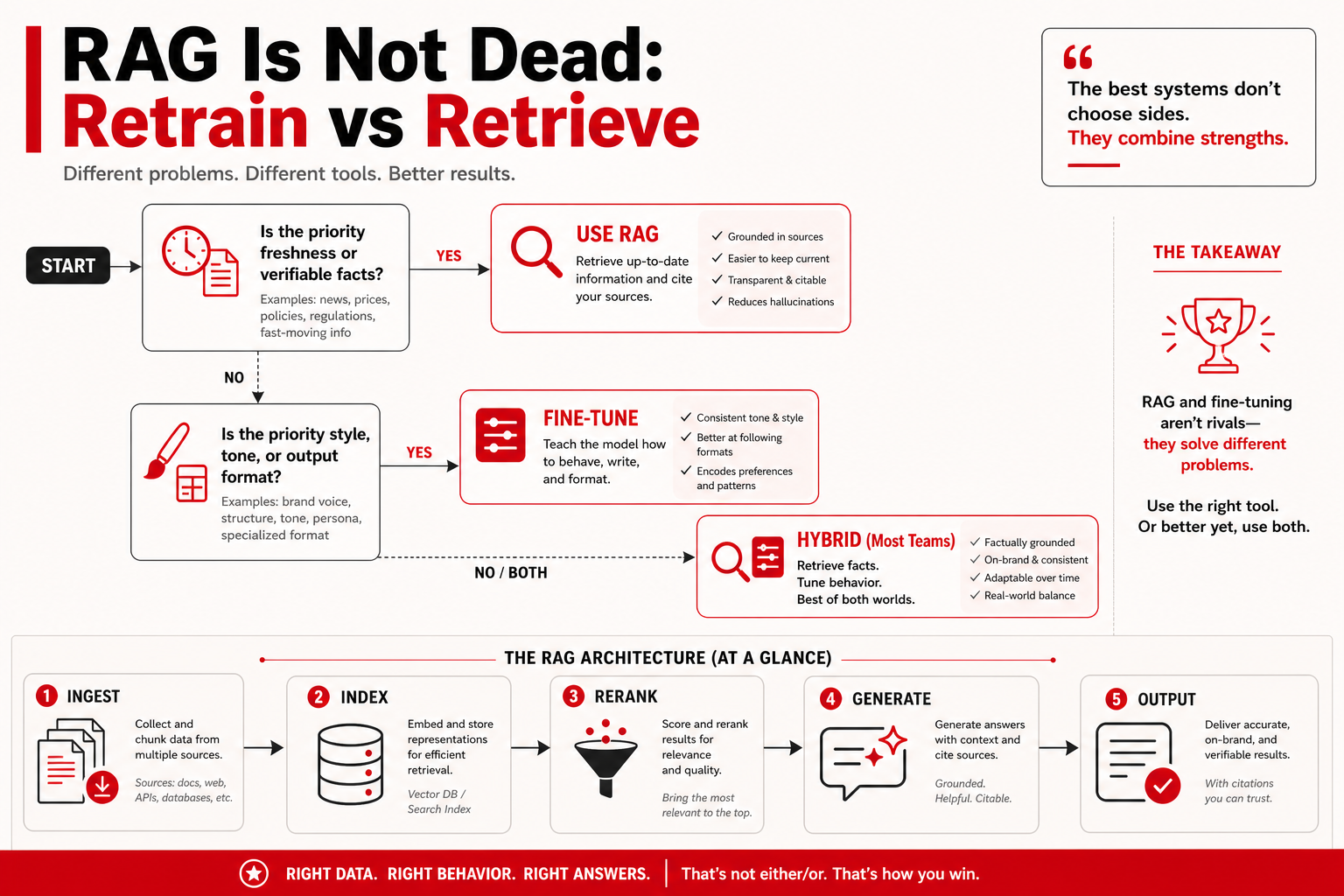
RAG retrain vs retrieve decisions should start with source freshness and audit needs. Retrieval-augmented generation (RAG) remains the default when a product needs fresh, citeable knowledge without retraining weights on every document change. Retrain or fine-tune when stable domain language, output format, tool habits, or behavioral tone matter more than daily corpus freshness—and when a labeled gold set can catch regressions. Most production teams in 2026 run a hybrid: retrieve facts at inference time, tune behavior separately, and evaluate retrieval and generation as separate layers.
Key takeaways
- RAG handles freshness and citations; fine-tuning handles stable style, schema adherence, and narrow task mimicry.
- Reasoning models improve synthesis but do not replace grounded retrieval for private or fast-changing corpora.
- Hybrid stacks—vector RAG plus optional graph structure plus lightweight adapters—dominate enterprise knowledge systems.
- Evaluate retrieval recall before blaming the generator; most “RAG failures” are upstream indexing problems.
- Agents multiply retrieval needs; session memory alone overfits without a durable index (agent memory hybrid).
Why the retrain vs retrieve question keeps returning
Every few months a product launch or research thread reopens the same debate: if models memorize more during pretraining and post-training, and if “long context” windows stretch to hundreds of thousands of tokens, do we still need RAG? The question is understandable but often mis-aimed. RAG was never primarily about models being too small to know facts. It was about control: which documents the system may use, how citations map to sources, how quickly knowledge updates after a policy change, and how tenant isolation works in multi-customer SaaS.
Fine-tuning and full retraining answer a different class of problems. When legal reviewers want clause language phrased in firm-specific style, when support bots must always emit JSON matching a schema, or when a coding assistant must follow internal API naming conventions, weight updates or strong instruction tuning can outperform retrieval alone. When yesterday’s price list, this morning’s incident postmortem, or a customer’s private contract must appear in the answer with an audit trail, retrieval wins unless you plan to retrain on every edit—which is usually infeasible.
This explainer is pillar content for Cluster C (RAG and knowledge systems, M5/M2). It routes decisions; it does not replace the operational guides on chunking and embedding choice, GraphRAG for enterprises, or retrieval evaluation. Read those after you know which layer your pain belongs to.
What RAG actually is (and is not)
Definition
RAG, in the sense popularized by Lewis et al. (2020) and adopted across industry, means: embed or search a corpus, retrieve top passages, inject them into the model context, then generate an answer conditioned on those passages. Variants add rerankers, hybrid sparse+dense search, metadata filters, access-control lists (ACLs), and graph expansion—but the core contract is external knowledge at inference time.
RAG is not the same as “paste the whole wiki into the prompt.” That pattern sometimes works in demos with small corpora but breaks on cost, latency, and attention quality at scale. It is also not a substitute for safety alignment: retrieved text can contain toxic or confidential content if ACLs fail. See practical AI safety for builders for cross-cutting governance.
What RAG is good at
- Freshness: Reindex documents without a training job when policies, products, or prices change.
- Provenance: Attach chunk IDs, URLs, or page spans so users and auditors can verify claims.
- Private data: Keep sensitive corpora out of shared foundation weights; scope retrieval per tenant.
- Cost control: Smaller generator models plus good retrieval often beat giant models trying to recall facts from parametric memory alone—especially when paired with smart inference economics.
- Debuggability: Log which chunks were retrieved when an answer is wrong; you cannot do that cleanly with opaque weight memory.
What RAG is weak at
- Stable formatting and tone when not reinforced by fine-tuning or strict structured-output modes.
- Procedural habits (always call tool X before Y) unless the generator was trained or scaffolded for tools—see chatbot to agent map.
- Global synthesis over entire corpora (“summarize everything we know about division Q3 performance”) without hierarchical indexing or graph summaries.
- Numeric precision when chunks split tables or when retrieval misses the row that matters—common in finance and clinical settings (vertical RAG).
What retrain and fine-tune actually change
“Retrain” spans a wide spectrum. At one extreme, foundation labs retrain or continue-pretrain trillion-token corpora— irrelevant for most application teams. At the other, your platform team runs LoRA adapters on 500–5,000 labeled examples to stabilize classification or formatting. This section focuses on what product and ML platform teams actually touch, mapped to the 2026 model stack.
| Method | Updates weights? | Best for | Freshness after ship | Eval burden |
|---|---|---|---|---|
| Prompt + system policy | No | Task framing, lightweight style | Immediate prompt edits | Low–medium |
| RAG / search index | No | Facts, docs, tickets, policies | Reindex pipeline | Retrieval + faithfulness |
| LoRA / adapter fine-tune | Partial | Narrow tasks, tone, extraction schemas | Requires redeploy adapter | Medium |
| Full SFT on domain corpus | Yes (checkpoint) | Stable jargon, internal code patterns | Stale until next tune | High |
| Continued pretrain on private corpus | Yes (base) | Air-gapped, proprietary language | Very stale; expensive | Very high |
Fine-tuning does not magically ingest your entire SharePoint. It nudges behavior toward patterns present in the training set. If the training set lacks last week’s security advisory, the model will not reliably know that advisory unless you retrieve it or retrain again. Teams that fine-tune away retrieval gaps often discover stale parametric answers that sound authoritative—worse than an explicit “I could not find a source.”
Decision tree: retrain vs retrieve
Use the table below as a routing heuristic, not a law. Your private eval set should break ties.
| Signal | Prefer RAG | Prefer fine-tune / retrain |
|---|---|---|
| Source data changes daily or weekly | Yes | No |
| Answers must cite primary documents | Yes | Rarely alone |
| Stable internal jargon and templates | Partial (glossary index helps) | Yes |
| Small gold set (<200 examples) but clear pattern | Maybe with few-shot | Often yes (adapter) |
| Multi-tenant isolation per customer corpus | Yes (ACL + per-tenant index) | Risky without strict data controls |
| Tool-calling workflow is fixed | Prompt + tools | Tool-tuning often wins |
| Regulated vertical needing audit trail | Yes with human review | Only with MRM / governance |
| “Whole corpus” analytic questions | Needs GraphRAG / summaries | Not a fine-tune substitute |
When headlines say RAG failed
Public case studies of disappointing RAG rollouts usually trace to implementable fixes:
- Naive chunking split tables, code, and legal clauses across boundaries—fix with structure-aware chunking (chunking guide).
- Embedding mismatch (English embedder on multilingual tickets, or stale embedder after model upgrade) — fix with domain-matched models and versioned indexes.
- No ACL enforcement at retrieval time—fix in platform layer, not by bigger LLMs.
- Skipping retrieval eval and tuning prompts for months—fix with recall@k and faithfulness suites (eval guide).
- Stuffing irrelevant chunks because k was set too high—fix with rerankers and metadata filters.
None of those require abandoning retrieval. They require engineering discipline the field sometimes skipped during 2023–2024 hype cycles.
Hybrid architecture most teams should assume
Production knowledge systems in 2026 rarely choose exclusively. A common pattern:
- Ingestion: Parse PDFs, HTML, tickets, code, and slides with structure-aware chunkers; store parent-child relationships for summaries vs details.
- Index: Dense vectors plus optional sparse (BM25) hybrid; optional knowledge graph for entity-heavy domains (GraphRAG).
- Retrieve: Filter by ACL, metadata, recency; fetch top-k; rerank to top-n for context budget.
- Generate: Instruction-tuned LLM with citation template; optional reasoning pass for multi-hop synthesis.
- Adaptation side path: Lightweight adapter or fine-tune for JSON schema, brand voice, or classification routing—not for entire document stores.
- Observe: Log queries, chunk IDs, latency, faithfulness flags; feed failures into index fixes or adapter retraining selectively.
This mirrors how agent systems combine durable memory with session state (short/long memory hybrid). Agents that rely only on conversation buffer without retrieval tend to hallucinate institutional facts after a few turns.
Long context vs RAG
Long context windows (see long context in practice) change economics, not the fundamental tradeoff. Pasting hundreds of documents into one prompt typically costs more per query, increases latency, and still suffers from “lost in the middle” attention effects unless the model and task are validated for your lengths. Long context is excellent for selected full documents after retrieval narrows the set—for example, one contract plus amendments—not for replacing search over a million-page archive.
A useful rule: use retrieval to select, use long context to read deeply within the selection.
Reasoning models and RAG
Reasoning-oriented models (chain-of-thought, test-time compute) improve multi-step synthesis over retrieved material. They do not remove the need for grounding when facts live outside weights. A reasoning model can integrate three retrieved passages about incident timeline, customer tier, and escalation policy better than a small chat model—but only if retrieval fetched the right passages.
Read reasoning vs chat models for capability framing, and how to read AI leaderboards before you upgrade generators based on bench scores that omit your retrieval pipeline. Leaderboard wins without your index are not deployment wins.
Cost, latency, and the inference layer
RAG adds components: embed queries, search, optional rerank, larger prompts. Fine-tuning adds training cost and redeploy complexity but can shrink prompt size if behavior is internalized. Total cost is workload-specific. Typical patterns:
- High QPS FAQ with small corpus: aggressive caching + small embedder + mid-size generator.
- Low QPS analyst copilot with huge corpus: hybrid search + reranker + frontier generator on top-n chunks only.
- Batch document processing: fine-tuned extractor + RAG for reference lookup, not one giant prompt per file.
Map spend to user journeys using inference economics frameworks (inference economy guide). The cheapest architecture is the one that meets recall and faithfulness SLOs—not the one with the fewest boxes in a diagram.
Organizational ownership
| Component | Typical owner | Common failure when orphaned |
|---|---|---|
| Document ingestion / chunking | Data platform or docs team | Silent index rot after template changes |
| Embeddings + vector DB | ML platform | Version skew after embedder upgrade |
| ACLs + tenancy | Security / platform | Cross-customer leakage |
| Generator selection + routing | App + ML lead | Benchmark chasing without eval |
| Fine-tune datasets | Domain SMEs + ML | Overfit style, underfit facts |
| Eval gold sets | Product + QA | Prompt tuning on noise |
Enterprise case patterns (desk synthesis)
We do not cite private customer metrics here; the patterns below recur in public write-ups and vendor case studies—always validate on your eval set.
Support and success teams
Ticket history changes hourly. RAG over CRM + knowledge base with ACLs per account tier is the durable pattern. Fine-tuning helps ticket classification and macro tone, not ticket facts from last Tuesday. Teams that fine-tuned on static ticket exports without retrieval report “confident wrong status updates” within weeks.
Engineering and developer docs
API references and runbooks benefit from structure-aware chunking and hybrid search (error codes, endpoint paths). Fine-tuning on internal code style helps codegen copilots; facts still come from indexed repos. Pair with AI app stack for knowledge workers when rolling out IDE integrations.
Policy and compliance assistants
Policy corpora need version metadata and human review in regulated settings (vertical RAG). Retrieval is mandatory; fine-tuning may standardize summary format for reviewers. Never treat weight memory as the system of record for obligations.
Sales enablement
Battlecards and pricing sheets rotate frequently. RAG with effective-date filters beats quarterly fine-tunes. Adapters can enforce battlecard section ordering in outputs without embedding prices in weights.
Scaling laws intuition without fake numbers
Pretraining scale still matters for reasoning depth and low-shot generalization—see scaling laws where returns diminish. That does not obsolete RAG: parametric scale improves how well the model uses retrieved context, not whether your private PDF from this morning is inside weights. Upgrade generators when faithfulness-with-good-retrieval plateaus; do not skip retrieval because a release note mentions larger pretrain.
Open vs closed access and hybrid ownership
Open vs closed frontier choices affect who owns embedders, fine-tunes, and inference. Closed APIs bundle post-trained generators; you still own indexes and ACLs. Open weights let you fine-tune adapters on-prem but shift inference ops to your team. Hybrid RAG is access-mode agnostic: indexes are yours either way.
Migration paths we see in practice
From pure prompt to RAG
Teams start with a general chatbot, hit factuality walls, then add search. Success requires defining citation UX early and building ingestion for the formats users actually ask about—not only marketing PDFs.
From RAG-only to hybrid fine-tune
After retrieval recall is stable, teams fine-tune adapters for output structure (ticket tags, JSON extractions, email tone). They keep facts in the index and behavior in weights—a clean separation that simplifies debugging.
From fine-tune-only back to RAG
When stale answers accumulate after fine-tunes on static snapshots, teams reintroduce retrieval rather than endless retraining cycles. This is normal, not a step backward.
Reasoning models and tool use in hybrid stacks
Reasoning models can plan multi-step retrieval: draft sub-queries, merge results, check coverage before answering. That is still RAG—tools and retrieval loops orchestrated at inference—not parametric memory replacement. Budget token and latency multipliers when enabling reasoning passes (reasoning vs chat models). Eval each sub-step; a clever plan with empty retrieval still fails.
Index lifecycle and deletion
Hybrid stacks must handle GDPR-style deletion, contract expirations, and mistaken uploads. Tombstone chunk IDs in logs; propagate deletes to vector and graph indexes. Fine-tuned weights cannot “unlearn” a leaked document—another reason sensitive material belongs in ACL-scoped retrieval, not training snapshots without governance.
Who this is for
- Engineering and product leads choosing between index investment and fine-tune projects.
- ML platform teams designing enterprise knowledge assistants with tenant isolation.
- Architects planning agent systems that must cite internal sources.
- Technical buyers evaluating vendor claims that “the model remembers everything now.”
Who should skip
- Teams with a tiny static FAQ (<50 pages) that fits in prompt cache—simple RAG may be optional.
- Readers seeking a single “best embedding model” ranking without eval—use the chunking guide and MTEB with your data instead.
- Organizations expecting fully autonomous legal or medical advice from RAG—see vertical disclaimers in regulated vertical RAG.
Common mistakes
| Mistake | Why it fails | Better move |
|---|---|---|
| Fine-tuning the full doc library monthly | Cost, staleness, contamination risk | RAG index + selective adapter updates |
| RAG without ACL filters | Compliance incident | Enforce tenant filters pre-retrieval |
| Upgrading LLM before fixing recall@5 | Expensive hallucination | Retrieval eval first |
| Treating GraphRAG as magic without graph hygiene | Wrong entity edges | ETL from systems of record |
| Assuming long context removes search | Cost + attention loss | Retrieve then deep-read selected docs |
| Single monolithic index for all products | Bad precision, noisy citations | Partition indexes by domain and ACL |
FAQ
Did reasoning models kill RAG?
No. Reasoning improves synthesis over provided context; it does not securely inject private or fresh documents without retrieval or tool access. Treat reasoning as a generator upgrade, not a replacement for indexes.
Should we fine-tune on retrieved chunks?
Sometimes—for distillation or teaching citation format—but not as the primary way to load facts. If facts change, the index should change; weight updates lag by definition.
How often should we retrain embeddings?
When you change embedding model, chunking strategy, or document schema—not on a calendar alone. Version indexes and run parallel recall tests before cutover.
Is RAG enough for agents?
Agents need retrieval plus tool governance plus memory policy. Start with the agent map and memory hybrid before adding autonomous loops.
What is the first metric to instrument?
Recall@k on a labeled question-passage set representing real user queries. Without it, generator swaps are guesswork.
Build vs buy for retrieval platforms
Teams choose between assembling open components (embedders, vector DB, rerankers, orchestration) and buying integrated retrieval SaaS. Buy when ops headcount is limited and standard connectors suffice. Build when ACL models, custom graph joins, or air-gap requirements exceed vendor flexibility. Either path still needs your gold eval set—platform logos do not replace recall@k on your tickets.
Integrated suites often bundle embed+search+UI; verify you can export chunk IDs, swap embedders, and run offline eval scripts without vendor-only APIs. Lock-in appears when you cannot reindex outside the vendor timeline.
Stakeholder communication template
When executives ask “why not just fine-tune GPT,” answer with three bullets tied to their risks: (1) freshness—how often facts change; (2) audit—whether citations are mandatory; (3) cost—retrain frequency vs reindex. Link hybrid eval plans to business owners so retrieval investment is not treated as “infra trivia.”
Sources
- Lewis et al., “Retrieval-Augmented Generation for Knowledge-Intensive NLP Tasks” (2020) — foundational RAG framing.
- Hugging Face Documentation — open embedders, fine-tuning, and inference patterns.
- Microsoft Azure AI Search — RAG overview — enterprise retrieval patterns (verify current SKU names when deploying).
What we did not test: We did not run a private head-to-head retrain vs RAG benchmark on customer data for this article. Tradeoffs are synthesized from public literature, vendor docs, and commonly reported production patterns—not EIA-measured rankings.
Corrections: When major labs ship default “memory” products or change embedding APIs, update the hybrid architecture and as-of date at the top—not isolated SEO adjectives.
Next step
Implement the retrieval layer with RAG chunking and embedding model choice, then instrument quality using evaluate retrieval: recall and faithfulness. If your questions require multi-hop entity joins, continue to GraphRAG and knowledge graphs for enterprises.