
Evidence note: Models Desk synthesis from public scaling-law papers, model-release materials, and serving documentation as of 2026-08-17; this article does not fit new scaling exponents or rank labs.
Quick answer
LLM scaling laws describe predictable improvements when you add compute, parameters, and training tokens—but those improvements are not uniform across tasks, products, or budgets. In 2026, frontier labs still scale pretraining because broad capability and platform moats reward it. Most application teams, however, hit diminishing returns far earlier: their users need fresher facts, safer tool use, lower latency, and cheaper tokens—not another trillion generic web tokens in the base model. Treat scaling as a supply-side story (labs) separate from your demand-side story (features). Measure marginal value per layer in the LLM model stack 2026, not from a single public leaderboard delta.
Key takeaways
- Pretrain scaling still moves aggregate benchmarks; product fit often moves on post-training, retrieval, and serving.
- Data quality, deduplication, and synthetic loops matter as much as raw token count—contamination inflates metrics without generalizing.
- Chinchilla-style compute–data balance remains a useful heuristic when planning training or fine-tune budgets.
- Inference cost scales with context length and reasoning depth—capability per watt and capability per dollar are the practical scaling metrics for builders.
- Pair scaling narratives with eval literacy (how to read AI leaderboards) before procurement switches.
Why scaling laws still matter in 2026
Search interest in “scaling laws LLM” spikes after every major release. Headlines compress years of compute into one chart: bigger model, better bar. That story is directionally true for many pretraining objectives—loss curves smooth downward as labs add parameters and diverse tokens. It is also dangerously incomplete for anyone shipping software.
Scaling laws, in the research sense, relate model loss (or downstream proxy metrics) to training compute, model size, and dataset size with power-law exponents. The insight helped justify cluster builds, MoE architectures, and trillion-token runs. It did not automatically tell you whether your support copilot should fine-tune, retrieve, or upgrade API tier—or whether your coding agent should route hard tasks to a reasoning endpoint.
This deep dive is cluster A1 in the Everything is AI semantic network. It extends—but does not repeat—the model stack pillar. Read that first if you cannot yet name pretrain vs post-train vs inference. Here we focus on where extra scale stops paying rent for different stakeholders.
What scaling laws claim—and what they omit
The core claim
Classic scaling narratives tie better loss to more compute and data. Open-weight releases and papers continue to cite smooth improvements on broad eval suites when training budgets grow. Labs with proprietary stacks report similar curves internally even when public detail is sparse.
For foundation model providers, the implication is clear: if competitors scale and you do not, aggregate capability may lag on public probes—hurting platform narrative, enterprise sales, and researcher recruitment. That incentive keeps capex cycles hot (hyperscaler capex).
What gets left out
Scaling laws are fitted on training objectives, not on your CRM workflow, hospital policy PDFs, or CI pipeline. They omit:
- Task structure: A model can improve on exam-style probes while failing agent harnesses or RAG faithfulness tests.
- Data exhaust: Repeating web text, benchmark-adjacent corpora, or synthetic self-play can move loss without robustness gains—see benchmark contamination.
- Serving economics: A checkpoint that is optimal at training scale may be unusable at your p95 context and QPS without quantization and routing (inference economy).
- Post-training and tools: Reasoning models and tool-tuned variants shift spend to inference-time compute (reasoning vs chat models).
Builders should treat scaling laws as one input to lab strategy and investor decks—not as a universal product roadmap.
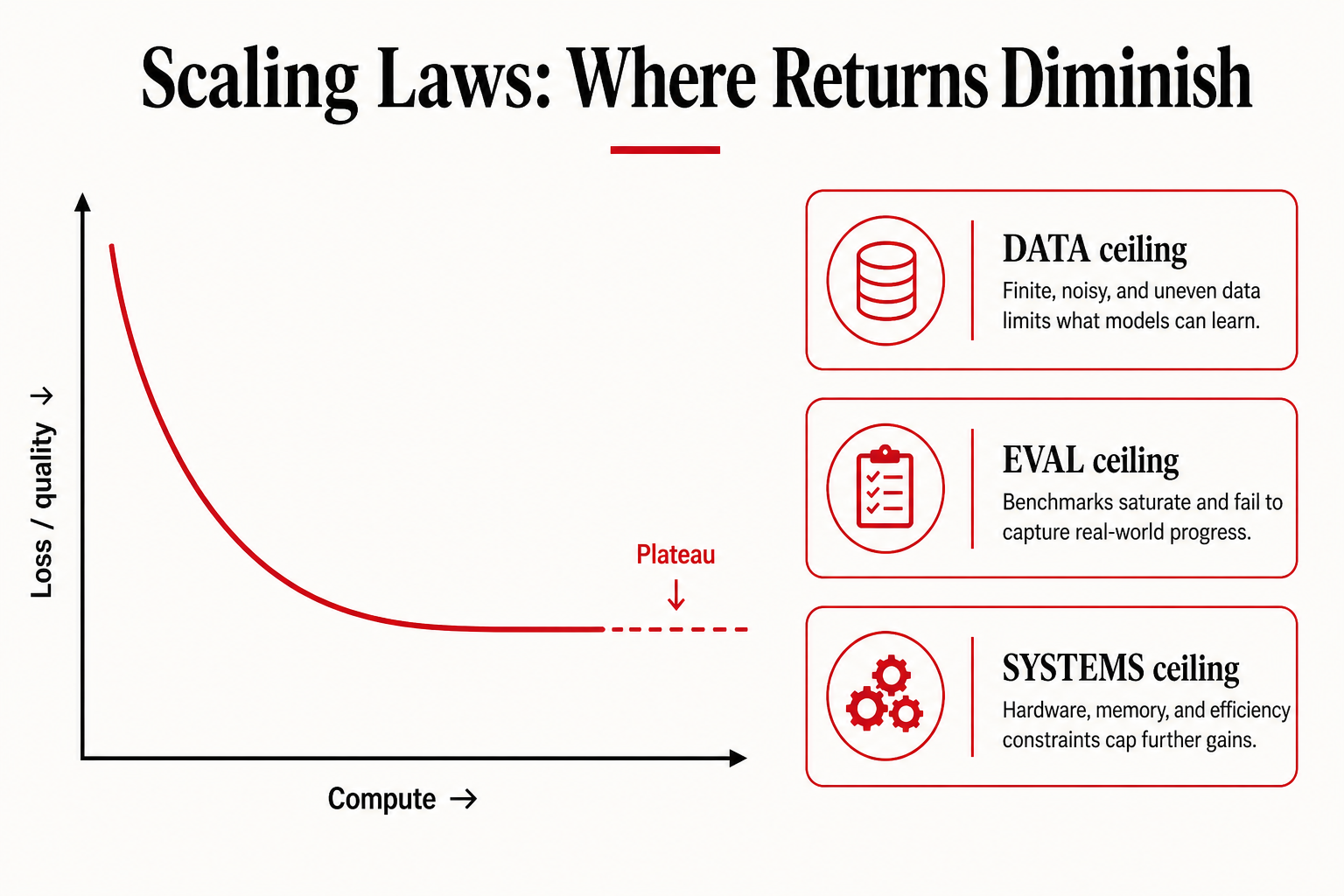
Three ceilings teams hit in practice
1. The data ceiling
High-quality human text, code, mathematics, and multimodal pairs are finite at a given quality bar. Labs respond with synthetic data generation, distillation from larger teachers, multi-stage curricula, and aggressive deduplication. Each technique introduces risks: mode collapse in synthetic loops, teacher bias propagation, and eval leakage when synthetic tasks resemble public benchmarks.
When a vendor claims “10× more training tokens” without describing filtering and dedup, ask what new information those tokens carry. For enterprise buyers, the relevant question is whether your proprietary logs and documents are the binding constraint—not whether the base model trained on another pass of Common Crawl.
2. The eval ceiling
When a benchmark family saturates, incremental pretrain spend produces marketing deltas more than user-visible jumps. Teams notice this when leaderboard percentages climb while private task pass rates plateau. Reasoning-focused product lines explicitly move investment toward test-time compute—longer chains, verifiers, search—rather than only wider pretrain.
Read scores with category discipline (Arena, MMLU, SWE-bench, GPQA explained). A single number rarely proves you should rebuild your stack.
3. The systems ceiling
MoE architectures, INT4/FP8 quantization, speculative decoding, and continuous batching on vLLM-class servers improve capability per dollar at serve time. NVIDIA H100/H200/B200 generations and memory bandwidth set hard floors for which checkpoints you can run at which context lengths (GPU map).
A team that cannot serve a 405B-class model efficiently may deliver better UX with a 70B instruct model, strong RAG, and a reasoning escalation path—despite lower parameter count on paper.
Chinchilla and the compute–data tradeoff
The Chinchilla line of work argued many models were under-trained relative to their parameter count—suggesting more tokens per parameter for optimal compute use. That insight still informs budget splits when planning open-weight reproductions or large fine-tunes on Hugging Face stacks.
Practical questions for platform teams:
- Given a fixed GPU-hour envelope, do we add parameters or tokens?
- Are we evaluating on held-out tasks that match deployment, not only training loss?
- Does our inference plan assume a checkpoint we cannot afford to serve?
At inference, the tradeoff flips: wider context windows and chain-of-thought traces consume KV-cache memory. A smaller model with better post-training, retrieval, and tools may beat a larger chat model on agent tasks—linking scaling discourse to the chatbot-to-agent map.
Scaling after the “easy data” era
Public discourse in 2025–2026 often asks whether scaling is “over.” Desk synthesis suggests a sharper formulation: generic web-scale pretrain faces diminishing returns, while targeted scale—unique multimodal corpora, reinforcement on verifiable tasks, inference-time search—still moves specific curves.
Examples of targeted scale (described in public materials, not ranked here):
- Code-heavy continued pretraining for software agents.
- Math and formal reasoning curricula for STEM copilots.
- Multilingual mixes for regions underserved by English-centric pretrain.
- Vision-language alignment for document AI and robotics stacks.
Each path has different diminishing-return points. Code scaling does not automatically fix legal citation accuracy; multilingual gains do not automatically fix tool JSON reliability.
Who should still invest in pretrain scale?
| Stakeholder | Case for scale | Case against scale |
|---|---|---|
| Frontier labs | Platform moat, broad capability, research brand | Capex, energy, regulatory scrutiny |
| Domain enterprises with proprietary data | Private eval gains on unique corpora | Ops cost, model drift, compliance |
| Chip and cloud providers | TAM grows with training demand | Supply chain, utilization risk |
| Typical SaaS product teams | Rarely—unless data is the product | RAG + post-train + routing usually win |
| Startups | Almost never at frontier pretrain | Distill, fine-tune, orchestrate instead |
Most readers of this article sit in the last two rows. Your scaling lever is usually better eval and serving, not a new pretrain cluster.
Open-weight vs closed frontier scaling narratives
Open-weight families (Llama, Qwen, DeepSeek, Mistral) and closed APIs (GPT, Claude, Gemini) both cite scale—but with different transparency and deployment paths. Open weights let you inspect checkpoints and self-host; closed APIs bundle post-training and inference SLAs you cannot replicate from weights alone.
Debates about “open catching closed” often mix layers: a distilled open model may match a closed model on a narrow bench while lagging on tool UX, multimodal latency, or policy filters. See open-weight vs closed frontier for a decision map—not a winner declaration.
Desk checklist before you cite “scale”
| Question | Green flag | Red flag |
|---|---|---|
| Do we have a private eval? | Task harness with version control | Public bench only |
| Is data unique? | Licensed logs, opt-in corpora | Scraped dupes + synthetic loop |
| Will users feel it? | Latency/cost within SLO | Leaderboard delta only |
| Can we serve it? | Quantized path on target GPUs | FP16 model no one can host |
| Which layer moves? | Named: pretrain / post-train / infer | “Upgrade the AI” vagueness |
Failure modes we see in the field
- Overbuying API tiers after a launch blog cites a single benchmark without task mapping.
- Underinvesting in eval until production regressions force a fire drill.
- Pulling the largest GGUF that fits RAM, then discovering agent loops timeout—see local open-weight checklist.
- Fine-tuning away a retrieval problem because “bigger model” sounds simpler than reindexing.
- Treating scaling papers as procurement law without as-of dates and checkpoint strings.
Mitigation: anchor decisions to stack layers, log model ID + version on every incident, and refresh evals when vendors ship new default models (weekly model moves framework).
Capability per watt: the builder’s scaling metric
Energy and datacenter politics now constrain how fast new capacity comes online (AI energy brief). Even if you do not train models, you pay for inference electricity directly (self-host) or indirectly (API pricing reflecting power and silicon).
MoE, sparsity research, and quantization are efficiency responses to diminishing pretrain returns—frontier research path J6 in the semantic network. For production teams, the actionable version is simpler: measure quality per dollar and per watt at your context distribution, not parameter count alone.
Who this is for
- Engineering leads and PMs deciding whether to upgrade models, invest in RAG, or fund internal training.
- ML platform teams explaining to finance why “train our own GPT” is usually the wrong default.
- Investors and strategists separating lab capex narratives from application-layer opportunity.
- Researchers writing honest release notes about which gains came from scale vs post-train vs eval scaffold changes.
Who should skip
- Readers seeking step-by-step code to pretrain a frontier dense transformer—out of scope; educational scales only via open communities.
- Teams with a working private eval and stable serving costs who only need a model card diff—use EIA model card template instead.
- Anyone looking for a guaranteed “scaling is dead/alive” headline—this article maps tradeoffs, not prophecy.
Common mistakes
| Mistake | Why it fails | Better move |
|---|---|---|
| Equating parameters with product value | Serving and task fit dominate UX | Task eval + TCO (self-host vs API) |
| Ignoring post-train when comparing releases | Same family, different instruct tune | Re-run refusal, JSON, tool tests |
| Scaling data without dedup | Memorization, contamination | Audit eval overlap |
| Chasing lab news without layer map | Fixes wrong team’s backlog | Use stack pillar routing |
FAQ
Are scaling laws “over”?
No—but generic web-scale pretrain faces diminishing returns for many tasks. Gains continue in targeted data, post-training, inference-time compute, and systems efficiency.
Should startups pretrain?
Rarely. Fine-tune, distill, or RAG on strong open weights unless you own defensible data and evals that require custom pretrain.
What metric replaces parameter count?
Pass rate on your private harness at acceptable p95 latency and $/task—capability per dollar at your context lengths.
How do reasoning models change scaling math?
They shift compute from training to inference—budget for tokens and latency, not only FLOPs at train time (reasoning vs chat).
Where does lab watch fit?
Track who scaled what and which access mode changed—use lab watch 2026 as an index, not a scoreboard.
Sources
- Training Compute-Optimal Large Language Models (Chinchilla) — compute–data balance reference.
- Scaling Laws for Neural Language Models (Kaplan et al.) — foundational scaling-law framing.
- Hugging Face — open-weight artifacts and community training reports.
What we did not test: We did not train models, fit scaling-law exponents, or publish new benchmark scores for this article.
Corrections: When major labs revise training stage naming or ship materially new efficiency architectures, update the ceilings section and as-of date first.
Next step
Compare how inference-time reasoning stacks against standard chat models: reasoning models vs chat models. Then map serving costs in the inference economy pillar if scale debates turn into budget meetings.