
Evidence note: Models Desk synthesis from public lab research pages, developer documentation, model cards, and policy notes as of 2026-08-17; this guide does not rank labs or verify unreleased models.
Quick answer
Frontier AI labs in 2026—the organizations shipping the largest-scale pretraining and post-training—set the pace for capability, access mode, and inference products everyone else routes around. Builders should track them for release cadence, API vs open-weight strategy, and eval transparency, not for Twitter victory laps. This field guide names what each major lab type optimizes for, how to read announcements without over-rotating, and which desk frameworks to apply when a new checkpoint drops. We do not publish a scored "#1 lab" table; we publish watch habits linked to your stack decisions (model stack, open vs closed, leaderboards).
Key takeaways
- Labs differ by access model (closed API-first vs open-weight releases vs hybrid)—not by a single universal capability score.
- Track version IDs, dates, and eval harnesses in release posts; ignore unsourced Elo screenshots.
- Capability, safety, and inference products ship on different clocks—post-train bumps can break your JSON schema without a pretrain headline.
- Open-weight drops from US, EU, and China-based labs carry different license and geopolitics implications (open source geopolitics).
- Use a weekly internal digest framework—not reactive model switching (weekly model moves).
What "frontier lab" means in 2026
A frontier lab here means an organization consistently training and deploying models at the upper tier of public discourse on scale and benchmark visibility—typically including well-capitalized teams behind flagship closed APIs (e.g., OpenAI, Anthropic, Google DeepMind/Gemini, xAI in public messaging) and major open-weight publishers (e.g., Meta AI Llama, Mistral, Alibaba Qwen, DeepSeek, Microsoft-linked releases where applicable). The set is fluid: startups graduate; labs consolidate. Verify entities on official sites when contracting.
Frontier is not synonymous with "best for your SKU." Mid-size specialized models from non-frontier teams often win on cost, latency, or vertical tasks. Frontier matters because it moves the ceiling and re-prices expectations (scaling laws).
Why builders should watch labs (and what to ignore)
Watch for
- New default API versions and deprecation timelines.
- Open-weight releases with license changes affecting commercial use.
- Context-length, reasoning mode, and multimodal product tiers (long context, reasoning vs chat, multimodal video).
- Safety policy shifts affecting refusals and enterprise liability.
- Inference stack products (batch, realtime, caching) that change unit economics (inference economy).
Ignore or defer
- Unverified leaderboard screenshots without checkpoint names.
- "AGI achieved" narrative posts without eval artifacts.
- Rumor threads on unreleased model names—wait for model cards.
- Hot takes urging same-day production swaps without regression suites.
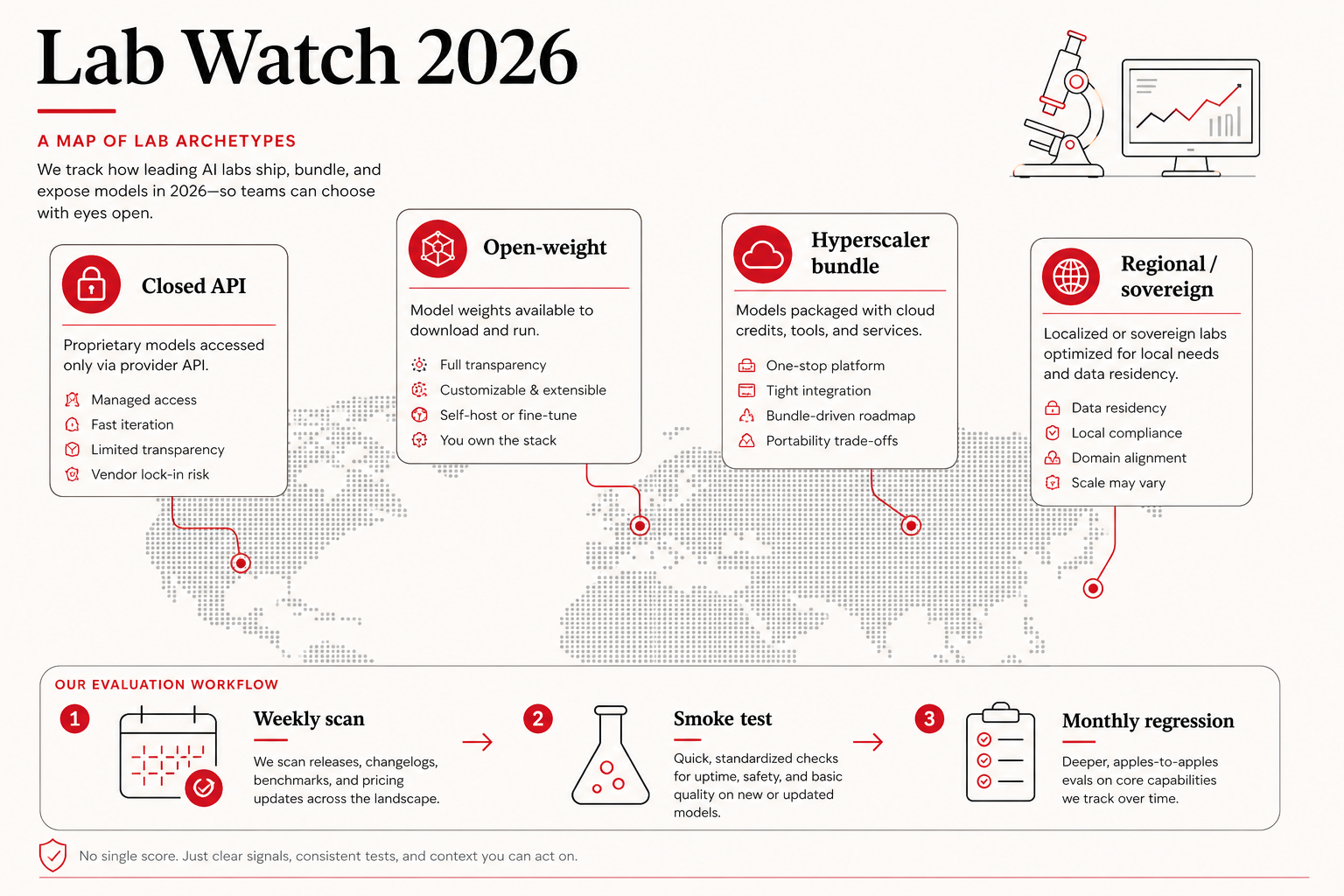
Lab archetypes (not a ranking)
| Archetype | Typical access | What they optimize in public | Builder implication |
|---|---|---|---|
| Closed API-first | Chat/reasoning APIs, enterprise VPC | Integrated products, safety narrative | Fast ship; opacity; watch version notes |
| Open-weight flagship | Downloadable instruct checkpoints | Developer adoption, ecosystem forks | Self-host option; license review |
| Hyperscaler bundle | Cloud AI suite + chips | Tight coupling to cloud spend | Procurement + egress costs (AI capital stack) |
| Efficiency / open research | Apache or custom licenses, MoE releases | Price-performance, replication discourse | Routing tier candidate; verify instruct quality |
| Regional sovereign push | National cloud + local models | Data residency, export control compliance | Sovereign AI constraints (sovereign AI) |
Major public labs — what to track (desk notes)
The following sections summarize public positioning as of mid-2026 synthesis—not private capability ordering. Confirm on official channels before legal or procurement commitments.
OpenAI
Known for closed flagship chat and reasoning endpoints, research posts, and periodic open-weight moves where announced. Watch: API version churn, reasoning product naming, tool and agent features tied to developer platform. Builders route hard tasks here in hybrid stacks while costing agent loops (chatbot to agent). Primary source: OpenAI Research.
Anthropic
Closed API-first with emphasis on long-context messaging, safety framing, and enterprise adoption. Watch: context tier changes, computer-use and tool products, policy updates affecting refusals. Compare eval claims with private structured-output tests—not arena alone. Primary source: Anthropic Research.
Google DeepMind / Gemini
Hyperscaler-integrated multimodal APIs and research; Gemini branding on consumer and developer surfaces. Watch: native multimodal input limits, Google Cloud SKU coupling, video and audio features (multimodal explainer). Primary source: Google AI for Developers.
Meta AI (Llama)
High-visibility open-weight releases driving self-host and fine-tune ecosystems. Watch: license versions, instruct vs base drops, community quant and fork quality—not just Meta benchmarks. Pair with local run checklist and open vs closed debate. Primary source: Meta AI Blog.
DeepSeek
Public discourse emphasizes efficiency-oriented architectures and open-weight releases with strong price-performance narrative in community benchmarks—verify on your tasks. Watch: license, MoE serving complexity, instruct checkpoint clarity. Primary source: vendor site and Hugging Face model cards (verify URLs at pull time).
Mistral, Qwen, Cohere, others
Mix of open and API products across EU, CN, and enterprise-focused APIs. Watch: regional hosting, multilingual strengths, and fine-tune programs. Open releases pressure closed pricing; API products pressure support SLAs. Avoid treating "Europe's answer" or similar slogans as eval results.
xAI, startups, and vertical labs
Smaller frontier-claiming teams can leapfrog on niches (coding, voice, robotics). Track only when your task map overlaps; use weekly model moves framework to limit thrash.
Release anatomy: how to read a lab announcement
- Entity + version string—exact API model ID or weight revision.
- Date + changelog—post-train-only or new pretrain?
- Eval table—which harness, scaffold, and comparator dates?
- Access path—API tier, waitlist, download, license.
- Known limits—rate, context, regions, finetune availability.
- Safety diff—refusal or jailbreak sensitivity changes.
- Inference product—batch discount, prompt cache, dedicated capacity.
Map findings to stack layer (model stack). A pretrain headline may not fix your agent tool-calling regression if the bump was alignment-only.
Open vs closed strategies across labs
2026 continues a **bifurcated market**: closed labs monetize frontier access and integrated UX; open-weight labs seed ecosystems and commoditize mid-tier tasks. Some labs do both sequentially—API first, open release later—compressing competitor windows. Builders should document assumptions when choosing only closed (vendor concentration risk) or only open (ops burden). Hybrid remains default for serious products (open vs closed).
Geopolitical and export-control news can suddenly affect weight availability (sovereign AI, geopolitics). Legal review stays mandatory.
Capital and infrastructure signals
Lab announcements increasingly coincide with **chip, datacenter, and capex** narratives—useful for forecasting inference supply, not for picking Tuesday's chat model. Hyperscaler capex cycles affect quota and spot pricing downstream (hyperscaler capex, GPU map). Treat capital news as **capacity context**, not capability proof.
Safety and policy watch
Frontier labs publish safety research and usage policies that change product behavior. Enterprise buyers care about indemnity, logging, and refusal rates on domain prompts (practical AI safety). Red-team benchmarks in papers rarely match your abuse scenarios—maintain internal tests (jailbreak and injection risks).
Desk workflow: Lab Watch routine
Weekly (30–45 minutes)
- Scan official blogs and release notes for pinned providers.
- Update internal **model allowlist** version column only after smoke pass.
- Log one paragraph in engineering digest: what changed, what we tested, what we ignored.
Monthly
- Re-run private task suite on candidate upgrades.
- Review token spend vs quality by model ID.
- Check license and region updates for open weights in production.
Quarterly
- Revisit hybrid routing policy and TCO (self-host vs API).
- Align with product roadmap: agents, multimodal, long context.
Formalize with weekly model moves framework so PM and infra share one changelog.
Connecting lab moves to your product map
| Lab signal | Likely product impact | First action |
|---|---|---|
| New reasoning API mode | Higher cost per hard task | Route only escalations; measure win rate |
| Open instruct drop | Self-host cost down | Shadow traffic on open tier |
| Context window extension | Long paste temptation | Read long context how-to |
| Multimodal video API GA | New SKUs, new failure modes | Gold clip eval |
| Safety tightening | More refusals in domain | Update prompts; escalate vendor ticket |
| Deprecated model ID | Forced migration | Pin sunset; regression suite |
Deprecation tracking: the boring failure that hurts
Lab marketing highlights launches; production pain often comes from sunsets. Maintain a calendar:
- API model IDs with announced end-of-life dates.
- SDK major versions tied to breaking schema changes.
- Open-weight repos where "main" moved to a new license family.
- Regional endpoints removed after geopolitical shifts.
Migrate on your schedule with shadow traffic—not on the vendor's last-week email. Link deprecations to regression suites described in weekly model moves.
M&A, talent, and lab boundaries (public frame only)
Consolidation and talent moves shift roadmaps—startup acquihires pause open releases; hyperscalers fold teams into bundled SKUs. We do not speculate on private deals; we note that org charts change default priorities. When a lab goes quiet for a quarter, check whether capability moved into a cloud bundle rather than a standalone model card. Industry reports on startup survival (AI startup graveyard) and M&A (M&A and talent wars) provide public context—not investment advice.
Buy vs build in a multi-lab world
Lab Watch informs the buy/build tree (buy vs build AI):
- Buy API when differentiation is UX and workflow, not weights.
- Build on open weights when adapters, residency, or marginal cost at scale dominate.
- Build agents regardless—orchestration is yours; labs supply steps.
Capital intensity at the pretrain layer keeps most enterprises out of training frontier models—watch labs for capability imports, not for becoming a lab (AI capital stack).
Community and ecosystem signals
Open-weight labs expose ecosystem health faster than closed APIs: Hugging Face download trends, quant community releases, fork quality, and issue threads on tool-calling regressions. Closed labs expose developer forum volume and third-party wrapper breakage after API changes. Neither replaces your smoke tests; both warn where to look first when quality tickets spike.
International labs and dual-stack strategies
Teams operating in multiple jurisdictions sometimes maintain dual allowlists: one stack for US/EU data paths, another for regional sovereign models. Lab Watch must be regional—export rules change weight availability faster than blog posts (open source geopolitics). Document which lab IDs are approved per region in the same registry as version pins.
Benchmarks and arenas in lab marketing
Labs cite MMLU-class knowledge, coding benches, math, and chat arenas in launches. Decode with leaderboard guide and bench explainers (arena and SWE-bench explained, contamination and gaming). Contested comparisons deserve competing views in your digest—not instant production flips.
Reading research papers vs product posts
Frontier labs publish both peer-reviewed research and product blogs. Builders should route them differently:
| Artifact | Useful for | Not sufficient for |
|---|---|---|
| Architecture paper | Understanding MoE, scaling, training efficiency | Production SLA proof |
| System card / model card | Eval harness, limitations, version lineage | Your private task win |
| Product launch blog | SKU names, availability, pricing hints | Long-term roadmap commitment |
| Safety paper | Threat model framing | Your abuse-case coverage |
Map papers to stack education (scaling laws); map product posts to your allowlist workflow.
Partner and competitor dynamics (builder lens)
Labs partner with chipmakers, cloud providers, and enterprise software vendors. A Gemini–Google Cloud bundle or OpenAI–Microsoft narrative affects **where quotas live**, not which model wins your coding eval. Watch partnership posts for:
- Exclusive preview windows on new chips or batch APIs.
- Default model routing inside office suites you already license.
- Data handling terms when the model runs inside another vendor's tenancy.
Your abstraction layer should treat bundled defaults as **distribution**, not mandatory architecture.
Policy watch: EU AI Act, US executive orders, and lab responses
Regulatory headlines move procurement faster than benchmarks. Public lab responses—transparency reports, watermarking commitments, system cards—belong in Lab Watch alongside capability posts. We do not interpret law; we flag that **policy releases can change product behavior** (logging, geographic blocks, refusal rates) on shorter cycles than pretrain. Cross-link safety pillar (practical AI safety) and copyright disputes (copyright and training data) when legal asks for primary sources.
Template: internal Lab Watch digest (copy-ready)
Paste into your weekly eng newsletter:
- Week of [date]: Models Desk Lab Watch (internal).
- Releases tested: [model ID] — smoke pass/fail — link to eval notes.
- Releases ignored: [headline] — reason (irrelevant SKU / no eval bandwidth).
- Deprecations: [API ID] — sunset date — owner assigned.
- Spend anomaly: token mix shift vs prior week — hypothesis.
- Next week: planned shadow tests — owner.
Consistency beats volume. One paragraph per item; link to weekly model moves framework for RACI.
Connecting Cluster A articles (2026 model foundations)
This Lab Watch piece sits in Cluster A alongside stack, scaling, reasoning, open vs closed, multimodal, and long-context guides. Read them together when a lab drop touches several layers at once—typical for flagship launches:
- Model stack 2026 — which layer moved.
- Scaling laws — whether spend narrative is pretrain or inference.
- Reasoning vs chat — new SKU class or marketing rename.
- Open vs closed — access implications.
- Multimodal video — video/context claims.
- Long context in practice — window vs effective use.
Evaluating lab claims on coding and agent benchmarks
Coding agent scores dominate 2026 launch posts. Decode them before re-architecting:
- Was the harness an **agent loop** or single-turn completion?
- Which **repo snapshot date** and language mix?
- Did the score use **private scaffolding** unavailable to customers?
- How does the same model perform on **your** monorepo smoke tests?
Cross-read coding agent tools compared and tool use: ships vs demos—lab numbers and product UX diverge often.
Newsletter and external signal hygiene
Social feeds amplify single benchmark screenshots. Lab Watch discipline: if a claim lacks checkpoint ID and date, it does not enter the internal allowlist discussion. Subscribe to primary sources (lab blogs, official developer changelogs) and use Everything is AI's newsletter for curated deltas—not as a replacement for your smoke tests.
Stakeholder map: who consumes Lab Watch output
| Role | Needs from Lab Watch | Deliverable format |
|---|---|---|
| Engineering | Version pins, deprecations, smoke results | Allowlist PR + changelog |
| Product | SKU limits, new modalities, UX opportunities | One-page release brief |
| Finance | Pricing/token tier shifts | Cost model update ticket |
| Legal | License and policy changes | Source links, not summaries alone |
| Support | Refusal behavior changes | Macro update in help center |
When a release touches multiple rows at once—new reasoning SKU plus higher context plus price change—run a joint review instead of three separate ad hoc threads. That is the operational payoff of Lab Watch: one digest, many stakeholders, same primary sources.
Cross-links to existing EIA pillars (required reading)
Lab Watch sits between news and architecture docs. These published/planned pillars ground release hype:
- How to read AI leaderboards
- From chatbot to agent
- AI app stack for knowledge workers
- Run open-weight LLM locally
- Scaling laws: where returns diminish
- Reasoning models vs chat models
Add this batch's Cluster A articles when a launch spans access, context, and modality at once—typical for flagship posts in 2026. Keep the digest short; link out to these pillars instead of copying their explanations into Slack.
Who this is for
- Engineering managers maintaining a provider roadmap.
- Developer advocates and PMs translating releases into user value.
- Procurement tracking deprecations and enterprise tiers.
- Analysts and journalists needing sober framing without hype scores.
Who should skip
- Teams locked into one model with no evaluation bandwidth—focus on stability.
- Readers wanting insider M&A or unreleased codenames—we stick to public artifacts.
- Researchers needing primary physics-of-training detail—read papers, not this ops guide.
Common mistakes
| Mistake | Why it fails | Better move |
|---|---|---|
| Switching prod on launch day | Hidden regressions | Shadow + pinned versions |
| Treating blog benchmarks as your eval | Harness mismatch | Private task suite |
| Ignoring deprecation notices | Forced fire drill | Calendar API lifecycles |
| Following one lab only | Miss open-price moves | Hybrid watchlist |
| Confusing research demo with GA product | SLA surprise | Verify SKU and limits |
FAQ
Which frontier lab is "best" in 2026?
There is no universal best—only best fit for your task, access mode, compliance, and economics. We do not publish composite lab rankings.
How fast do lab releases obsolete our stack?
Capability perception shifts weekly; production should move on gated eval cadence (weekly digest, monthly regression), not on every blog post.
Should we standardize on one lab for brand simplicity?
Single-vendor simplifies procurement but concentrates risk. Many teams standardize on an abstraction layer with two-plus providers behind it.
Do open-weight labs "catch up" immediately after a closed launch?
Often within months on popular benchmarks for open copies or parallel training, but not uniformly on multimodal, reasoning products, or enterprise features. Measure, assume nothing.
Where does reasoning model hype fit?
Reasoning endpoints are a product layer on post-training and inference (reasoning vs chat)—track them as SKUs with cost implications, not magic intelligence jumps.
How do we avoid lab fanboyism on the team?
Standardize on task evals and cost metrics, not brand loyalty. Rotate shadow tests across two-plus providers where policy allows; document wins with version IDs, not logos.
Should startups track every lab?
Track providers you pay or might pay within two quarters plus open-weight sources for your routing tier. Depth beats breadth—use weekly model moves to limit noise.
How does Lab Watch differ from news aggregators?
Aggregators optimize for clicks; Lab Watch optimizes for version IDs, deprecations, and task-relevant deltas tied to your allowlist. Skip items that do not change a decision you will make this quarter.
Sources
- OpenAI Research — releases and system cards (verify dated pages).
- Meta AI Blog — Llama and open-weight announcements.
- Anthropic Research — policy and capability posts.
- Google AI for Developers — Gemini API documentation and updates.
What we did not test: We did not conduct independent capability rankings across labs or verify unreleased models. This guide synthesizes public positioning and builder workflow—not insider lab scores.
Corrections: When labs rename products, change default licenses, or merge orgs, update archetype notes and primary source links—refresh as-of date at top.
Next step
Turn releases into decisions with open vs closed frontier and leaderboard literacy. Operationalize watching via weekly model moves framework—then stress-test agent and context bets in chatbot to agent map and long context in practice.