
Evidence note: Models Desk synthesis from public model documentation, open-weight model cards, and eval methodology notes as of 2026-08-17; this is a routing framework, not a private latency benchmark.
Quick answer
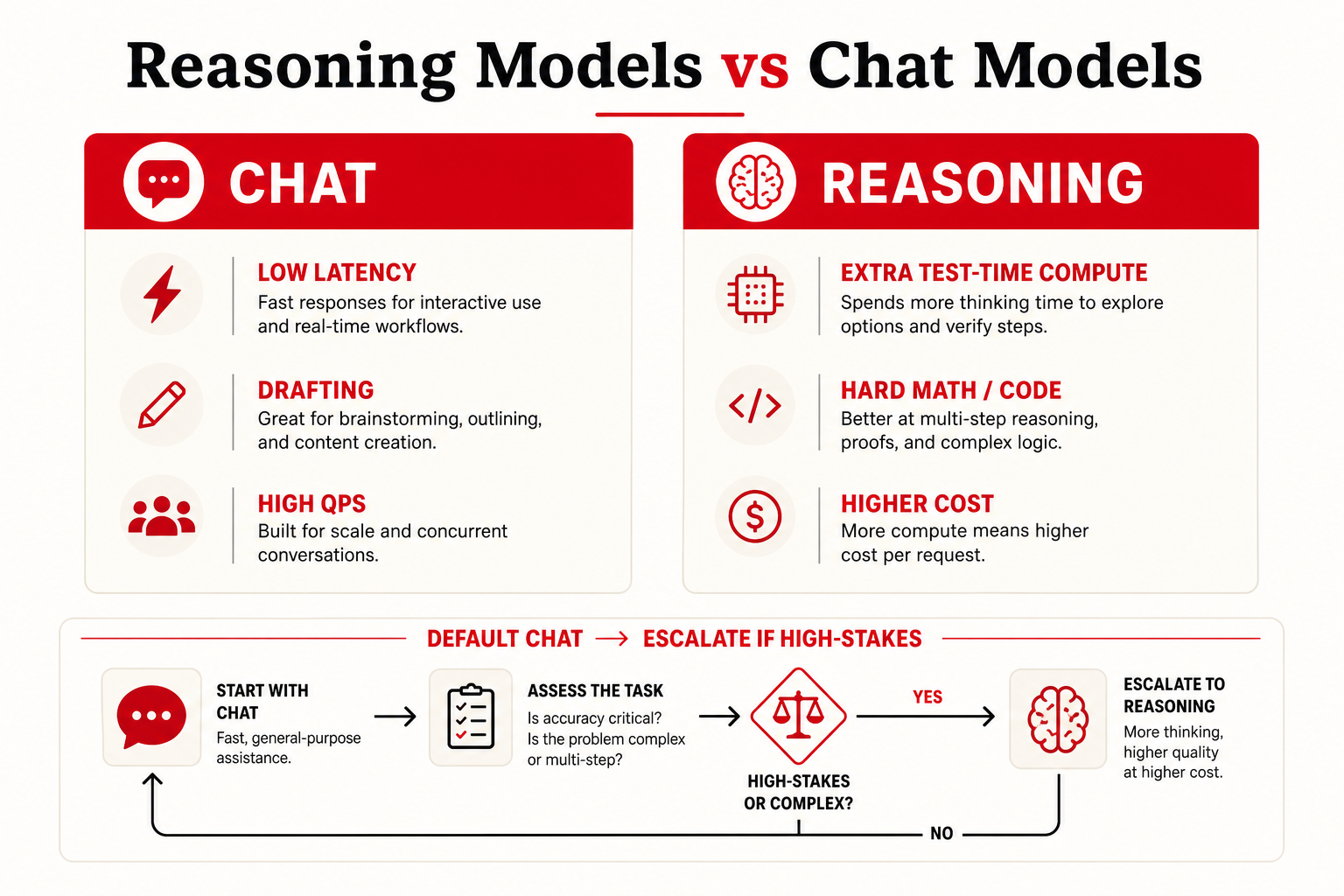
Chat models optimize fluent, low-latency answers on a single forward pass—ideal for drafting, Q&A, and high-QPS interfaces. Reasoning models allocate extra inference compute (longer internal chains, self-critique, search, or sampling) to improve hard math, code planning, and multi-step analysis. In 2026, the compare is not “smart vs dumb”; it is where compute is spent and which SLAs you can afford. Default to chat for interactive UX; escalate to reasoning for high-stakes or offline tasks—or use hybrid routing with logged budgets.
Key takeaways
- Reasoning models trade latency and $/token for pass rates on difficult probes—not for every user message.
- Expose reasoning depth as a product knob: chat by default, reasoning on opt-in or failure.
- Evals must record scaffold (tools, retries, thinking budget) and model version—see leaderboard guide.
- Open-weight R1-class models enable self-hosted reasoning with VRAM planning (local checklist).
- Agent stacks often combine both: fast router model + deep worker model (agent map).
Who should read this compare
Read this if you are choosing default models for a product, designing API routing, or interpreting release notes that mention “thinking,” “reasoning,” or “o-series.” Skip if you only need general stack literacy—start with the model stack pillar.
This article is cluster A2. It pairs with scaling laws (training vs inference-time scale) and open vs closed frontier (access modes).
Definitions without marketing blur
Chat models
A chat model in 2026 is a post-trained instruction-tuned LLM served for conversational turns. Training includes SFT and preference optimization; serving is typically one forward pass per user-visible step unless your app adds tools. Examples in public documentation include standard GPT-4 class chat endpoints, Claude Sonnet chat modes, Gemini conversational APIs, and open instruct checkpoints (Llama-Instruct, Qwen-Instruct, Mistral-Instruct).
Chat models excel when users need quick iteration, tone control, and moderate reasoning on familiar patterns. They fail loudly when tasks require deep search, long derivations, or careful verification—unless you add external tools and loops (agent territory).
Reasoning models
A reasoning model is a product category that spends additional test-time compute before or while producing the final answer. Mechanisms described in public materials include extended chain-of-thought, self-consistency sampling, verifier models, tree search, and explicit “thinking” tokens billed separately on some APIs.
Vendor naming shifts frequently—OpenAI o-series, DeepSeek-R1 narratives, Gemini thinking modes, and community distillates. Treat names as moving targets; anchor evaluations on checkpoint strings, thinking budgets, and dates.
Comparison table for builders
| Dimension | Chat model | Reasoning model |
|---|---|---|
| Typical latency | Low–medium | Medium–high |
| Cost at similar context | Lower $/1M tokens (typical) | Higher (more internal tokens/compute) |
| Best tasks | Drafting, RAG QA, support chat | Math, proofs, multi-step code plans, audit |
| UX fit | Streaming chat, mobile, voice | Batch jobs, analyst tools, CI gates |
| Failure mode | Confident hallucination on hard tasks | Timeouts, cost blowouts, overthinking |
| Ops complexity | Standard rate limits | Budget caps, fallbacks, escalation rules |
When to route to reasoning
Use reasoning paths when errors are expensive relative to latency:
- Financial modeling and spreadsheet logic with audit trails.
- Codegen plans that must pass CI before merge.
- Security review and threat modeling drafts (human verified).
- Scientific derivations and formal logic checks.
- Complex policy interpretation with citation requirements (vertical RAG often pairs here).
Stay on chat when speed, voice, and cost dominate: brainstorming, rewriting, retrieval-grounded FAQ, and most consumer mobile flows.
Hybrid routing pattern
Production pattern emerging across desks:
- Default chat model handles the turn.
- Classifier or heuristic detects “hard” tasks (length, keywords, user tier, prior failure).
- Escalate to reasoning endpoint with explicit user consent or silent retry on failure.
- Log route, tokens, latency, and outcome for quarterly eval review.
Document the router in observability stacks—tie to agent failure modes when loops multiply calls.
Training and stack placement
Reasoning behavior is not magic—it is post-training plus inference policy sitting on a capable base (model stack). Some gains come from RL on verifiable rewards (math, code execution); some from inference procedures not fully disclosed in open weights.
Implication: a “reasoning” label on a release note means re-run your JSON, tool, refusal, and long-context tests—even if public math scores jumped.
Open-weight reasoning angle
DeepSeek-R1, Qwen reasoning variants, and community distillates let teams self-host reasoning-class behavior—subject to license, VRAM, and serving maturity. Self-host shifts spend from API list price to GPU lease and engineer time (self-host vs API TCO).
Closed APIs often lead on integrated tool + computer-use UX and managed safety filters. Open weights lead on inspectability and air-gapped deploys—see open vs closed for portfolio thinking, not ideology.
Serving considerations
- Reasoning traces inflate KV cache and output tokens—plan headroom on target GPUs.
- Quantization may hurt chain quality before it hurts chat tone—regression-test both.
- Speculative decoding compatibility varies—quantization guide.
Eval pitfalls specific to reasoning
Public math and code scores often include undisclosed tool use, majority voting, or undisclosed thinking budgets. Before citing:
- Copy model name + version string.
- Note thinking budget or reasoning mode if exposed.
- Record benchmark track and harness version (SWE-bench, GPQA, etc.).
- Add date and primary source URL.
Cross-read benchmark explainer and contamination brief. Reasoning models are not immune to eval gaming—harder probes can still leak into training mixes over time.
Cost modeling without fake precision
API pricing changes frequently; methodology matters more than snapshot numbers. Build scenarios:
- Input tokens: system + RAG + user + prior tool outputs.
- Output tokens: user-visible answer plus hidden reasoning tokens where billed.
- Retry multiplier: agent loops that re-invoke reasoning on failure.
- Concurrency: p95 latency under load vs demo latency.
Compare chat-only and reasoning-heavy journeys side by side in a spreadsheet—then stress with p95 context, not mean demo prompts. Link macro trends to inference economy.
Product UX patterns
Good patterns
- “Deep analysis” button with time and cost estimate.
- Progress UI for long reasoning jobs (async email/Slack delivery).
- Automatic downgrade to chat on timeout with transparent message.
- Enterprise tier gating for reasoning endpoints.
Anti-patterns
- Routing all traffic to reasoning “because it scores higher.”
- Hiding reasoning latency in mobile chat without async mode.
- No logging of internal token use—finance surprises at month end.
- Assuming reasoning fixes bad RAG—fresh facts still need retrieval.
Agents and reasoning
Agents multiply model calls. A planner on reasoning plus workers on chat (or vice versa) can optimize cost—if orchestration is observable. Multi-agent patterns (orchestration guide) should name which roles require reasoning depth and which need speed.
Coding agents (tool compare) blur the line: IDE copilots feel like chat but may invoke heavy models on background tasks. Treat background jobs as reasoning-tier for budgeting.
Who this is for
- Product and engineering leads defining default models and escalation rules.
- FinOps and platform teams forecasting token spend under mixed routing.
- ML engineers evaluating open-weight reasoning checkpoints for self-host.
- Procurement comparing vendor claims with task-specific private evals.
Who should skip
- Teams with only single-turn FAQ bots and no hard reasoning tasks—chat plus RAG may suffice.
- Readers wanting a single “best reasoning model” ranking—use private harnesses instead.
- Anyone needing legal/medical definitive advice—reasoning models are not licensed professionals.
Common mistakes
| Mistake | Why it hurts | Better move |
|---|---|---|
| Reasoning on every message | Cost and latency explode | Route on task class |
| No fallback path | Timeouts ruin UX | Chat downgrade + retry policy |
| Citing public scores without scaffold | Procurement misfires | Citation template from leaderboard guide |
| Ignoring RAG freshness | “Deep” wrong answers | Retrieve first, reason second |
FAQ
Should I disable reasoning to save money?
Yes for default UX; keep an escalation path for high-stakes tasks and log when it triggers.
Do reasoning models fix hallucinations?
They reduce some error types on structured tasks but can still confabulate; grounding with RAG and human review remains necessary.
Are open reasoning models production-ready?
Some are—for teams that can serve them and maintain evals. Maturity varies by model string and serving stack; run your harness before committing.
How do reasoning models relate to scaling laws?
They shift scale from training FLOPs to inference tokens—see diminishing returns for the broader picture.
What should we log?
Route decision, model ID, thinking budget if any, input/output tokens, latency, task outcome, and human override flag.
Sources
- OpenAI model documentation — reasoning product descriptions (verify current names).
- arXiv — public reasoning and RLVR papers (cite specific papers when making training claims).
- DeepSeek on Hugging Face — open-weight reasoning artifacts and cards.
What we did not test: We did not run paired latency benchmarks across all vendors on identical hardware for this article.
Corrections: When vendors rename reasoning modes or change token accounting, update the comparison table and cost section first.
Next step
Map access and deployment tradeoffs: open-weight vs closed frontier. If you self-host, continue to quantization and speculative decoding before load testing reasoning traces.