Quick answer
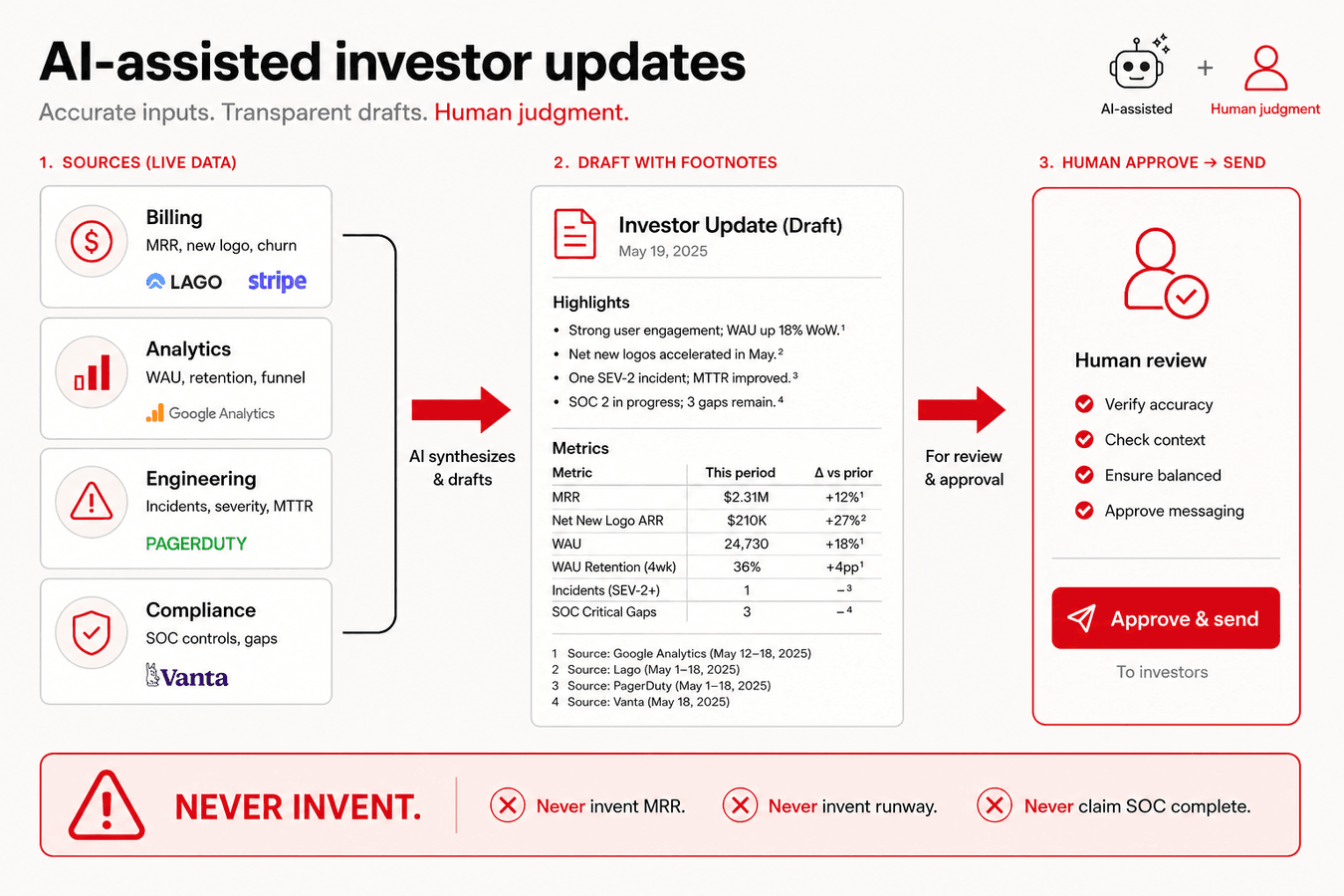
AI-assisted investor updates should pull live metrics from billing (Lago / Stripe), product analytics (PostHog WAU/retention), engineering risk (open incidents), and compliance status (SOC gaps)—then draft narrative sections for humans to edit. Never let the model invent MRR, runway, or “SOC complete.” Cite sources like footnotes. Monthly cadence beats quarterly surprise emails. CorpIM demo: Compliance → IR Kit; Copilot prompt “Draft investor update from live metrics”—then you approve send. Open CorpIM and verify every number before the message leaves your outbox.
Key takeaways
- Standard sections: highlights, metrics, product, GTM, team, ask, risks—each tied to systems of record.
- Copilot value is drafting + citation, not autonomous investor email.
- Data room numbers and update numbers must match; treat mismatch as a trust incident.
- Monthly rhythm plugs into the company calendar—see weekly operating rhythm.
- Disclose AI COGS sensitivity, incidents, and SOC status early; silence ages badly in diligence.
Who this is for
- Seed–Series A founders sending monthly updates to angels and VCs.
- CFOs or ops leads building data rooms that must match investor emails.
- Teams using an ops Startup Copilot—not unsupervised bots emailing LPs.
- AI SaaS companies whose metrics include inference cost, adoption funnels, and enterprise security status.
- Founders wiring IR into an AI-native Startup OS Compliance loop.
Who should skip
- Bootstrapped companies with no outside investors—run internal metrics reviews; skip investor mail merge.
- Public companies with mandated securities filings—this is private-company IR craft, not listed-equity IR.
- Teams without billing/analytics connectors—fix data plumbing before AI drafting.
- Anyone seeking guaranteed fundraising outcomes or valuation advice—out of scope.
- Readers who only need SOC control maps—see SOC 2 checklist for AI SaaS.
What “AI-assisted” must mean here
AI-assisted IR is not “ChatGPT, write a bullish update.” It is a constrained pipeline:
- Connectors read systems of record.
- The draft shows metrics with source tags and as-of timestamps.
- A human edits narrative, ask, and risk language.
- A human sends; the archive matches the data room.
If step 1 is missing, the model will invent. If step 3 is missing, you will ship tone-deaf or material misstatements. If step 4 is missing, diligence will catch you later at higher cost.
This is internal ops copilot territory—see copilot vs chatbot for startups. It is not an investor-facing chatbot and not a substitute for counsel on material disclosures.
Prerequisites (do these before prompting)
- Billing truth: MRR/ARR definitions documented (gross vs net, what counts as churn).
- Analytics truth: WAU/active account definitions stable week to week.
- Cash truth: Burn and runway from bank/accounting export—not LLM estimates.
- Risk inputs: Open P0/P1 incidents, known SOC gaps, major vendor dependencies.
- Cap table hygiene: SAFE/priced round status consistent with what you will say in the update.
Without shared customer IDs across billing and support, churn narrative will fight itself. OS wiring patterns: AI-native Startup OS.
Metrics block — source of truth table
| Metric | Typical source | Do not | AI assist role |
|---|---|---|---|
| MRR / ARR, net new MRR | Lago, Stripe, finance system | Round from pitch deck memory | Format table; never invent |
| Cash runway, burn | Bank / accounting export | Let LLM “estimate runway” | Narrative around human-entered numbers |
| WAU, active teams | PostHog (or equivalent) | Count raw logins as “users” | Summarize trend with footnote |
| Logo churn / churn risk | Billing + CRM + support tags | Ignore bill-shock tickets | List at-risk accounts with sources |
| AI feature adoption | Product analytics funnel | Vanity “AI clicks” | Draft product section from funnel |
| Inference COGS / usage | Metering at edge | Hide margin sensitivity | Flag anomalies for human review |
| Incidents | Error tracker + postmortems | Hide outages during pilots | Summarize closed vs open |
| Compliance status | GRC tool | Claim “SOC done” without report | Quote control gaps with dates |
Usage metering context: bill AI API usage with open-source patterns. Adoption funnel detail: measure AI feature adoption.
Decision table: monthly vs quarterly vs event-driven
| Situation | Prefer | Avoid |
|---|---|---|
| Active seed round, engaged angels | Monthly short update | Silence until you need a favor |
| Investors explicitly prefer quarterly | Quarterly + interim note on material events | Over-emailing vanity metrics |
| Material incident, lawsuit threat, or runway shock | Event-driven note soon | Waiting for the next scheduled PDF |
| Fundraise in progress | Consistent metrics pack + IR archive | Different numbers in deck vs email |
| No connectors yet | Human-built table first month | AI draft from vibes |
Align the monthly slot with Friday metrics → monthly IR so the update is a byproduct of operations, not a separate heroic project.
AI assist workflow (how-to)
- Sync connectors — billing, analytics, GRC, cap table, incident tracker.
- Freeze definitions — as-of date, MRR rules, active-user rules for this send.
- Generate draft — IR Kit or Copilot with required source tags per metric sentence.
- Founder edit — highlights, ask, risks, tone; remove unsupported claims.
- Counsel check when disclosing material contracts, litigation, or sensitive forward-looking statements.
- Send via your normal channel; log recipients.
- Archive PDF/HTML in the data room folder that diligence will open later.
Reject any draft that states a number without a source tag. “Approximately” is still a claim—either cite or delete.
Section-by-section guidance
Highlights
Three bullets maximum. Outcomes, not effort. Tie to the north-star for your stage from the weekly rhythm. Bad: “We worked hard on the new model.” Better: “Enterprise pilot expanded to 3 teams; prompt-to-success on flag cohort improved vs prior week (PostHog).”
Metrics
Table with as-of date. Footnote each source. Include AI COGS or usage if it materially affects margin—investors will ask later anyway. Do not invent benchmarks against “industry averages.”
Product
Ships that change customer value. If AI-heavy, include adoption signal from adoption metrics, not feature launch screenshots alone.
GTM
Pipeline movement, win/loss themes, enterprise blockers (security questionnaire, SOC timeline). Honest blockers beat theater.
Team
Hires, open critical seats, key-person risks. Do not inflate headcount plans you cannot fund.
Ask
Specific intros, hiring help, customer intros, strategic advice. Vague “help with fundraising” is weaker than one named ask.
Risks
Open incidents, SOC gaps, vendor concentration, runway changes. Early disclosure builds trust; late discovery destroys it. SOC language patterns: SOC 2 checklist.
Sample metric footnote style (pattern)
Use a consistent citation shape so humans can verify quickly:
MRR $X as of 2026-09-01 (Stripe MRR dashboard export / Lago)WAU Y week ending 2026-08-31 (PostHog insight {id})Open P1 incidents: 1 (GlitchTip fingerprint {id}; postmortem draft)SOC 2: Type II observation started {month}; CC8.1 vendor reviews due {date} (Probo)
Copilot should emit this shape. Founders should click through before send.
Fundraise prep playbook (when IR becomes a data room)
When you enter active raise mode, IR is not only email—it is the living index of diligence:
- Update cap table status.
- Freeze a metrics snapshot with definitions.
- Refresh data room folders (financials, security, customers, product).
- Draft IR that matches the snapshot.
- Prepare Q&A for repeated diligence questions (security, AI data flows, retention).
CorpIM Guide demos a Fundraise prep playbook on later stages: cap table → metrics → data room → IR → diligence Q&A. Whether you use that demo or Notion, the sequence matters more than the brand.
Risks AI SaaS should disclose without drama
- Open SOC 2 gaps and Type I/II timeline honesty.
- Production incidents that affected enterprise pilots.
- Model vendor dependency and margin sensitivity if usage spikes—link metering work in usage billing.
- Key-person dependency and any material burn change.
- Customer concentration if a single logo drives most AI usage or revenue.
Tone: factual, owned, with next actions. Not apocalyptic, not euphemistic.
Prompting Copilot without inviting fiction
Bad prompt: “Write a compelling investor update that makes us look strong.”
Better prompt shape:
- Period and as-of date fixed.
- Required sections listed.
- Hard rule: every numeric claim needs a source tag or must be omitted.
- Hard rule: do not invent runway, pipeline $, or SOC status.
- Ask the model to list gaps where connectors returned empty.
Example intent (adapt to your tools): “Draft September investor update. Pull MRR from Lago/Stripe, WAU from PostHog, open P1s from error tracker, SOC gaps from GRC. Use footnotes. Leave Ask and Risks for founder voice. Abstain on missing fields.”
If the draft fills gaps with plausible numbers, delete them. Plausible fiction is worse than an explicit “metric unavailable this month.”
Data room alignment checklist
Before send, spot-check that the email will not contradict diligence folders:
- MRR/ARR matches the finance export you will upload.
- Customer logos mentioned match signed reality (no “verbal LOI” inflation).
- Security statements match the subprocessor list and SOC timeline in SOC 2 materials.
- Headcount matches payroll reality.
- AI product claims match adoption evidence, not demo video vibes—see adoption metrics.
Treat mismatch as a severity incident for trust. Fix the system of record, then the email—not the other way around.
Voice and length — what busy investors actually read
Desk synthesis favors short, scannable updates:
- Email body: roughly one screen plus a metrics table.
- Highlights: three bullets.
- Links to deeper docs only when needed (postmortem, security FAQ).
- No attached 40-slide deck every month unless investors asked for it.
AI drafting helps most on the metrics table and first prose pass. It helps least on the Ask (relationship-specific) and on judgment calls about what is material. Keep human time on those sections.
AI SaaS-specific metrics investors increasingly probe
Beyond classic SaaS MRR charts, expect questions on:
- Gross margin sensitivity to inference. What happens if usage doubles?
- Vendor concentration. One model API vs multi-provider routing.
- Reliability. Incidents during pilots; error budgets.
- Adoption. Do customers use the AI feature after week one?
- Trust. Data flows, retention, SOC timeline.
You do not need invented industry benchmarks to answer. You need your numbers, your definitions, and honest dependency notes. Metering depth: AI API usage billing. Reliability narrative feeds from engineering observability and RCA practice.
Worked example: down month done right
Situation: net new MRR flat; one enterprise pilot paused after an AI outage; WAU dipped on the exposed cohort.
Weak update: skip the month, or bury the outage under “platform improvements.”
Stronger update pattern:
- Metrics table with as-of dates and footnotes—flat MRR visible.
- Highlights: what still moved (e.g., self-serve expansion) without drowning the miss.
- Product: link outage to fix (rollback, monitor, canary)—not vague “learning.”
- Risks: pilot pause status, SOC or reliability follow-ups, runway unchanged or changed with math from finance export.
- Ask: specific help (intro to a reliability advisor, hiring) if real.
Investors can work with bad weeks. They cannot work with surprise contradictions in diligence.
Legal and fiduciary boundaries (plain language)
This desk does not practice law. Practical operating boundaries founders use:
- Do not let a model send mail.
- Do not fabricate traction, logos, or security attestations.
- Escalate to counsel for material contracts, disputes, or statements that could be read as formal offerings.
- Keep private customer data out of prompts that leave your controlled systems unless policy allows.
“AI-assisted” is an efficiency layer on truthful reporting—not a way to outsource fiduciary judgment.
Building the habit in 60 days
- Days 1–14: Define metrics glossary; connect billing + analytics read-only.
- Days 15–30: Produce one human-written update using the live table (no model yet).
- Days 31–45: Add Copilot draft with mandatory footnotes; compare to human version.
- Days 46–60: Archive to data room; add SOC/incident connectors; schedule monthly slot on the operating calendar.
Skip straight to autonomous drafting and you will debug trust problems instead of formatting problems.
Angel syndicates, lead VCs, and different audiences
One update body can serve multiple lists, but the Ask may differ:
- Lead VC: more detail on pipeline quality, hiring plans, and board-level risks.
- Angels: shorter highlights + clear asks for intros.
- Strategic investors: product roadmap alignment and partnership blockers.
Do not maintain three conflicting metric tables. Maintain one metrics block; vary narrative emphasis. AI can help fork tone; it must not fork numbers. When lists diverge, change the Ask paragraph only.
Cap table and SAFE notes in the same breath as metrics
Investor updates that celebrate traction while ignoring closed SAFEs, option pool changes, or side letters create diligence landmines. Minimum hygiene:
- Note closed financings in the period with counsel-approved language.
- Keep cap table tool exports current before fundraise IR.
- Do not ask Copilot to “summarize ownership percentages” from messy PDFs without human verification.
IR Kit demos that sit beside cap table views exist for this reason: metrics without capitalization context are half a story. Soft explore in CorpIM Compliance. If you lack a cap table tool, a counsel-maintained spreadsheet still beats an AI guess.
When not to use AI on the draft
Skip model assistance when:
- Connectors are down or numbers disagree across systems.
- You are disclosing sensitive legal matters still in flux.
- The update is a crisis note that needs founder voice first, formatting second.
- You cannot spare ten minutes to verify footnotes—then write a shorter human note instead of an unverified long draft.
AI is optional. Truthfulness is not. A late honest note beats an on-time update that invents precision.
Template skeleton you can paste into IR Kit
- Subject: {Company} — {Month} update
- Highlights (3)
- Metrics table + as-of + footnotes
- Product
- GTM
- Team
- Ask
- Risks
- Appendix links (optional): postmortem, security FAQ, hiring roles
Keep the skeleton stable so investors learn your format. Stability also makes Copilot safer: fewer layout hallucinations, more energy on citations. Change the skeleton deliberately when your stage changes—not every time a new tool appears in the stack.
Relationship to weekly founder notes
Internal Friday notes can be franker than investor email. Do not paste internal blame language into IR. Do reuse the same metric footnotes. The translation layer—founder edit—is where tone shifts and materiality judgments happen. That is also why unsupervised send is unacceptable.
Operating system context: AI-native Startup OS. Copilot scope boundaries: copilot vs chatbot.
Board decks versus monthly email
Monthly email is not a substitute for board materials, and board slides should not invent a second metrics universe. Practical split:
- Monthly email: continuity, risks, asks, lightweight metrics.
- Board pack: deeper narrative, strategy options, hiring plan, scenario runway.
Feed both from the same exports. If Copilot drafts board prose, apply the same footnote rules—and expect heavier founder rewrite. Never let slide design pressure create rounder numbers than the email archive. When in doubt, the archived monthly email is the continuity record investors will quote later.
Handling conflicting connector numbers
When Stripe MRR and Lago disagree, stop drafting. Reconciliation order:
- Confirm period boundaries and timezone.
- Confirm definition (gross vs net, trial inclusion, refunds).
- Pick a system of record for IR; document the choice in the glossary.
- File an eng/ops todo to fix the join—do not paper over it with “approx.”
Sending through conflict teaches investors that your metrics are decorative. Fixing the conflict is company work; AI cannot average two truths into one. Until reconciled, ship a shorter update that marks the contested metric as unavailable rather than guessing.
Common IR mistakes table
| Mistake | Why it backfires | Fix |
|---|---|---|
| MRR from memory | Stripe/Lago export mismatch in data room | Live pull + as-of date |
| AI draft without source tags | Cannot verify before send | Cite-or-abstain rule |
| Hide incident during pilot | Customer tells investor first | Risks section with status |
| Quarterly-only with no material notes | Surprises compound | Monthly or event-driven notes |
| No risks section | Reads naive or evasive | Always include risks |
| “SOC complete” without report | Diligence credibility hit | Accurate status + timeline |
| Vanity AI metrics only | Investors discount the pack | Adoption + revenue + reliability |
| Autonomous send by bot | Fiduciary and relationship risk | Human approve every send |
Friday → monthly: making IR cheap
If Friday top-3 notes already cite live metrics, monthly IR is assembly—not archaeology. Operating calendar: AI startup weekly operating rhythm. If every month starts from zero, fix the weekly rhythm before buying another IR template.
CorpIM demo path
- Compliance — Open Investor relations / IR Kit; inspect draft readiness and metric sources.
- Startup Copilot — Run “Draft {month} investor update from live metrics”; verify footnotes.
- Guide — On enterprise-ready stage, open Fundraise prep and confirm data room checklist owners.
Live demo: https://www.romewayai.com/corp-im/. Soft next step: generate one draft against your real connectors, delete any uncited number, then send only after founder edit. If connectors are incomplete, finish plumbing before the next scheduled send.
Failure modes when AI drafts IR
AI-assisted updates go wrong in ways that look polished. Watch for these before you hit send:
- Stale connector snapshot. Copilot cites “MRR $X” from a cache older than your as-of date. Always re-pull or show connector timestamp next to every money number.
- Silent unit confusion. Mixing ARR and MRR, or seats and MAU, in adjacent sentences. Force one unit per metric row in the source table before drafting.
- Risk section optimism bias. Models trained on upbeat corpora bury incidents. Require a non-empty Risks bullet; if none, write “No material incidents this period” deliberately—not by omission.
- Compliance hallucination. “SOC 2 Type II complete” when Probo-class status is “controls in progress.” Cite the GRC object or delete the claim.
- Audience bleed. Language meant for a lead VC lands in an angel syndicate email with different NDAs. Separate templates; do not BCC blindly from one draft.
Decision rule: if any number lacks a footnote to a live system, cut it. Speed of drafting never beats a diligence mismatch later. Keep the habit cheap by assembling from Friday notes in your weekly operating rhythm, then soft-check the IR Kit path in CorpIM Compliance.
What we did not test
This article is desk synthesis. We did not measure open rates, fundraising success, or claim that AI drafting raises valuation. Tool names (Lago, Stripe, PostHog, Probo-class GRC) are illustrative systems of record. Nothing here is financial, legal, or investment advice. If your counsel or lead investor specifies a disclosure format, that format wins over this template.
FAQ
Can Copilot email investors directly for AI-assisted investor updates?
No. Human founders approve every send. Copilot drafts and cites; you own material disclosures and relationships.
Monthly vs quarterly investor updates?
Monthly is common for active seed rounds. Quarterly minimum if investors prefer it—still send event-driven notes for material incidents or runway shocks. Align with the monthly IR slot in your operating calendar.
What if metrics are down?
Report with context: cohort, incident, seasonality, pricing change, or AI cost spike. Investors forgive dips with honest narrative and a plan—not with omitted months.
How does IR connect to Startup OS?
IR is the Compliance loop output when billing, product, engineering, and GRC connectors feed one workspace—see AI-native Startup OS.
Should we include model eval scores in investor updates?
Only if they are real, dated, and relevant to customer value. Do not invent benches or paste leaderboard screenshots without methodology. Prefer adoption, revenue, reliability, and cost signals customers feel.
Continue the semantic path
Keep the machine running with weekly operating rhythm, deepen the OS with AI-native Startup OS, meter costs via AI API usage billing, and keep diligence honest with SOC 2 for AI SaaS.