Quick answer
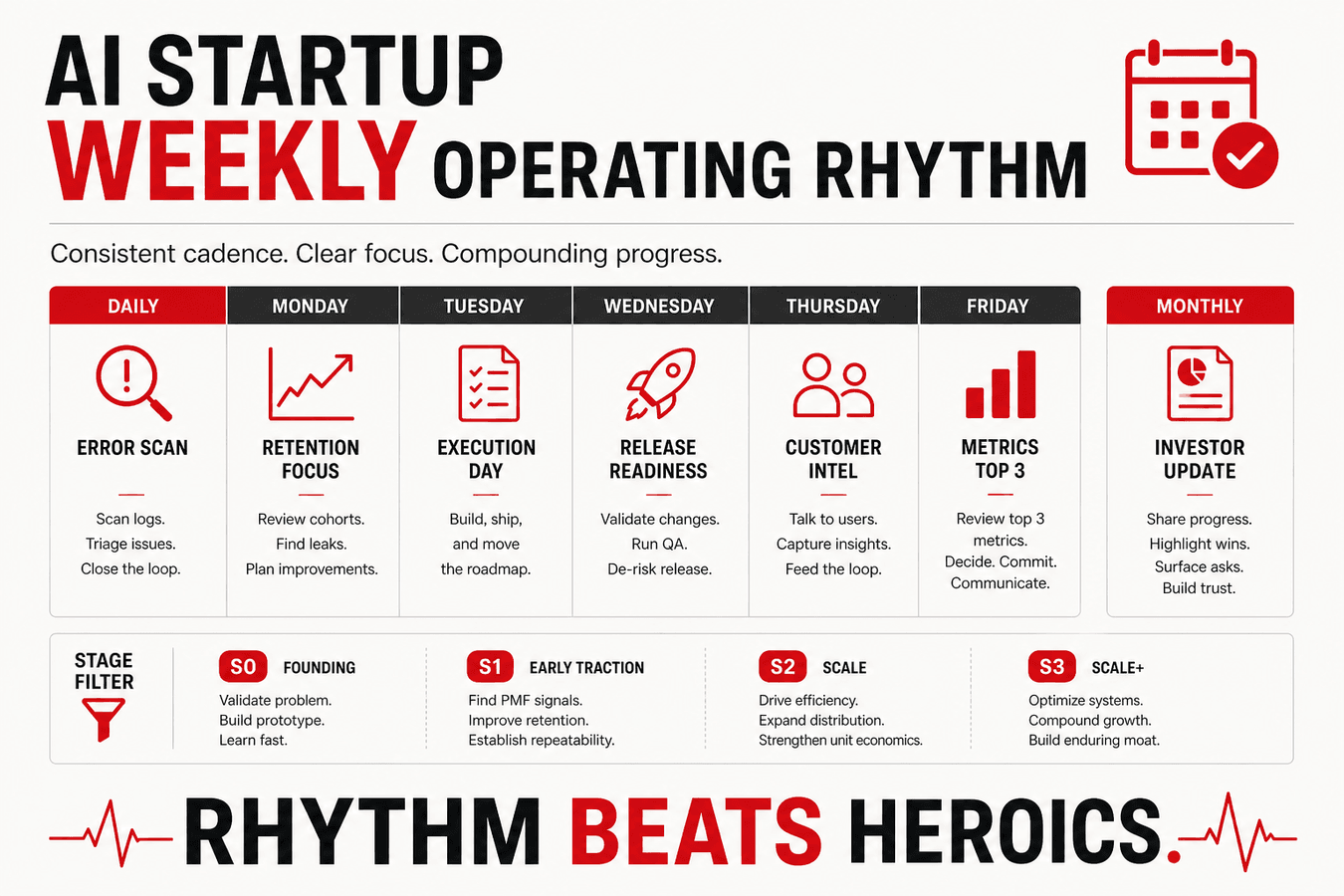
An AI startup weekly operating rhythm is a fixed cadence that turns fragmented SaaS signals into decisions: daily error and revenue-risk scans, Monday retention and feedback, Wednesday release readiness (flags, CI, security scans), Friday metrics and top-3 priorities, monthly investor updates from live numbers. Each slot has an owner, a tool surface, and a stage filter (S0–S3)—so pre-revenue teams do not run enterprise SOC drills, and Series A teams do not skip billing churn. Map the calendar to an AI-native Startup OS; try the stage-filtered Guide in CorpIM.
Key takeaways
- Rhythm beats heroics: the same questions every week beat ad-hoc “war rooms” that never become process.
- One north-star metric per stage beats ten dashboard tiles with no decision.
- Wednesday release gates prevent “CI red on main” Fridays and weekend model hotfixes.
- Friday Copilot drafts accelerate investor email only when metrics are cited from live systems—not invented.
- IM todos aggregate cross-loop blockers so product, eng, revenue, and compliance share one narrative.
Who this is for
- Founders and COOs at roughly 5–50 person AI SaaS teams who feel permanently reactive.
- First-time operators who inherited tool sprawl without a written cadence.
- CTOs who need release discipline that includes model/prompt changes, not only app deploys.
- RevOps or CS leads who need churn signals beside support queues on a predictable day.
- Teams adopting an AI-native Startup OS and needing rituals that match product, eng, revenue, and compliance loops.
Who should skip
- Solo founders with no customers yet—weekly retention review has no signal; keep a simple daily build note.
- Large enterprises with mandated PMO cadence—adapt the tables; do not replace governance theater with blog theater.
- Readers who only need SOC evidence collection—see SOC 2 checklist for AI SaaS.
- Teams mid-catastrophic incident—pause roadmap rhythm and run incident playbooks until stable.
- Anyone seeking a ranked “best calendar apps for startups” list—this is operating design, not software shopping.
Why AI SaaS needs a tighter rhythm than generic startups
AI products add variance that classic SaaS calendars ignore: inference cost spikes, model provider latency, prompt regressions, silent quality drops that do not throw 500s, and enterprise buyers who ask for security evidence while you are still fixing queue depth.
Without rhythm, founders become the ETL layer—copying PostHog into Notion, Stripe into investor email, GlitchTip into Slack, and SOC gaps into a forgotten folder. Agents and copilots cannot help if the company never looks at the same signals on a schedule. Rhythm is how an OS becomes operational instead of decorative.
Desk synthesis failure modes:
- Dashboard theater — beautiful tiles, no owners, no todos.
- Friday deploys — model/prompt changes land when on-call is thin.
- Retention myths — “users hate AI” without step-level funnel diagnosis.
- IR from memory — monthly update numbers disagree with the data room.
Prerequisites before the calendar works
- Shared customer IDs across billing, support, and analytics—or you will debate “which churn” forever.
- One north-star + two guardrails per stage written down (examples below).
- Error and deploy tags correlated enough to answer “what broke after ship?”
- Human owners for Monday / Wednesday / Friday slots—even if one person wears three hats.
- Cite-or-abstain rule for any Copilot draft used in Friday or monthly IR.
If those are missing, spend two weeks on plumbing before optimizing calendar aesthetics. Connector-first thinking matches Startup OS patterns.
Weekly calendar (owners and surfaces)
| When | Owner | Action | Primary signals | CorpIM surface |
|---|---|---|---|---|
| Daily | Engineering | Scan errors + CI; triage new HIGH; note model timeouts as app errors | Error fingerprints, deploy tags, queue depth | Studio → Engineering |
| Daily | Growth / CS | Leads + support queue; escalate billing surprises and churn risk | Failed payments, ticket tags, usage cliffs | Studio → Revenue |
| Monday | Product | Retention + top feedback; AI funnel steps if AI shipped | WAU/retention, prompt-to-success, feedback themes | Studio → Product |
| Wednesday | Eng lead | Release readiness: flags, canary, security scan, rollback owner | CI green, flag %, scan HIGH count | Guide → Release playbook |
| Friday | Founder | Metrics + next week top 3; IM summary; optional Copilot draft with citations | North-star, guardrails, open blockers | Guide + Copilot |
| Monthly | Founder | Investor update from live metrics | MRR, burn, risks, SOC status | Compliance → IR Kit |
| Quarterly | Ops / Legal | Vendor reviews, backup/incident drills, SOC gap review | Vendor register, evidence freshness | Compliance → SOC 2 |
Times are local to your team; the order matters more than the clock. Daily scans can be ten minutes. Wednesday can be a 30-minute gate. Friday should end with written top-3 todos, not a meeting that evaporates.
Stage filters (S0–S3) — decision table
| Stage | North-star example | Run | Skip or lighten |
|---|---|---|---|
| S0 Validate | Activation / interview learning quality | Daily builds, Monday feedback themes | Heavy SOC, NRR theater, formal IR automation |
| S1 First revenue | MRR / paying accounts | + billing churn scan, incident RCA, basic Friday metrics | Enterprise onboarding playbook weekly |
| S2 Repeatable sales | Pipeline quality + NRR / retention | + CRM rhythm, Wednesday release discipline, adoption funnels | Full data-room prep every week |
| S3 Enterprise-ready | ACV pipeline + audit readiness | + SOC gaps, quarterly vendor drills, monthly IR from live systems | Vanity traffic metrics as north-star |
Pick stage explicitly in CorpIM Guide (or your own doc). Running S3 rituals at S0 wastes calendar; skipping S1 billing checks while chasing logos burns runway.
How to run each slot (concrete)
Daily engineering scan (10–15 minutes)
Open errors first, not Slack. Group by fingerprint. Ask: new since last deploy? model timeout vs application bug? queue depth climbing? If HIGH and customer-facing, assign owner before standup ends. Model provider status pages are inputs, not excuses—customer-facing timeouts are still your incident.
Wire this to observability practice in open-source observability for LLM apps and RCA habits in production root cause.
Daily revenue / CS scan (10 minutes)
Failed payments, “bill shock” tickets, usage cliffs on trials, and enterprise pilot blockers. High trial inference without a card is a same-day todo, not a Friday footnote. Metering context lives in billing AI API usage.
Monday product: retention and feedback
Start from funnel steps, not vibes. If you shipped AI features, review prompt-to-success and D7 retention for exposed cohorts—see measure AI feature adoption. Pair with top feedback themes. Output: one diagnosis + one experiment or fix owner—not a slide deck.
Wednesday release gate
Checklist pattern:
- CI green on release candidate; security scans attached or exceptions logged.
- Feature flags and canary plan for model/prompt changes—see gradual rollout.
- Rollback owner named; monitors for error rate and key funnel step.
- No “just this once” Friday prod push for AI hotfixes without the same gate.
If the gate fails, slip the ship. Weekend incidents cost more than a Wednesday delay.
Friday founder script (15 minutes)
- Read north-star + guardrails for your stage.
- Review open top-3 todos; close or re-own stale ones.
- Ask Copilot only with connectors live: “What should we ship next week?” — require citations.
- If AI shipped this week, glance at adoption funnel health.
- Post a short IM summary with owners. That summary becomes monthly IR raw material.
Monthly investor update
Pull live metrics; do not retype from memory. Workflow detail: AI-assisted investor updates. Rhythm without IR still helps operations; IR without rhythm invents numbers under deadline pressure.
Quarterly compliance drill
Vendor reviews, backup/restore or incident tabletop, SOC gap owners. Checklist depth: SOC 2 checklist for AI SaaS. At S0–S1, keep this light; at S3, put it on the calendar like payroll.
Decision table: meeting vs async
| Slot | Prefer async | Prefer live meeting | Output that must exist |
|---|---|---|---|
| Daily scans | Default | Only if P0 incident | Owner on new HIGH / churn risk |
| Monday retention | Doc + comments if <8 people | When funnel broke or pricing changed | One diagnosis + next experiment |
| Wednesday gate | Checklist in PR/IM | When rollback risk is high | Ship / no-ship decision |
| Friday top-3 | Founder note in IM | When priorities conflict across loops | Written top 3 with owners |
| Monthly IR | Draft async; founder edits | Board meetings only | Sent update + archived PDF |
If every slot becomes a 45-minute meeting, you will abandon the rhythm. Protect calendar by defaulting to written outputs.
Tool mapping without lock-in
Illustrative open references—not a ranked stack:
- Product: PostHog-class analytics and flags; issue tracker of choice.
- Engineering: GlitchTip/Sentry-compatible errors; SigNoz/Grafana-class metrics; CI with security scans.
- Revenue: Lago/Stripe metering; Chatwoot-class support.
- Compliance: Probo-class GRC; IR templates.
The rhythm survives tool swaps. What must not swap weekly is owner accountability and the north-star definition.
Compressing for a 3-person team
Full calendar is a template, not a religion:
- Merge daily scans into one 15-minute “ops pulse.”
- Combine Monday + Wednesday into a single midweek “ops hour.”
- Keep Friday top-3 sacred—decision debt compounds faster than meeting debt.
- Drop quarterly vendor drills until S2 unless a questionnaire forces earlier.
Compression is allowed. Deleting outputs (no owners, no top-3) is not.
North-star and guardrails — write them once, read them weekly
A rhythm without a north-star becomes a meeting about feelings. Write one primary metric and two guardrails per stage, then force Friday review against that card—not against every tile in the BI tool.
- S0 example: north-star = qualified learning interviews or activated waitlist accounts; guardrails = build green on main, no unpaid inference burn runaway.
- S1 example: north-star = MRR or paying accounts; guardrails = logo churn, p95 AI latency or error budget.
- S2 example: north-star = NRR or expansion; guardrails = retention of AI-exposed cohorts, sales cycle length.
- S3 example: north-star = enterprise pipeline quality; guardrails = SOC evidence freshness, severity-1 incident count.
When two founders disagree on priority, the written card wins until you deliberately change it. Changing the card mid-quarter is allowed; pretending you never had one is how “urgent” work displaces company-critical work forever.
AI SaaS adds a third guardrail class most calendars omit: unit economics of inference. If trial tenants can burn a month of GPU budget in a weekend, Friday metrics without a usage check are incomplete. Metering patterns live in billing for AI API usage.
IM as the operating surface (not another meeting)
The weekly rhythm fails when outputs live in five docs nobody opens. Prefer a single IM spine:
- Daily HIGH errors and churn-risk cards land in named channels with owners.
- Wednesday ship / no-ship decision is a durable message, not a Zoom memory.
- Friday top-3 is pinned or threaded where the whole company can see owners.
- Approvals (flag rollback, refund, customer email) leave an audit trail.
That is the practical meaning of an AI-native Startup OS: events → IM → todos → write-back, with humans gating irreversible actions. If your “rhythm” requires everyone to open PostHog, Stripe, Sentry, and Notion before saying anything, you still have tool sprawl—you only renamed it “ops.”
Copilot prompts belong on top of that spine. “What should we ship?” without error, billing, and flag context invents a roadmap. Cite-or-abstain is a cultural rule: no citation, no priority claim.
Release discipline for models and prompts
Application deploys are not the only production changes. Prompt edits, router weights, retrieval configs, and model ID swaps change customer outcomes. Treat them as releases inside the Wednesday gate:
- Name the change with a version (
prompt_version,model_id, flag key). - Define the canary cohort and the monitor that would force rollback.
- Confirm observability carries the version into errors and product events—see LLM observability.
- Refuse “quick prompt tweak on Friday” unless the same gate passes.
Process depth: gradual rollout for models and prompts. The weekly calendar is how that process gets a standing appointment instead of a wiki page nobody follows during crunch.
Connecting product adoption to Monday
Monday retention reviews go wrong when the team argues about “AI quality” with no funnel. Minimum Monday pack for AI features:
- Exposure: who saw the flag or entry point?
- Attempt: who started a prompt / agent run?
- Success: who reached your product-defined success event?
- Return: D1/D7 for exposed cohorts vs control when you have one.
If attempt is high and success is low, you have a quality or UX problem. If exposure is low, you have distribution. If success is fine and return is poor, you have habit or value density problems. That vocabulary stops the vague “users hate AI” spiral. Method detail: measure AI feature adoption.
Compliance without drowning the calendar
SOC work should not replace product rhythm—but it must appear before enterprise diligence week. Practical insertion points:
- Wednesday: security scan attached to release evidence (CC7.x flavor).
- Friday: note open compliance blockers that affect enterprise pipeline.
- Monthly IR: honest SOC status, not silence.
- Quarterly: vendor reviews and gap owners—see SOC 2 checklist for AI SaaS.
At S0–S1, compliance is hygiene. At S3, it is a loop with the same dignity as revenue. Do not run a two-hour weekly “GRC standup” with empty evidence folders; run short checks tied to systems that already move.
Worked example: one compressed week (S1, 6 people)
Mon: Product lead posts funnel drop on AI “summarize ticket” success step; assigns one experiment owner.
Tue: Daily eng scan finds model timeout spike correlated with a Friday hotfix (anti-pattern caught late); opens incident thread.
Wed: Release gate blocks new prompt ship until timeout monitors and rollback owner exist; security scan attached.
Thu: CS flags two bill-shock tickets; RevOps links Lago usage cliff to the same tenants.
Fri: Founder top-3: (1) stabilize timeouts, (2) ship metering warning UX, (3) delay non-critical feature. Copilot draft cites GlitchTip + Lago; founder edits and posts to IM. Monthly IR later reuses the same citations.
Nothing fancy—just closed loops. That is the entire point of the calendar.
Remote and time-zone teams
Distributed AI startups break rhythm when “Monday” means three local Mondays. Pick a company-canonical timezone for the calendar labels, then allow async execution windows:
- Daily scans: any overlapping on-call hour; results posted before the next scan.
- Monday pack: written by product owner’s end-of-day; comments within 24 hours.
- Wednesday gate: must complete before the ship window opens in the primary eng region.
- Friday top-3: founder posts before weekend start in HQ timezone.
Do not multiply meetings to simulate presence. Multiply written outputs with owners. If a region never owns a slot, they are not in the operating system—they are spectators.
Hiring into the rhythm
New PMs, eng leads, and CS hires should inherit the calendar on week one—not invent parallel rituals. Onboarding checklist:
- Read stage card (north-star + guardrails).
- Shadow one daily scan and one Wednesday gate.
- Own a single recurring output within two weeks.
- Learn cite-or-abstain before using Copilot for priorities.
Culture is what happens every Wednesday when CI is red. Document that, or new hires will recreate Slack chaos. The calendar is a teaching tool as much as an execution tool.
What to do when the week is on fire
If you are mid-incident all week, pause roadmap rhythm. Run the incident playbook until stable, write the postmortem, then resume. Do not permanently live in firefighting mode and call it culture. After two consecutive “pause weeks,” schedule a Wednesday that only addresses reliability debt.
Incident depth: AI feature production root cause.
Anti-patterns / mistakes table
| Anti-pattern | Why it fails | Replace with |
|---|---|---|
| All-hands metrics with no decision | Dashboard theater | Top-3 todos + owners in IM |
| Friday prod / prompt deploy | Weekend incidents; thin on-call | Wednesday gate + canary |
| IR drafted from memory | Diligence mismatch | Live-metrics IR |
| Monday retention without funnel steps | “Users hate AI” narrative | Step-level adoption diagnosis |
| Skip security scan for AI hotfix | Enterprise deal and Type II risk | CI gate + exception log |
| Same calendar for every stage | S0 teams drown in NRR/SOC | S0–S3 filter table above |
| Copilot priorities without citations | Confident nonsense | Cite-or-abstain; connectors first |
90-day adoption sequence
- Days 1–14: Write stage, north-star, owners. Start daily eng + revenue scans only.
- Days 15–30: Add Wednesday release gate for any model/prompt change. Document rollback.
- Days 31–60: Add Monday funnel review and Friday top-3. Connect adoption metrics if AI features exist.
- Days 61–90: Add monthly IR from live systems; light quarterly compliance if selling upmarket.
Do not buy more dashboards in week one. Buy fewer surprises by week twelve.
CorpIM demo path
- Guide — Pick S1 or S2; open the weekly operating rhythm table; note which playbooks bind to Wednesday/Friday.
- Studio — Walk Product → Engineering → Revenue loops; confirm events can become todos.
- Startup Copilot — Ask for next week’s top priorities with citations; reject answers without sources.
Live demo: https://www.romewayai.com/corp-im/. Soft next step: run one real Friday top-3 in your IM using live metrics, then decide which connector gap blocked citations.
Decision depth: what to cut when the calendar collides
Real weeks collide: a SEV, a board ask, and a release window on the same Wednesday. Pre-decide cut order so founders do not invent process under stress:
- Never cut customer-visible SEV response. Daily eng/revenue risk scans stay; everything else yields.
- Defer Monday deep-dive, keep the metric snapshot. Paste funnel numbers async; reschedule narrative for next week.
- Compress Wednesday release, do not skip the gate. If you must ship, keep flag + rollback + one owner—drop the optional security theater if stage is S0/S1 and no enterprise clause forces it.
- Protect Friday top-3 length, cut attendees. Three priorities with owners beat a 45-minute meeting with none.
- Move monthly IR only with an explicit delay note to investors—silence is worse than “IR slips three days; numbers attached.”
Write this cut order once next to your stage filter. Soft-run the same prioritization against live objects in CorpIM Guide so Copilot suggestions cite blockers instead of inventing a calm week. Pair with gradual rollout so Wednesday never means “ship model at 100% because calendar said so.”
What we did not test
This article is desk synthesis. We did not time-motion study named startups, publish productivity lifts, or claim a universal calendar. Tool names are illustrative. Your cadence must fit on-call reality, customer time zones, and stage—not a screenshot of someone else’s Notion.
FAQ
How is an AI startup weekly operating rhythm different from OKRs?
OKRs set quarterly outcomes. Weekly rhythm is the execution cadence that connects daily signals to those outcomes. Rhythm without OKRs drifts; OKRs without rhythm stall. You need both.
Can a 3-person team run the full calendar?
Compress: daily pulse, one midweek ops hour, Friday top-3. Drop quarterly vendor drills until S2 unless a buyer forces earlier. Keep outputs; cut meetings.
Where does billing review fit?
Daily RevOps scan for failed payments; Monday join usage + churn with metering context from AI API usage billing. High trial usage without conversion is a same-day todo.
What if we are mid-incident all week?
Pause roadmap rhythm; run incident playbooks until stable; write the postmortem; resume. After repeated pause weeks, schedule reliability-only Wednesdays.
Should Copilot run the Friday meeting?
No. Copilot drafts options with citations. Humans set top-3 and own customer and fiduciary consequences. Unsupervised priority bots create confident fiction.
Continue the semantic path
Zoom out to AI-native Startup OS, keep numbers honest with AI-assisted investor updates, ship safely via gradual rollout, and measure whether AI features actually land with adoption metrics.