Quick answer
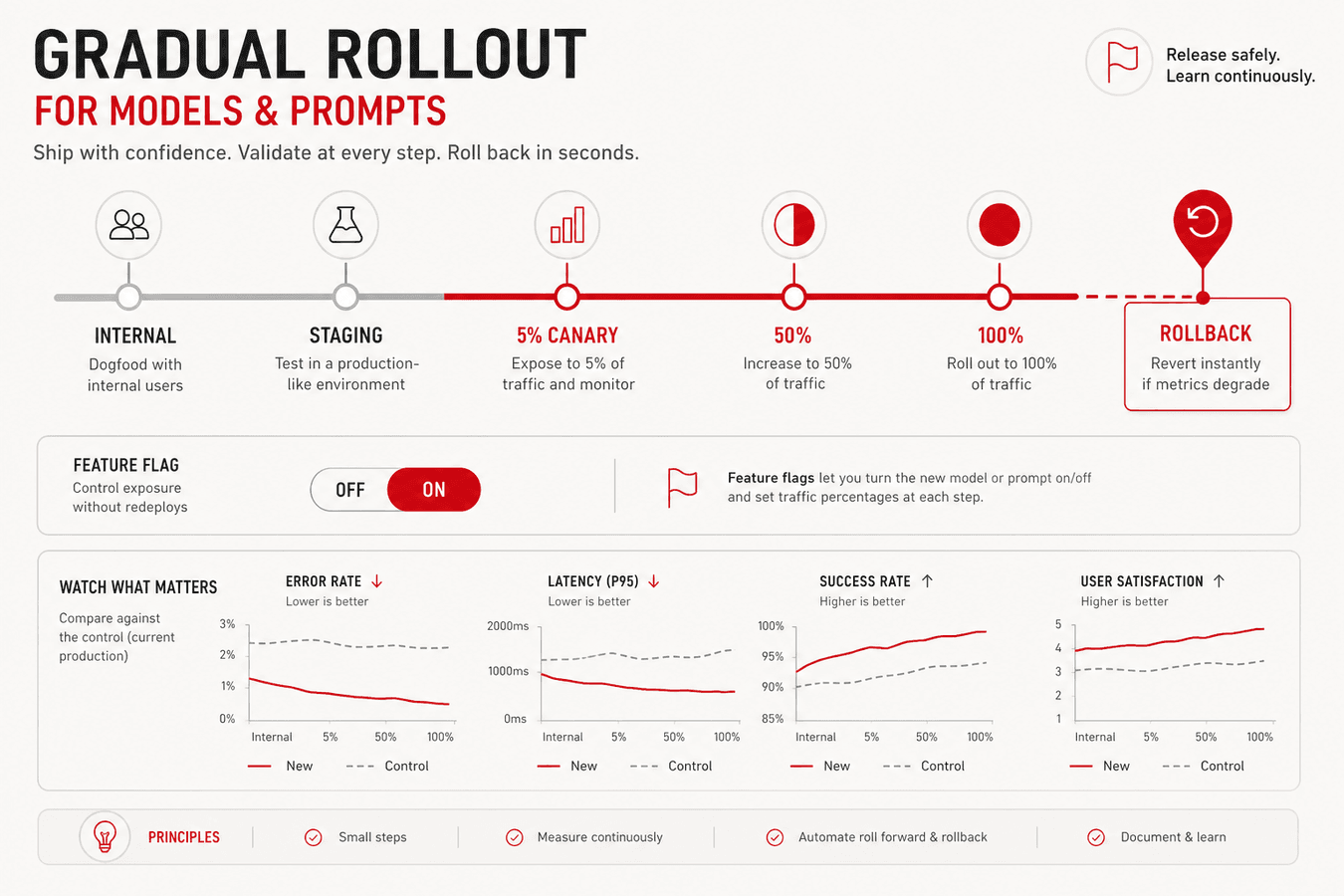
Gradual rollout for new models and prompts means: ship behind a feature flag, expose a small tenant cohort, watch error rate, latency, and success funnel against a control, then increase percentage—never flip 100% on Friday because a leaderboard moved. Pair Unleash-class (or PostHog) flags with GlitchTip-class errors and product analytics. Pin rollback to a previous model_id and prompt_version before you expand. CorpIM-style demo todos such as FLAG-API2 exist to rehearse “paid tenants only after CI is green,” not to invent a universal percentage schedule. Practice the release loop in CorpIM Studio.
Key takeaways
- Target flags by tenant + plan in B2B—not only random users—so one company does not see mixed models across seats.
- Define rollback pins before canary: previous model ID and prompt version.
- Wednesday release review checks flag %, open errors, and cohort success—not vibes.
- Security CI gates still apply to “AI hotfixes”; container HIGH findings block enterprise trust.
- Changelog and status readiness are part of rollout, not a postscript after 100%.
Who this is for
- Engineering leads shipping model swaps, prompt template changes, or new agent tools.
- Product teams measuring adoption during flag exposure—see AI feature adoption.
- Teams that have burned production with a “small prompt tweak” on Thursday evening.
- Compliance-minded founders who need change evidence when auditors ask how model updates ship.
Who should skip
- Single-tenant internal tools with no customer SLA and no support queue.
- Batch offline pipelines with no user-facing latency—use versioned backfills, not interactive flags.
- Pre-production prototypes with no metrics instrumentation—flags without signals are theater.
- Readers mid-outage—use the production RCA playbook first, then return here to re-enter safely.
Why models and prompts need a different rollout than CSS
A CSS tweak fails loudly in screenshots. A prompt tweak can fail politely: HTTP 200, fluent text, wrong business outcome. A model swap can change latency, cost, tool-calling behavior, and refusal patterns at once. Desk synthesis across AI SaaS release loops says the same thing repeatedly: treat model ID and prompt version as production dependencies with pins, canaries, and rollback drills—the same seriousness you give database migrations, with worse observability if you only watch uptime.
Gradual rollout is how you buy learning without buying outages. It is not slower shipping if your alternative is a weekend incident plus a trust scar. It is slower only compared to unmeasured hope. The goal is controlled discovery: each percentage step should teach you something you could not learn from staging alone.
Rollout ladder (decision table)
| Stage | Exposure | Gate to advance | Primary owner |
|---|---|---|---|
| 0 — Internal | Staff tenants only | Manual QA + eval set pass on golden tasks | Feature eng + PM |
| 1 — Staging / preview | PR preview envs | CI green + integration tests + security scan | Eng + CI |
| 2 — Canary | ~5% paid tenants (or design-partner set) | Error rate ≤ baseline; success funnel stable ~24h | On-call + PM |
| 3 — Expand | 25% → 50% | p95 within budget; support tags flat; cost per success acceptable | Eng lead |
| 4 — Full | 100% | ~48h clean metrics; changelog published; pins documented | Release owner |
Percentages are typical starting points, not laws. High-risk agent tools may linger at canary longer. Low-risk copy templates on internal notes may move faster. What you must not skip is a declared gate with a named metric.
What to change behind which flag
Isolation beats cleverness. Prefer separate flags (or variants) for:
- Model ID only — same prompt, new weights/provider route
- Prompt version only — same model, new template
- Tool / agent policy — new tool permission or planner
- Retrieval / index version — RAG corpus or embedding pipeline
Bundling model + prompt + tool policy into one “AI v2” flag creates un-debuggable regressions. If you must ship a bundle, still record sub-versions on every event so RCA can see which subchange landed.
Targeting rules for B2B
Random user percentages are a consumer-product habit that hurts multi-seat B2B:
- One tenant’s users get mixed models → inconsistent outputs → “your AI is random” tickets.
- Admins cannot evaluate a coherent pilot.
- Billing and support macros cannot describe who is affected.
Prefer tenant sticky assignment: a company is in or out of a variant. Further refine by plan (paid first), region, or voluntary opt-in for design partners. Sticky assignment also makes cohort analytics honest for adoption measurement.
Guardrails — pause before you increase
| Signal | Typical pause threshold | Action |
|---|---|---|
| Error rate | ~2× baseline for ~10 minutes on exposed cohort | Pause increase; consider rollback |
| p95 latency | ~+30% vs pre-rollout control | Check model size, region, queue; pause |
| Success funnel | ~−5% relative on exposed vs control | Treat as prompt/model regression |
| Support tag spike | Correlated with flag exposure | Pause; run RCA |
| Cost per success | Breaks plan margin assumptions | Pause; route or shrink context |
| Security scan | HIGH container finding on inference image | Block release until patched |
Thresholds are illustrative desk patterns—set numbers from your baseline and SLA, then write them in the release checklist so on-call does not invent policy at 1 a.m.
Without errors, traces, and funnels, gradual rollout is gradual blindness. Wire the planes described in open-source observability for LLM apps before you celebrate flag infrastructure.
Prerequisites checklist (before stage 2)
- Pinned rollback — previous
model_idandprompt_versionreachable without a code redeploy if possible. - Event properties — analytics and errors carry flag variant, model, prompt version, tenant, plan.
- Control cohort — enough traffic left on the prior variant to compare.
- Eval snapshot — golden tasks that already passed on the candidate in staging.
- Runbook link — Outline page: how to drop flag to 0%, who to page, status macro.
- CI green — integration tests for the feature path; security scan clean enough for your policy.
- Owner of the clock — named human who advances or pauses the percentage.
If any item is missing, stay on stage 0–1. Flags are easy to add; trust is not.
Release playbook integration (weekly rhythm)
Ship model/prompt changes on a predictable day. Many Startup OS teams use Wednesday release review inside the weekly operating rhythm: CI green → security scan → changelog draft → flag increase → 24h watch. Avoid Friday afternoon expansions unless you staff weekend on-call on purpose.
Monday product review should refuse further expansion if exposed-cohort success or D7 worsened. Wednesday should not override Monday’s adoption evidence with “but the new model feels smarter.”
CorpIM Guide playbook shape Release v0.x: engineering and product loops share the same release object—flag %, open errors, blockers summary. Copilot prompts like “Summarize blockers for release v0.2” only help when those objects are real.
Rollback checklist
- Pin previous
model_idandprompt_versionin config—do not “redeploy and hope.” - Set the new-model flag to 0% (or sticky tenants back to control); verify error rate and p95 normalize within a short window (often ~15 minutes if the issue was flag-scoped).
- Post a status update if customer-visible API or feature degraded.
- Log the change for SOC 2 change-management evidence: who, what, when, why.
- Write a short incident or near-miss note before re-attempting the rollout.
- Re-enter at a lower stage with a tighter gate; do not jump back to the percentage that failed.
Rollback drills in staging once per quarter beat discovering your pin path is broken during a SEV.
Prompts, models, and evals in the ladder
Eval sets are the offline twin of canaries. Before stage 2:
- Freeze a golden task set that mirrors production jobs-to-be-done (not public leaderboard clones alone).
- Score the candidate model/prompt on that set in staging.
- Record known failure modes (refusals, tool misses, format breaks).
During canary, sample production failures (redacted) back into the eval set. That closes the loop between rollout and quality without pretending MMLU is your product. Leaderboard improvement is a reason to start a ladder, not to skip it.
Agent tools and multi-step changes
When the change is a new tool or planner policy, add gates:
- Tool success rate and side-effect confirmation (not model text alone)
- Permission denials vs unexpected allows
- Max step count / loop detection metrics
Agent failures need the observability language in agent failure modes and the incident join patterns in production RCA. A tool that “answers” without writing the ticket is a soft production break—even if flags look healthy on HTTP errors.
Security and compliance during AI rollouts
“It’s just a prompt” is not a security argument. Inference workers still ship containers; prompt injection surface can change with new tools; logging may suddenly capture more sensitive context. Keep:
- Container/image scans in CI for worker images
- Secret scanning on config that holds provider keys
- Change tickets for production model pins when enterprise contracts require them
- Data-handling notes if the new prompt asks users for more PII
Auditors reviewing AI SaaS care that you can show controlled change—not that you moved fast on Twitter. Map evidence to the SOC 2 checklist.
Communication and changelog
Customer-facing model changes deserve a changelog entry when behavior or latency visibly shifts. Internal-only prompt fixes may not. Decide in the release review:
- What tenants will notice
- Whether support needs a macro
- Whether status page standby is required during expansion windows
Surprising users with a “smarter” model that breaks their macros is how you create adoption cliffs that look like mysterious churn in analytics.
Common rollout mistakes (failure table)
| Mistake | Why it hurts | Fix |
|---|---|---|
| Random user % on multi-seat B2B | Mixed models inside one tenant | Tenant-sticky targeting |
| No cohort compare | Cannot prove the flag caused a drop | Always keep a control slice |
| Prompt + model in one flag | Cannot isolate regression | Separate variants or sub-version props |
| 100% because leaderboard improved | Wrong optimization target | Ladder + your task eval + canary |
| Skip security scan for AI hotfix | CVE + trust failure | Same CI gates as other releases |
| No rollback pin | Rollback becomes a scramble | Pin before canary |
| Expand on Friday night | Empty on-call, slow response | Wednesday-style release window |
| Ignore soft success drops | Brand damage without red errors | Watch adoption funnel on exposed cohort |
| Flags without analytics properties | Blind canary | Require flag + model + prompt on events |
| Re-enter at failed percentage | Repeat the outage | Drop a stage after rollback |
Worked example (desk synthesis)
Team wants Model B for “draft reply.” Eval on golden tickets looks slightly better. They create flag draft_model_b, tenant-sticky, paid only. Stage 0 dogfood finds a formatting break in their CRM paste path—fixed in prompt v3 before any customer sees it. Staging CI passes; security scan clean. Canary 5% for 24h: errors flat, p95 +12% (under their +30% pause rule), success rate +1% vs control. Expand to 25%. Support tags a spike in “too verbose.” They pause, ship prompt v4 behind the same model flag (prompt-only variant), verify verbosity tickets fall, then continue to 50% and 100% with changelog note. Cost per success rises modestly; FinOps accepts it against plan allowances.
Contrast failure mode: same team ships model+prompt+new tool in one Friday 100% flip because a public arena score jumped. Monday is an RCA. The ladder exists to make the first story the default.
How rollout connects to the rest of Startup OS
- Adoption — exposed vs control success and D7 decide expansion (measure AI feature adoption).
- RCA — when gates trip, join errors, deploys, tickets (production RCA).
- Observability — without planes, flags are decorations (LLM observability).
- Rhythm — Monday metrics, Wednesday release (weekly operating rhythm).
- System — flags, Guide playbooks, and IM alerts as one loop (AI-native Startup OS).
Config architecture: pins you can actually roll back
Flags that only hide UI while the server hard-codes a model ID are fake gradual rollout. Design the serving path so runtime config chooses:
model_id(provider route + version string you control)prompt_version(immutable template ID, not “latest”)- optional
tool_policy_versionandretriever_version
Store pins in a config service or flag payload your workers read on each request (or cache briefly with a known TTL). Document cache TTL in the runbook—rolling back a flag while workers cache the old pin for thirty minutes creates a ghost incident. Prefer short TTLs during active expansions.
Never delete the previous prompt artifact when you publish a new one. Tombstoned templates break rollback. Keep at least N prior versions (pick N from your release cadence; many teams keep the last three production pins hot).
Sampling and statistics without fake precision
Canary decisions need enough traffic to be meaningful, but startups often lack arena-scale volume. Practical rules:
- If the 5% slice is tiny, extend time instead of jumping percentage.
- Prefer relative comparison to control over absolute “industry” thresholds.
- Do not claim statistical significance you did not compute; say “exposed cohort worse on success for 24h” and act.
- For low-traffic enterprise features, use design-partner tenants as the canary set and interview them on a schedule—still with a flag pin for instant exit.
Desk synthesis favors honest small-N process over theater dashboards with confidence intervals nobody trusts.
Cost and capacity gates
A model can pass quality and still fail the business. Add capacity checks to the expand stages:
- Token or step cost per successful outcome vs plan allowance
- Worker CPU/GPU saturation and queue age under the new variant
- Provider rate-limit headroom at projected 100% concurrency
If canary looks great on quality but queue age climbs linearly with exposure, pause and scale or shed before 50%. Gradual rollout is also a load test you are already paying for.
Multi-region and multi-provider notes
If you serve multiple regions, expand per region or prove the new route in the smallest region first. Provider latency and rate limits differ by geography; a US-only canary does not clear EU risk. If you fail over across providers, treat provider route as its own flag dimension—do not assume API-compatible models behave identically on tools and JSON schemas.
Changelog and support readiness template
Before stage 4, fill a short release note the support team can reuse:
- What changed (model/prompt/tool) in plain language
- Who is exposed now vs next
- Known differences customers might notice (verbosity, latency, format)
- How to opt out or report regressions
- Link to status page if a watch window is active
If you cannot write that note, you are not ready for 100%—you are hoping users will not notice.
Decision table: advance, pause, or roll back
| Observation on exposed vs control | Decision | Next step |
|---|---|---|
| Errors and p95 within budget; success ≥ control | Advance | Increase % per ladder; keep watch window |
| One metric soft-misses; others healthy | Pause | Investigate 4–24h; do not expand |
| Hard error spike or severe success drop | Roll back | Flag to pin; status if user-visible; RCA |
| Cost/capacity breach with good quality | Pause | Scale, route, or shrink context; then retest |
| Support narrative contradicts dashboards | Pause | Sample tickets; check soft failures |
CorpIM CTA
In CorpIM Studio, open Product → Flags and Engineering → security scan blockers. Run Guide playbook Release v0.x and ask the copilot to summarize release blockers only when the underlying objects are connected.
Open CorpIM → https://www.romewayai.com/corp-im/
Failure modes that look like “the model got worse”
Teams often blame the new model pin when the ladder is fine and the surrounding system changed. Treat these as first-class failure modes before you rewind intelligence:
- Retrieval drift under the same flag. Embedding index rebuilds, chunker changes, or a corrupted corpus can tank answer quality while the model version string is unchanged. Compare retrieval hit rates and empty-context rates on exposed vs control cohorts before you pin the previous LLM.
- Tool schema mismatch. A prompt that expects
search_docs(query)will “fail quality” if a deploy renamed the tool or tightened arguments. That is a code/flag coupling bug, not a model regression—roll the tool schema with the prompt, or gate both behind one composite flag. - Silent timeout → empty success. Gateways that map provider timeouts to HTTP 200 with empty body poison success funnels. Your rollout dashboard shows “healthy errors, collapsing success.” Fix the contract, then re-run the ladder stage; do not increase percentage to “get more signal.”
- Cohort contamination. Sticky assignment that expires mid-ramp mixes users across pins and invents fake A/B gaps. Audit assignment TTL and hash salt before you trust a pause decision.
- Eval suite vs production distribution. Offline evals that omit the top three customer intents will green-light a pin that burns enterprise accounts. When support narrative contradicts dashboards, sample production transcripts by intent—not by random 50—before advancing.
Decision rule: if exposed and control share the same model pin and diverge after an infra or retrieval change, stop the AI ladder and open a classical incident. Gradual rollout of models cannot compensate for a broken ground truth path. Tie the RCA to your production root-cause playbook so the team does not argue model taste during an outage.
Worked example: 5% → 25% with a soft quality miss
Scenario (desk synthesis, illustrative): you ship prompt v14 + model pin provider-B-fast behind a PostHog-class flag at 5% of paid tenants. After 48 hours, p95 latency is within budget, GlitchTip error rate is flat, but “task completed” success on the exposed cohort is ~4 points below control. Support has three tickets saying “answers feel shorter,” not “system down.”
Pause, do not expand. Pull twenty paired transcripts (exposed vs control) for the same intent. You find v14 cut the system prompt’s “cite source or say unknown” clause, so the model invents concise but ungrounded answers that pass a naive length check and fail a human “would I send this to a customer?” bar.
Actions in order: (1) keep percentage at 5% or drop to 0% if enterprise logos are in the exposed set; (2) restore the citation clause in v14.1 without changing the model pin; (3) re-run offline evals that score citation presence; (4) only then re-open 5% with a 24-hour watch window. Cost and capacity were fine—this was a prompt contract failure, not a GPU story.
Document the incident as “prompt contract regression under flag,” not “model B is bad.” That label keeps Wednesday release gates honest and prevents a cargo-cult ban on the provider. Soft explore the same release blockers pattern in CorpIM Product → Flags when you want the operating surface next to Engineering scans.
FAQ
Feature flags vs blue/green deploy?
Blue/green swaps app binaries; flags swap model/prompt logic inside a running app. AI products often need both: deploy code safely, then ramp model exposure independently so you can roll back intelligence without rolling back the whole binary.
PostHog flags vs Unleash?
PostHog ties flags to product analytics cohorts—strong for adoption measurement. Unleash-class tools excel at runtime flag delivery in services. Many teams use one integrated stack or both; pick based on where your exposure decisions and analytics already live.
How long between 5% and 50%?
Often at least ~24h of clean metrics at each meaningful step for customer-facing API or copilot changes. Move faster only for internal tenants or clearly non-critical surfaces—and write that exception down.
Do we need observability before rollout?
Yes. Without errors, traces, and funnels, gradual rollout is gradual blindness.
What if evals pass but canary fails?
Trust the canary. Production distribution differs from golden sets. Rollback, sample failures into evals, and fix before re-entering the ladder.
Continue the semantic path
Measure what the canary teaches with AI feature adoption. When a stage fails loudly, use production RCA. For the operating system that holds flags, reviews, and alerts together, read AI-native Startup OS.
Measure adoption · Production RCA · Weekly rhythm · LLM observability · SOC 2 checklist · Startup OS