Quick answer
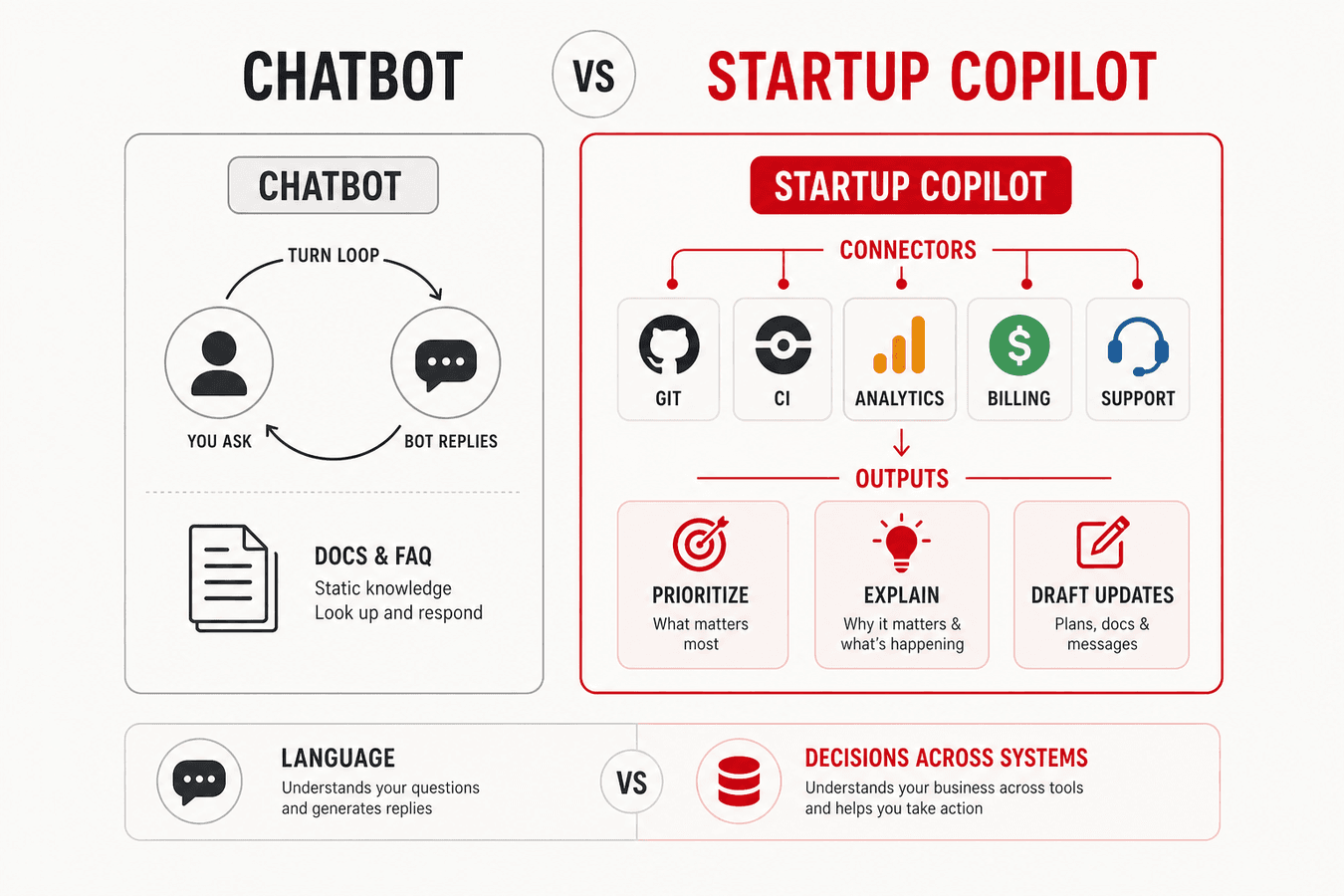
A chatbot answers questions in a turn loop—great for docs and FAQs. A startup copilot is an ops agent with connectors to Git, CI, product analytics, billing, and support so it can prioritize work, explain incidents, and draft investor updates from live metrics. If your AI product already has inference costs and enterprise buyers, you need copilot-class context engineering on the business stack, not another browser tab. Try cross-system prompts in the CorpIM Startup Copilot demo (Studio → Copilot tab).
Key takeaways
- Chatbots optimize language; copilots optimize decisions across systems.
- Without ACL-aware retrieval from tickets and repos, both will confidently invent facts.
- Dev Agent (code/CI) and Startup Copilot (company ops) are different products—do not merge blindly.
- Measure copilot value by time-to-RCA and release confidence, not “messages per day.”
- Ground on the same observability discipline as production agents: agent failure modes.
Who this is for
- Founders who ask cross-system questions weekly (“churn + errors + blockers”).
- Eng leads running incidents that span deploys, flags, and support tickets.
- RevOps syncing billing usage with support sentiment before renewals.
- Product leads deciding whether to ship a docs widget or an ops agent first.
- Security-minded builders who need ACL and audit expectations before buying “copilot” branding.
Who should skip
- Pre-launch sites with static docs only—deploy a docs chatbot first.
- Teams with no connector budget and no API access to Git or billing.
- Readers defining customer-facing product architecture—start with chatbot to agent map.
- Buyers hunting a ranked “top 10 copilots” list—this article compares architecture patterns, not vendor scores.
Definitions that prevent marketing confusion
Chatbot (ops sense): a conversational interface over a mostly static knowledge base or FAQ corpus. Success is deflection, CSAT, and answer latency. Writes—if any—are limited (open a ticket, link a URL).
Startup copilot (ops sense): an agent that retrieves and cites live operational systems—Git, CI, product analytics (for example via PostHog), metering (for example Lago), payments (for example Stripe API), support queues—and proposes actions with human approval. Success is faster correct decisions.
Marketing will call both “copilot.” Ignore the label. Ask: What systems does it read? What can it write? Who audits the trail?
Customer-facing product chatbots and agents are a related but separate decision tree. Use from chatbot to agent: practical map for product architecture; use this article for the company operating surface. The two share failure modes (prompt injection, stale context) but different blast radii.
Comparison table
| Dimension | Chatbot | Startup copilot |
|---|---|---|
| Primary user | Customer or internal FAQ | Founder, eng lead, RevOps |
| Data sources | Static KB, website crawl | Git, CI, PostHog, Lago, Chatwoot, GRC |
| Actions | Text only (or open ticket) | Draft + link todos; human approves writes |
| Failure mode | Wrong FAQ answer | Wrong ship priority or RCA |
| Build pattern | RAG on docs | Event bus + agent with tool/schema access |
| Success metric | Deflection rate, CSAT | Time-to-RCA, release gate pass rate |
| Typical build time | Days (KB + widget) | Weeks (connectors + ACL + audit log) |
| ACL complexity | Usually one corpus | Per-system scopes; least privilege |
| Observability need | Conversation logs | Tool-call traces + source citations |
When a chatbot is enough
- Pre-product waitlist site with a few dozen pages of content.
- Internal HR policy lookup with quarterly updates and no write paths.
- Developer docs assistant with read-only API scopes and no billing access.
- Customer support deflection where tickets never need Git or billing context.
- Status-page FAQ (“is X down?”) backed by a monitored status feed—not inventing outage causes.
Decision rule: if the correct answer never lives outside a document corpus (or a single trusted status feed), chatbot wins on cost and latency. Do not pay the connector tax for vanity “AI ops.”
Chatbots still need hygiene: crawl freshness, citation of source pages, refusal when the KB lacks an answer, and injection defenses on uploaded documents. Those are cheaper problems than wiring Stripe and Git with ACLs.
When you need a copilot
- Production 500s correlate with failed CI and angry support tickets.
- Founders manually stitch MRR, WAU, and burn for investor emails.
- Release managers cannot answer “blockers for v0.2” without five tabs.
- Enterprise prospects ask for SOC 2 status while engineering is mid-incident.
- RevOps sees usage spikes on trials with no payment method and no owned follow-up.
These are cross-system questions. They require the AI-native Startup OS shape: loops + event hub, not a chat widget bolted onto Notion.
If your weekly pain is “I already know the answer is in three tools, I just cannot assemble it,” you are in copilot territory. If your weekly pain is “customers ask the same ten FAQ questions,” stay with a chatbot.
Facet winners (tradeoffs, not trophies)
| Facet | Usually wins | Caveat |
|---|---|---|
| Time-to-first-value | Chatbot | Days vs weeks of connector work |
| Cross-system decisions | Copilot | Only with real connectors and citations |
| Customer deflection | Chatbot | Keep ops data out of customer bot scope |
| Incident RCA | Copilot | Needs deploy + error + ticket IDs |
| Compliance narrative | Copilot (draft) | Human owns accuracy; cite GRC sources |
| Cost predictability | Chatbot | Copilot token + tool-call cost is higher |
| Blast radius if wrong | Chatbot (usually lower) | Copilot wrong priority can waste a sprint |
There is no universal “winner.” There is a wrong purchase: a chatbot marketed as a startup copilot, or a copilot shipped without connectors.
Architecture sketch
Production copilot stack (desk synthesis pattern):
- Connectors — webhooks and scheduled sync from SaaS tools (Stripe, PostHog, GlitchTip-class tools, Lago, support).
- Event hub — normalize to chats, todos, and audit log with shared customer/release keys.
- Context assembly — retrieve by incident ID, customer ID, or release tag; attach as-of timestamps.
- Agent — plan → cite sources → suggest actions (human approves writes).
- Observability — log every tool call; treat missing citations as failures. See failure modes and observability and production RCA patterns in AI feature production root cause.
CorpIM demos this with mock connectors; production uses the same shape with real APIs. Chatbot architecture is thinner: corpus → embeddings/search → answer → optional ticket open. Do not pretend the thin stack is the thick stack by renaming the UI.
ACL and least privilege
A support chatbot should not read payroll. A startup copilot should not give every employee refund authority. Scope connectors per role:
- Eng lead: errors, deploys, flags, related tickets.
- RevOps: billing usage, support sentiment, churn-risk joins—not private HR notes.
- Founder: aggregate metrics for IR drafts with footnotes—see AI-assisted investor updates.
Enterprise buyers will ask how ACLs work. If your answer is “the model is careful,” you are not ready.
Cite-or-abstain
Require the agent to cite connector records (invoice ID, error fingerprint, PostHog insight URL, Lago subscription) or refuse. Free-form MRR is a trust-destroying failure mode. Chatbots that invent policy are bad; copilots that invent runway are dangerous.
Risks both share
| Risk | Chatbot | Copilot | Mitigation |
|---|---|---|---|
| Prompt injection | Via KB uploads | Via tickets, PRs, emails | Treat retrieved text as untrusted; strip instructions |
| Stale context | Old KB crawl | Metrics from last week | as-of timestamps; refresh connectors |
| Over-automation | Auto-reply to customers | Auto-merge, auto-refund | Human approval on all writes |
| Hallucinated numbers | Rare if KB-grounded | Common if no billing connector | Cite Lago/Stripe; never free-form MRR |
| Scope creep | Bot sees too much CRM | One agent for code + finance | Split products; least privilege |
Security reviews for AI SaaS should cover subprocessors and human review—start with practical AI safety for builders. Injection and tool abuse are not “advanced topics”; they appear as soon as you retrieve untrusted ticket text.
Failure modes unique to copilots
Desk synthesis highlights failures chatbots rarely hit:
- Priority inversion. Loud support volume outranks silent retention collapse because analytics never joined the hub.
- Partial connector truth. Billing is live but errors are stale → RCA blames the wrong layer.
- Action theater. Agent creates todos nobody owns; work looks “automated” while nothing ships.
- IR contamination. Investor draft mixes aspirational roadmap language with live metrics without labeling speculation.
Instrument these as product metrics: citation rate, connector freshness, todo completion rate after agent suggestions, and founder edit distance on IR drafts.
How to measure copilot ROI (not vanity)
- Time-to-RCA — minutes from alert to cited root cause (teams often target a large cut versus tab hopping; measure your baseline first).
- Friday metrics prep — founder minutes to draft weekly priorities with sources.
- Release gate confidence — Wednesday review passes without “surprise” Friday hotfixes.
- Investor update draft — first draft with footnotes to live systems, not slide fiction.
- Churn-risk follow-ups owned — trials over quota without cards become todos with owners, not Slack lore.
Do not optimize “messages per day.” A copilot that answers one RCA correctly per week may save more than a chatbot with thousands of deflected FAQs—different jobs, different units.
For customer-facing AI features, pair this with product adoption funnels in measure AI feature adoption (linked from the Startup OS cluster). Ops copilots and product AI share the need for outcome metrics over vanity chat counts.
Build vs buy vs assemble
| Path | Fits when | Watch outs |
|---|---|---|
| Chatbot SaaS / open widget | Docs/FAQ only | Do not feed it billing secrets |
| Generic LLM workspace (ChatGPT Enterprise-class) | Ad hoc personal questions | No persistent ops connectors or incident audit |
| Assemble OS + Copilot pattern | Cross-system weekly pain | Connector and ACL engineering cost |
| Coding agent only | Repo/CI productivity | Does not replace company ops copilot |
Soft CTA: if you want to feel the assemble pattern before wiring production APIs, open CorpIM and run the three prompts below against the demo connectors.
CorpIM demo: ask these three prompts
- “Root cause for OAuth 500 spike on production” — engineering + support linkage.
- “What should we ship this week?” — product + compliance + release blockers.
- “Draft September investor update from live metrics” — revenue + IR pattern.
Open CorpIM → Studio → Startup Copilot. Note whether answers cite sources. If a tool cannot show citations in a demo, assume production will invent.
Migration path: chatbot → copilot without a rewrite cult
- Keep the FAQ chatbot for customers; do not expand its data scope.
- Stand up shared IDs across billing, support, and errors.
- Emit events to an IM/todo hub with owners.
- Add read-only connectors for one high-pain question (usually RCA or churn risk).
- Enforce cite-or-abstain and human write gates.
- Only then expand to IR drafts and release-blocker summaries.
Skipping steps 2–4 and buying a “copilot” is how teams get eloquent nonsense.
Worked scenarios (decision practice)
Scenario A: Docs site with growing support load
You have a marketing site, API docs, and a support inbox. Customers ask the same setup questions. Engineering does not want another tool.
Pick chatbot. Ground it on docs, measure deflection and CSAT, refuse when docs lack an answer. Do not connect Stripe. Connecting payments to a public-facing bot expands blast radius for little gain.
Scenario B: Mid-incident founder questions
Every outage, the founder asks in chat: “Is this the OAuth deploy? Are enterprise customers hitting it? Did payments fail too?” Three people spend thirty minutes assembling tabs.
Pick copilot (read-only first). Connect errors, deploys, and support tags. Require citations. Human still owns customer comms. See production root cause for how product AI failures differ from classic HTTP outages.
Scenario C: Board pack every month
Founder copies MRR from Stripe, WAU from analytics, and burn from a spreadsheet into slides. Numbers disagree twice a quarter.
Pick copilot draft + human finalize once billing and analytics connectors are trusted. Pattern notes in AI-assisted investor updates. Until connectors exist, a chatbot summarizing last month’s Notion page will only amplify stale narrative.
Scenario D: “One AI for everything”
Leadership wants a single agent that codes, answers customers, refunds invoices, and updates investors.
Refuse the merge. Split customer chatbot, Dev Agent, and Startup Copilot. Shared model provider is fine; shared unbounded tools are not. Safety baselines: practical AI safety for builders.
Evaluation checklist before you buy or build
| Check | Chatbot project | Copilot project |
|---|---|---|
| Corpus freshness process exists | Required | Helpful for policy docs only |
| Shared tenant IDs across systems | Optional | Required |
| Cite-or-abstain enforced | Recommended | Required |
| Human write gate | If any writes | Required for all writes |
| Tool-call logging | Nice | Required |
| ACL per role | Basic | Least privilege per connector |
| Success metric defined | Deflection/CSAT | Time-to-RCA / owned follow-ups |
If a vendor demo cannot satisfy the copilot column, you are being sold a chatbot with better typography.
Cost and latency tradeoffs (qualitative)
Chatbots are usually cheaper per answer: retrieval over a static KB, short context, few or no tools. Copilots cost more because each useful answer may call multiple tools, assemble larger context, and keep audit logs. That cost is often still lower than founder hours—but only if answers are correct and cited.
Latency also differs. FAQ bots can answer in a second or two. Cross-system copilots may take longer while tools return. Set user expectations in the UI (“gathering deploy + error + ticket context”) instead of pretending it is a pure chat model.
Do not invent dollar benchmarks here. Meter your own token and tool-call costs after a pilot week and compare to the hours you previously spent assembling the same answers.
Observability: treat the copilot like production software
Log prompts (with redaction), tool names, tool arguments, tool results hashes, citations returned, and human approve/reject outcomes. Without that trail, you cannot debug wrong RCA or prove to an auditor that writes required approval.
Map failure classes explicitly—empty connector, stale as-of, injection attempt, missing citation, rejected write—as in agent failure modes and observability. A chatbot that fails usually shows a wrong FAQ; a copilot that fails can mis-prioritize a sprint.
Team roles and RACI (lightweight)
Small teams still need named owners or the copilot becomes everyone’s unfinished side project.
- Founder / COO: defines the three weekly questions the copilot must answer well; accepts or rejects IR drafts.
- Eng lead: owns connector freshness for Git/CI/errors; reviews RCA citations during incidents.
- RevOps / CS: owns billing and support joins; closes churn-risk todos.
- Security / ops (even if part-time): reviews ACL scopes, retention, and subprocessors when copilots touch customer data.
Publish a one-page RACI next to your Startup OS stage guide. Without it, demos look great and production ownership evaporates.
Anti-patterns in vendor evaluations
- Scoring demos on eloquence instead of citation rate.
- Allowing a single shared service account across Stripe, Git, and support “for ease.”
- Measuring success as “employees opened the chat 100 times” with no decision outcomes.
- Feeding production tickets into a model without injection hardening.
- Promising auto-refunds in the sales deck before write gates exist.
Bring the comparison table from this article to vendor calls. Ask them to map each row. Ambiguous answers are data.
Pilot plan (two weeks)
- Week 1: One read-only question (RCA or churn). Measure citation completeness and time-to-answer versus tab hopping.
- Week 2: Add todo creation with human approval. Measure todo completion rate and false suggestions rejected.
Kill or redesign if citation rate is poor or humans reject most suggestions. Expanding scope without those signals only scales nonsense. Keep the customer FAQ chatbot unchanged during the pilot so you do not confuse product support metrics with ops-copilot metrics.
Bottom-line decision rule
Choose a chatbot when the truth lives in documents. Choose a startup copilot when the truth lives across live systems and a wrong answer wastes a sprint or a renewal. If you need both, ship both with separate scopes—never one unbounded agent with a “copilot” sticker. For the operating surface those copilots sit on, read the AI-native Startup OS explainer next.
Decision depth: write gates and blast radius
The chatbot-vs-copilot choice often hides a sharper decision: which actions may the system propose, and which may it execute. Write that matrix before you buy connectors.
| Action class | Example | Default gate | Failure if ungated |
|---|---|---|---|
| Read aggregate | Summarize open SEV-2s | ACL + citation required | Leaked tickets across tenants |
| Create draft | Draft IR / postmortem | Human edit + send | Fiduciary / tone risk |
| Create work item | Open todo / ticket | Human approve create | Ticket spam, wrong owners |
| Mutate money | Issue credit, change plan | Dual control + audit log | Revenue and trust damage |
| Mutate prod config | Flip flag %, pin model | Role + change ticket | Silent production change |
Chatbots that only retrieve docs rarely need rows four and five. Copilots that sit on Lago, Stripe, Git, and flags almost always do. If a vendor cannot show where each class is blocked, you are buying a chatbot with write APIs—not an ops copilot. Soft-check the same scope split in CorpIM Startup Copilot vs Dev Agent tabs: different jobs, different blast radius.
What we did not test
We did not benchmark named commercial copilots on identical prompts, publish accuracy scores, or claim a ranked market list. Latency and cost numbers vary by model, tool-call depth, and connector freshness. Treat this as an architecture decision guide grounded in public docs for metering and analytics (PostHog, Lago, Stripe) and trust frameworks (AICPA SOC overview when copilots touch compliance narratives).
FAQ
Can we use ChatGPT Enterprise as our startup copilot?
It helps for ad hoc questions but typically lacks persistent connectors, ACL-aware retrieval from your ticket queue, and audit logs tied to incident IDs. Treat it as a personal assistant, not an ops system of record.
Should customer support and internal ops share one bot?
Usually no—different data scopes, different failure costs. Support bots need ticket + KB; ops copilots need Git + billing + GRC. Split permissions at the connector layer.
Copilot vs coding agent (Cursor, Devin-class)?
Coding agents optimize repo and CI. Startup Copilot optimizes company metrics and cross-loop blockers. CorpIM separates Dev Agent and Startup Copilot tabs for this reason. Buy both only if both pains are real.
When does a chatbot become a copilot?
When you add validated tool calls that change or cite live system state—not when you rename the product “Copilot” in marketing. Citations and write gates are the tell.
How do SOC 2 conversations change the choice?
Enterprise diligence asks how AI tools access customer data and who reviews outputs. Copilots that touch billing and tickets need clearer subprocessors, retention, and human review than a public docs chatbot. Use AICPA’s SOC overview as vocabulary, then map controls to your connectors.
Sources and further reading
- PostHog documentation — analytics context copilots often cite
- Lago documentation — usage metering for revenue joins
- Stripe API documentation — payments and billing objects
- AICPA SOC for Service Organizations — trust language for enterprise buyers
- Internal: AI-native Startup OS, production RCA, agent failure modes
Continue the semantic path
What is an AI-native Startup OS? · RCA when AI features break production · AI-assisted investor updates · practical AI safety for builders