
Quick answer
Browser agents help research and analyst desks open sources, extract quotes, and fill structured memos when bounded to allowlisted domains, citation requirements, and human verification gates. Use them for gather-and-cite work, not for autonomous publishing, legal conclusions, or trading decisions. The value is faster primary-source sweeps and consistent URL/timestamp capture; the risks are paywalls, hallucinated quotes, SSO fragility, and prompt injection on untrusted pages. Human review stays mandatory for publishable research.
Key takeaways
- Allowlist domains and block credential entry in agent paths; separate internal vs external web.
- Force citation snippets with URL, access timestamp, and stored artifact hash.
- Log every fetch for compliance; retention aligns with MNPI and copyright policy.
- Compare reliability against API-first workflows before choosing GUI automation (tool use vs computer use).
- Instrument failures early (agent observability) and embed in the knowledge worker stack.
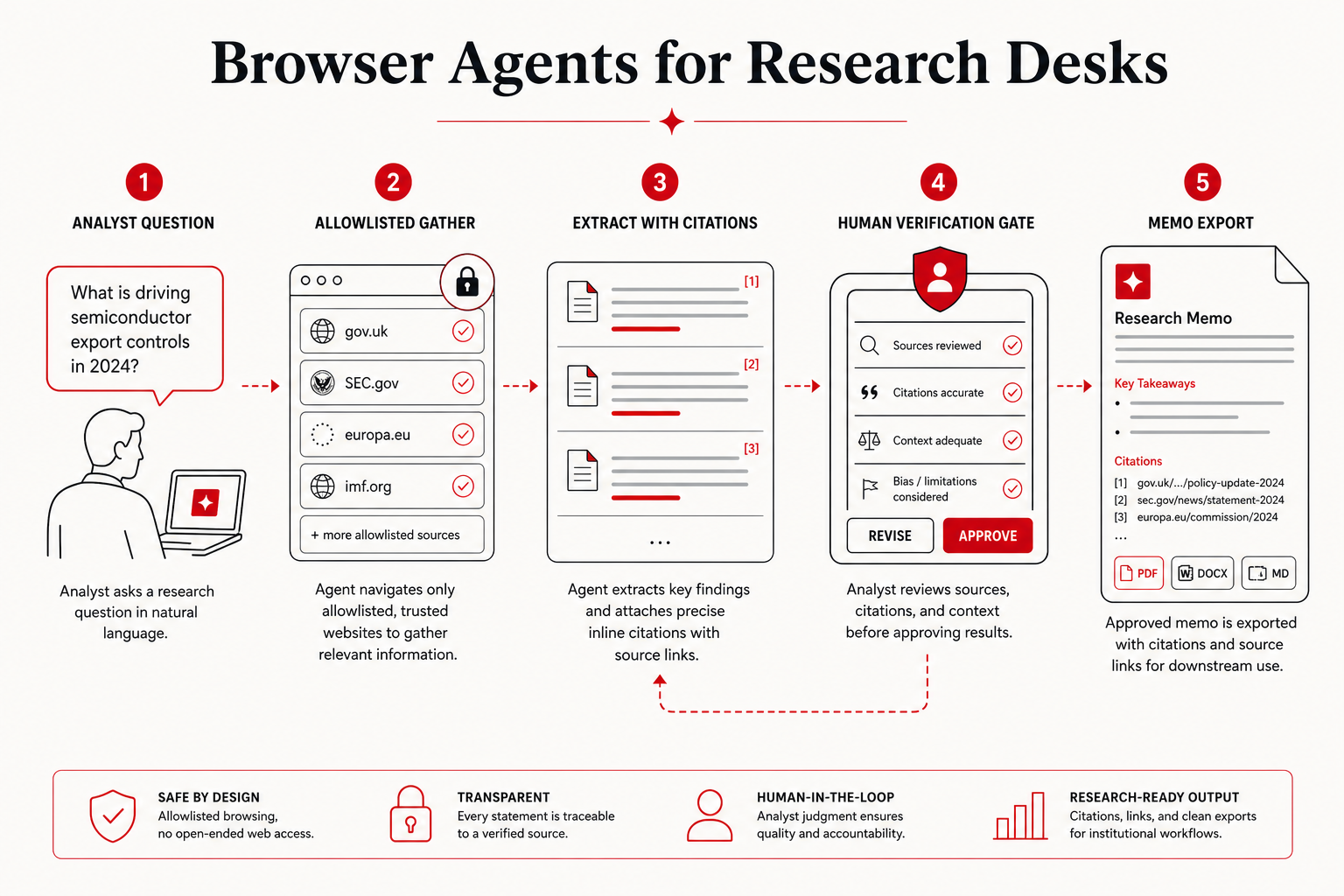
Why research desks reach for browser agents
Analyst workflows are web-native: filings, press releases, regulator sites, trade press, conference webcasts, and vendor documentation. Much of this material lacks clean APIs. Traditional research stacks combine manual browsing, PDF highlights, and copy-paste into memos or CRM notes. Browser agents promise to compress the gather-and-cite loop while preserving links.
The case is narrower than “replace analysts.” It is accelerate gathering under governance: the agent proposes sources and extracts candidate bullets; humans verify quotes, context, and materiality before publication or client use. This case note describes that bounded pattern—desk synthesis, not legal advice on copyright or MNPI.
Workflow template (research desk)
Stages
- Question intake: analyst defines scope, tickers, date range, and excluded sources.
- Plan: agent or supervisor selects search strategy and allowlisted domains.
- Gather: browser agent opens pages, captures text snippets, records URL + timestamp + screenshot optional.
- Structure: output fills memo template (thesis, evidence bullets, open questions).
- Human verify: editor confirms quotes against source, checks paywall compliance, adds judgment.
- Export: CRM, research library, or ticket system—no silent auto-send to clients.
Human gates (non-negotiable for publishable output)
- Quote verification against primary text.
- Materiality and conflict checks.
- Compliance review for restricted lists and MNPI walls.
- Citation format matching desk style guide.
Architecture components
| Component | Role | Failure if missing |
|---|---|---|
| Allowlist policy | Domain + path rules | Stray sites, ToS risk |
| Browser harness | Playwright/Puppeteer or vendor mode | Flaky ad-hoc scripts |
| LLM planner | Navigate/extract decisions | Blind scraping |
| Artifact store | HTML/PDF snapshots | He-said she-said on quotes |
| Citation schema | URL, time, snippet hash | Hallucinated references |
| Trace + audit log | Compliance replay | Incident blindness |
| Human review UI | Approve/reject bullets | Auto-publish risk |
Harness reference: Playwright. Agent orchestration may use supervisor pattern (orchestration patterns).
Browser agents vs API-first research
Before browser agents, ask whether an API or licensed feed exists: SEC EDGAR APIs, vendor terminals, news wires, RSS. API-first paths are more stable, cheaper to operate, and easier to audit. Browser agents fit residual web surfaces where APIs are absent or delayed—but maintenance cost is real (DOM changes, A/B tests, cookie banners).
Decision heuristic from ships vs demos: if a stable API exists, use it as a tool; reserve browser for gaps. Mixed stacks are normal: API tools for filings, browser for niche trade blogs on allowlist.
| Source type | Preferred path | Reason to skip browser agents |
|---|---|---|
| Regulatory filings with structured access | API/feed first, browser for verification views | Browser adds fragility without more truth |
| Company IR pages and official blogs | Browser agent on allowlist | Site terms or dynamic paywall disallow automation |
| Licensed terminals and wires | Licensed feed / terminal workflow | Contract may prohibit automated extraction |
| Social posts and forums | Human-curated source queue | High misinformation and context risk |
Governance: copyright, ToS, MNPI
Research desks operate under copyright, terms of service, and market abuse rules that vary by jurisdiction and employer policy. Browser agents do not grant fair use rights or wire-service licenses. Typical controls:
- Allowlist only sources desk already uses manually.
- No paywall circumvention—agents use credentials only via approved SSO paths, not credential stuffing.
- MNPI walls: separate internal research systems from external agent browsing; block paste of internal notes into external agents.
- Retention: snapshot storage policy matches legal hold requirements.
- Client deliverable gate: no automated client email from agent output.
Safety framing: practical AI safety for builders. Injection on malicious pages: injection risks.
Failure modes specific to research browsing
- Hallucinated quotes when agent paraphrases without matching snapshot—mitigate with snippet hash verification.
- Wrong document version (draft vs final filing)—capture version metadata.
- Session drop on SSO mid-run—detect auth failures and pause for human.
- Dynamic paywalls showing different text to bot vs human—compare artifact to human view.
- Prompt injection in page HTML hidden text—sanitize and allowlist.
- Over-collection scraping beyond scope—step budget and domain caps.
General agent failures: observability guide.
Memory and retrieval in research agents
Research agents should not stuff entire prior memos into context. Use:
- Structured task state (open questions, tickers, dates).
- RAG over internal library for past desk research with ACLs.
- Episodic logs of prior agent runs with citations—not raw re-ingest of web spam.
See agent memory hybrid and RAG pillar.
Eval for research desk pilots
Define tasks from real analyst week: e.g., “summarize last 8-K footnote change for ticker X with citations.” Metrics:
- Citation accuracy (human judged).
- Time saved vs manual baseline.
- Human edit distance on memo draft.
- Policy violations (zero tolerance).
- Cost per completed memo.
Do not rely on generic web benchmarks (leaderboards guide).
Integration with knowledge worker stack
Browser research agents sit beside docs, CRM, and comms tools—not instead of them. Surface agent proposals inside existing memo editors; show citations inline; require explicit “approve for library” action. Map to layers in AI app stack for knowledge workers.
Inference and model choices follow model stack: vision for screenshots costs more than DOM text extraction—default to DOM when accessible.
Security controls
- Dedicated browser profile with no personal cookies.
- Network egress allowlist.
- No download execution without scan.
- Secrets in vault—not agent context.
- Kill switch on runaway navigation.
When not to use browser agents on research desks
- Licensed terminal already provides structured feed.
- Task requires real-time market orders—out of scope.
- Legal prohibits automated access to target site.
- Team cannot staff human verification.
Rollout playbook
- Document 20 representative research tasks.
- Build allowlist from existing desk manual sources.
- Pilot with read-only agent + human verify on all outputs.
- Add artifact store and citation schema.
- Instrument traces and compliance logs.
- Compare cost/time vs API alternatives quarterly.
- Expand domains only after eval pass.
Relation to agent map
Browser research agents are typically rung 2–3: tool-using loops, sometimes supervisor + worker for gather vs synthesize (chatbot to agent map). They are not autonomous “research AGI.”
Memo templates and structured outputs
Research agents should fill schemas—not freeform essays until verify step:
{
  "thesis": "...",
  "evidence": [{ "claim": "...", "quote": "...", "url": "...", "captured_at": "ISO8601" }],
  "open_questions": ["..."],
  "confidence": "low|medium|high"
}
Structured output enables deterministic validation: non-empty URL, quote substring match against artifact store, confidence cap when only secondary sources found.
Source tiering and desk policy
| Tier | Examples | Agent use |
|---|---|---|
| T0 Primary regulatory | Filings, central bank releases | Allowlist + cite required |
| T1 Company primary | IR pages, official blogs | Allowlist |
| T2 Established press | Major wires (per license) | Policy-dependent |
| T3 Social/forums | Posts, anonymous tips | Usually exclude or flag only |
Tier rules belong in config, not prompt prose—compliance updates tiers without redeploying prompts.
Collaboration with human analysts
UX patterns that ship:
- Side-by-side: agent bullets left, source preview right with highlight sync.
- Suggest-only mode: agent cannot edit published memo without accept click.
- Diff mode: show what changed since last library version on reruns.
- Comment threads: analyst notes why a bullet rejected—feeds eval set.
Embed in broader knowledge stack (knowledge workers)—not a standalone browser bot.
Multi-agent research graphs
Common split:
- Gatherer agent: browser tools only, allowlisted.
- Synthesizer agent: no browser, reads artifacts + internal RAG.
- Compliance checker: rule-based + LLM, no external tools.
Separation reduces injection reach—gatherer output treated as untrusted input to synthesizer (orchestration, injection).
Performance and cost expectations
Browser agents are slower and costlier than API research:
- Page load + render latency dominates.
- Vision snapshots multiply tokens if overused.
- Parallel tabs need caps—swarm without budget burns spend.
Measure time-to-verified-bullet, not raw pages per minute. Compare against analyst manual baseline on same task sample.
Training analysts on agent limits
Analyst enablement should cover:
- Agents omit nuance and counterarguments unless prompted.
- Citation UI does not replace reading source context.
- Session failures require human takeover—not silent retry loops (observability).
- MNPI never enters external agent profiles.
Change management beats model upgrades for desk adoption.
Integration with internal RAG
External gather + internal library is the usual hybrid:
- Agent fetches external evidence with citations.
- Separate retrieval pulls prior desk notes from vector store with ACLs.
- Synthesizer merges with explicit “external vs internal” labels.
Memory design: agent memory hybrid; freshness: RAG pillar.
Pilot success criteria (example)
After 90-day pilot, leadership should see:
- ≥15% median time reduction on scoped gather tasks (measured, not surveyed only).
- Zero compliance violations in logged fetches.
- Citation accuracy ≥98% on audited sample.
- Analyst NPS neutral or positive vs control group.
- Cost per memo within agreed bound vs manual.
Without criteria, pilots drift into permanent demo.
Vendor vs in-house browser stacks
| Factor | Vendor browser agent | In-house Playwright + LLM |
|---|---|---|
| Time to pilot | Days–weeks | Weeks–months |
| Allowlist control | Verify contractually | Full |
| Data residency | Vendor-dependent | Your infra |
| DOM break maintenance | Shared with vendor | Your on-call |
| Compliance narrative | Vendor attestations | Your audits |
Neither is universally superior—finance desks with strict MNPI often prefer in-house harnesses on VPC even if slower to build.
Accessibility tree vs screenshot
Prefer DOM/accessibility snapshots when sites expose stable trees—cheaper and more precise than vision. Fall back to screenshots for canvas charts or PDF viewers. Log which mode used per fetch for cost tuning (inference economics).
Escalation paths when agents fail mid-memo
Analyst UX should offer:
- Resume from last artifact checkpoint.
- Switch to manual browse with same citation template.
- Flag “agent incomplete” on memo metadata—downstream consumers know status.
Silent partial output is worse than explicit failure—see failure taxonomy in observability guide.
Relationship to trading and execution systems
Research gathering must not wire directly to order management systems without independent risk controls. Browser agents belong upstream of human decision—not execution buttons. Architecture reviews should treat any “research-to-trade” pipe as higher scrutiny than memo drafting alone.
Quarterly desk review agenda
- Allowlist changes and new sources.
- Citation audit sample results.
- Cost and time metrics vs baseline.
- Incident log (injection attempts, session failures).
- Model/vendor version changes and re-eval outcomes.
Link agenda items to leaderboard claims only when evaluating new model SKUs—not for desk workflow KPIs.
Sample analyst briefing (desk template)
Before pilot kickoff, brief analysts with:
- What the agent will and will not do (gather vs publish).
- How citations appear and how to verify quotes.
- Escalation when SSO fails or pages look wrong.
- Where to report suspected injection or policy violations.
- How agent logs support compliance audits.
Briefings reduce “shadow IT” browser plugins that bypass governance—often bigger risk than vendor agent itself.
Extending to multi-desk and multi-region
Shared platform, partitioned policy: US equity desk allowlist ≠ EU credit desk allowlist. Memory and artifact stores namespace by desk ID. Supervisors route tasks only to workers configured for that desk’s policy bundle (orchestration).
Central platform team owns harness; desk heads own allowlist content. Decentralize policy, centralize engineering—mirrors how research libraries evolved pre-LLM.
Artifact retention and legal hold
Snapshots taken during research runs may be discoverable in litigation. Retention policies should define:
- Default retention period per artifact type.
- Legal hold override behavior (pause deletion jobs).
- Geographic storage region for snapshots.
- Access audit for artifact downloads.
Legal counsel defines periods—we flag engineering must implement holds in object storage lifecycle rules, not only CRM notes.
Comparison to manual research QA
Quality teams already sample analyst memos. Extend QA rubric with agent-specific checks:
- Quote-to-source integrity on sampled bullets.
- Allowlist compliance on URLs logged.
- Time-to-first-verified-citation vs manual baseline.
Agents should improve QA throughput, not bypass QA—especially where clients pay for human judgment premium.
Offshore and follow-the-sun considerations
Global desks running browser agents need follow-the-sun runbooks: who approves allowlist changes, who responds to SSO failures overnight, and which regions prohibit automated access to local-language regulators’ sites. Agent logs should carry desk timezone and analyst locale for audit—not for model quality.
Integrating with existing terminal workflows
Many analysts still live in Bloomberg/Reuters-class terminals (licenses permitting). Browser agents complement terminals—they do not replace licensed feeds. Architecture should avoid duplicate fetches that violate license counting; log fetch origin to prove compliance during audits.
Measuring research quality beyond speed
Speed without accuracy is negative value. Track post-publication correction rate on agent-assisted memos vs control group over six months. If corrections rise, tighten verify gates even if gather time improved—desk reputation dominates short-term efficiency metrics.
Client-facing research boundaries
Client research products must label agent-assisted sections in metadata—even when prose is human-edited—so compliance can filter downstream reuse. Some firms prohibit AI-generated content in certain deliverable types; product flags should enforce template-level bans, not rely on analyst memory.
Handling multilingual and local regulator sites
Global desks need language-aware allowlists and analysts who verify translations—not raw machine translation of statutory text without human sign-off. Browser agents should record source language in citation schema; downstream memo templates can require human translation fields before client send.
Disaster recovery for artifact stores
Snapshot stores are evidence in disputes—backup and restore drills should include artifact buckets, not only databases. RPO/RTO targets for research artifacts may differ from transactional systems; document in business continuity plans alongside agent incident runbooks.
Analyst hiring and skill shift
Desks adopting browser agents should hire and train for verification skill, not just speed—spot-checking quotes, spotting material omissions, and knowing when automation failed silently. Job descriptions that emphasize “AI prompt wizardry” over domain judgment misalign incentives. Training budget should cover citation verification drills alongside tool onboarding.
Vendor evaluation for research browser agents
Ask vendors: allowlist enforcement mechanism, artifact export API, SSO failure behavior, injection test results on recorded pages, and data residency for screenshots. Prefer pilots where vendor runs inside your VPC over sending URLs to multi-tenant SaaS when MNPI policies apply—compare with in-house Playwright stacks in total cost of ownership, not license list price alone.
Ethical sourcing and ESG research notes
ESG and controversy research often mixes NGO reports, company statements, and news—tier sources explicitly in templates so agents do not treat advocacy PDFs as equivalent to filings. Human editors judge framing; agents supply linked excerpts only. Contested topics need dual-source requirements in structured output schema before memo promotion.
Seasonality and event-driven research
Earnings seasons and macro events spike gather volume—scale browser agent queues and human verify staffing proactively. Agents do not remove surge staffing; they change the mix toward verification vs manual search. Capacity planning should model agent-assisted memos per analyst hour under peak load, not average Tuesdays.
Who this is for
- Research and analyst team leads piloting gather automation.
- Compliance officers reviewing web automation policy.
- Platform engineers building memo workflows with Playwright.
- Knowledge product PMs integrating citations into UX.
Who should skip
- Desks with full licensed data feeds and no web-gap tasks.
- Teams expecting unsupervised publishable research.
- Organizations that cannot store fetch artifacts compliantly.
Common mistakes
| Mistake | Why it fails | Better move |
|---|---|---|
| Open web without allowlist | ToS + injection risk | Domain policy |
| Trust paraphrase as quote | Client errors | Snapshot hash verify |
| Skip human verify for “internal only” | Bad decisions propagate | Same gate, lighter UI |
| No session failure handling | Silent partial memos | Auth alerts + pause |
| Auto-email drafts | MNPI/compliance breach | Human send only |
FAQ
Can browser agents replace junior analysts?
They accelerate gathering and first-pass structuring; judgment, verification, client context, and materiality calls stay human.
How is this different from generic computer use?
Narrower action space (tab-only), allowlists, and citation-first outputs. See ships vs demos.
Do we need vision models?
Only when DOM text is insufficient (canvas charts, scanned PDFs in browser). Vision increases cost—default to text extraction.
What should logs contain?
URL, timestamp, user/analyst ID, agent version, snippet hashes, allowlist rule matched, human approver ID.
Can one agent serve equity and credit desks?
Separate allowlists, templates, and ACLs—shared infrastructure, partitioned policies and memory.
Can browser agents run on air-gapped research VMs?
Often yes—and preferred for MNPI-sensitive desks. Model inference may still require approved internal endpoints; document data flows so air-gap reviews cover both browser egress and LLM API paths.
What if the agent misses a primary source a human would find?
Track recall on audited task sets; tune allowlists and search strategies—not only model swaps. Missed sources are product bugs with compliance implications, not acceptable “AI variance.”
Should research agents use live market data feeds?
Prefer licensed feeds for prices; browser agents for narrative and documentary sources—mixing them requires clear UX labels so readers know data provenance. Never infer real-time prices from stale web pages without timestamp and source tier in the citation block.
How do browser agents fit the agent pillar map?
They are tool-using agents with a narrow browser tool surface—see chatbot to agent map rung 2–3, not a separate product category exempt from observability, memory design, and safety rules.
Sources
- Playwright — browser automation for controlled research harnesses.
- SEC EDGAR — example of structured public filings (prefer APIs/feeds when available).
- Anthropic tool use documentation — conceptual reference for agent + tool patterns.
What we did not test: We did not run a proprietary bake-off of vendor browser agents on live paywalled sites or publish desk-specific success rates.
Corrections: Update allowlist examples, vendor browser modes, and regulatory references when policies change—revise as-of date at top. When primary source sites redesign DOM structure, refresh pilot eval tasks and artifact verification scripts—not only marketing screenshots. Update citation schema version when compliance requires new metadata fields.
Browser agents for research desks occupy a narrow, high-value niche: faster, citeable gathering from allowlisted web sources under human verification—not autonomous publishing or execution. Success is measured in verified bullets per hour and zero compliance violations, not pages scraped. Integrate with knowledge worker stack and leaderboard literacy when evaluating new model SKUs for gather quality—not hype scores or vendor demos alone.
Next step
Compare coding-side automation in coding agent tools compared, or harden tool layers in tool use vs computer use before expanding allowlisted domains. Return to the agent map if your desk has not yet stabilized single-agent gather workflows with traces, citations, and human verification gates. Do not skip compliance review when adding new source tiers.